Looking for a yellow electric pressure washer that delivers solid power without the noise and fumes of gas units? This guide highlights five top options that balance performance, portability, and user-friendly features. It’s ideal for homeowners tackling cars, patios, driveways, fences, and decks. Each product is chosen for reliability, value, and suitability for typical American outdoor cleaning tasks. Below is a quick buying table to compare the standout models at a glance.
| Product | Best For | Why It Stands Out |
|---|---|---|
| Westinghouse ePX3500 | Heavy-duty residential cleanup | Strong 2500 max PSI, onboard soap, anti-tipping wheels |
| Westinghouse ePX3100v | Compact, light-duty to mid-range tasks | Low weight, detachable foam cannon, easy transport |
| Yeryork Adjustable 5000 PSI | Adaptable power for diverse surfaces | 33 ft retractable hose reel, adjustable pressure |
| Greenworks 1800 PSI | Light-duty tasks and beginners | Low maintenance, built-in GFCI safety |
| Imdot 5000 PSI Deep Clean | Heavy grime and tough jobs | High PSI, long hose, foam options |
Westinghouse ePX3500 Electric Pressure Washer

Best for: Medium-duty outdoor cleanup on decks, driveways, fences, and vehicles. This unit delivers a high max PSI with a solid water flow, enabling efficient cleaning of stubborn grime. It’s well-suited for homeowners who want robust performance with manageable portability.
Why selected: The 2500 max PSI and 1.76 max GPM (with 2000 PSI and 1.2 GPM rated usage) provide strong cleaning power for typical chores. The pro-style steel wand with quick-connect nozzles (0°, 15°, 25°, turbo, and soap) supports versatile tasks. Anti-tipping wheels and a compact 16.5″ tall frame improve stability and storage. An onboard 20-ounce soap tank adds detergents when scrubbing decks or siding.
Best for convenience: The onboard soap and streamlined nozzle set simplify mid-range jobs without swapping accessories constantly. Caution: The unit’s portability depends on stability on uneven surfaces; keep wheels on firm ground to avoid tipping during use.
Westinghouse ePX3100v Electric Pressure Washer

Best for: light-to-mid-cleaning on cars, fences, driveways, and patios where weight and ease of transport matter. Its built-in carry handle aids mobility around the home.
Why selected: The 2100 max PSI and 1.76 max GPM offer reliable cleaning with a compact footprint. It weighs about 18 pounds, making it easy to maneuver. A detachable foam cannon supports detergent use for tougher grime. The easy-coil 20′ hose adds to user-friendly setup. Caution: For heavy-duty concrete cleaning, higher PSI models may work more efficiently.
Yeryork Adjustable 5000 PSI Pressure Washer
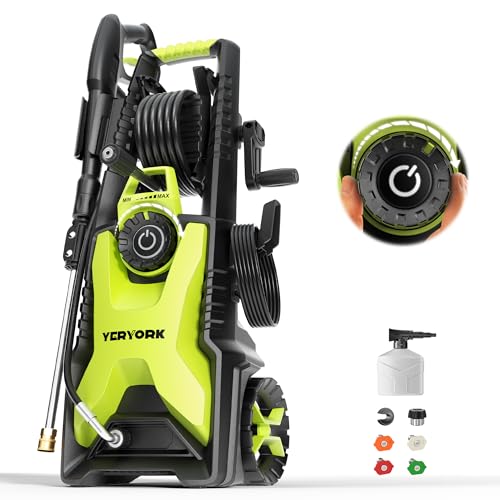
Best for: homeowners needing strong cleaning with adjustable pressure, plus a neat hose reel for organized storage. Suitable for cars, fences, and patios with varying grime levels.
Why selected: This unit offers a powerful 2.5 GPM flow and adjustable pressure via a rotating dial. The 33 ft retractable hose reel minimizes tangles, improving workflow. It uses a 1900W motor for strong cleaning power. Caution: Repeated high-pressure use on delicate surfaces can cause damage; dial down pressure for such tasks.
Greenworks 1800 PSI Electric Pressure Washer

Best for: entry-level cleaning tasks and light residential duties. Ideal for beginners who want simple operation with built-in safety features.
Why selected: It offers 1800 PSI at 1.1 GPM, making it well-suited for cars, boats, outdoor furniture, and windows. It requires minimal maintenance and includes a 35-foot power cord with a GFCI plug. Caution: Not ideal for heavy grime or large outdoor surfaces compared with higher-PSI units.
Imdot 5000 PSI Electric Pressure Washer (Green)
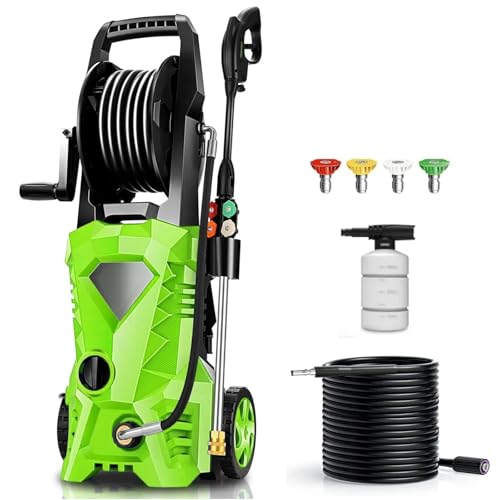
Best for: heavy grime removal on driveways, fences, and large patios where maximum pressure is helpful. The 33 ft hose and optional foam application support tougher cleaning tasks.
Why selected: With 5000 PSI and 2.8 GPM, this model delivers strong cleaning performance. The hose reel and 33 ft hose support extended reach and reduced setup time. A foam bottle enhances detergent-based cleaning. Caution: High PSI can damage delicate surfaces if not used with appropriate nozzle and distance.
Buying Guide: How to Choose the Right Yellow Electric Pressure Washer
- Power and water flow: Higher PSI and GPM mean faster cleaning on tough grime but can increase wear on delicate surfaces. Match power to the surface type.
- Portability vs. stability: Lighter units are easier to move but may tip on uneven ground. Look for anti-tip design, wheels, and carry handles for stability.
- Nozzle options: A diverse nozzle set (0°, 15°, 25°, 40°, along with a foam/soap nozzle) enables targeted cleaning from tight spots to broad surfaces.
- Detergent integration: Built-in soap tanks or compatible foam cannons help with decks, siding, and vehicles. Ensure easy detachment when not needed.
- Hose length and reel: Longer hoses expand reach but add weight. Retractable hoses reduce tangling and save space in storage.
- Safety features: Look for GFCI protection, automatic shutoff, and stable frames to minimize accidents in wet outdoor environments.
- Maintenance needs: Electric washers require less maintenance than gas units but check for corrosion-resistant fittings and simple filter access.
- Surface suitability: For delicate surfaces (vinyl, painted wood), prefer lower PSI with appropriate nozzle and technique. For concrete or heavy grime, higher PSI helps but test a small area first.
Frequently Asked Questions
- What PSI is best for home cleaning? For general home cleaning, 1900–2500 PSI covers most tasks effectively without risking damage to surfaces.
- Do I need a detergent tank? A detergent tank is convenient for decks and siding work but not essential if you plan to use external cleaners.
- Is a longer hose better? A longer hose improves reach, especially for large yards, but adds weight and can reduce water pressure if not paired with adequate pump capacity.
- Can high PSI damage my surfaces? Yes. Use appropriate nozzles and distance; start at a lower setting and increase gradually on stubborn stains.
- Are electric washers safer than gas? Generally yes for indoor-friendly use, with fewer emissions and easier startup. They are best for light to mid-range tasks.
- What maintenance is typical? Rinse after use, check hoses and fittings for leaks, and store in a dry place to prevent rust and mold.