The best wood band saw machines deliver clean, accurate cuts for hobbyists and professionals alike. This guide highlights five solid options, outlining who each is best for and why. Use this overview to compare capacity, speed, portability, and versatility to match your workshop needs.
| Product | Key Benefit | Best For |
|---|---|---|
| WEN 9-Inch Band Saw (BA3959) | Compact benchtop, good for small shops | Beginners and hobbyists with limited space |
| QD-KYOHO 9-Inch Portable Band Saw | Portable, versatile cutting angles | Mobile workshops and DIYers needing angle cuts |
| DeWalt 9″ Band Saw | Two speeds, strong LED lighting | Households and DIYers needing flexible speeds |
| MAXXT 10-Amp Metal/Wood Band Saw | Heavy-duty power with wide cutting scope | More demanding projects and metal/wood mixes |
| RIKON 10-1414 14-Inch Deluxe | Large resaw capacity and dual-voltage | Advanced woodworkers needing large stock handling |
WEN 9-Inch Band Saw, BA3959

The WEN BA3959 is ideal for small shops and beginners who need a compact, straightforward bench-top band saw. Its 2.8-amp motor drives blades up to 2500 feet per minute, enabling efficient wood cutting. It can cut up to 3-1/2 inches deep and 9 inches wide, using 59-1/2-inch blades, with blade sizes ranging from 1/8 to 3/8 inches. Best for entry-level projects, small parts, and hobby work where space is limited. A potential limitation is the smaller throat width compared to larger floor models, which may constrain very wide boards.
Band Saw, Portable 9-Inch Bandsaw for Woodworking
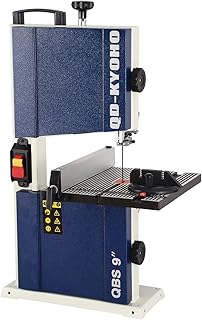
This portable 9-inch model from QD-KYOHO emphasizes versatility at a budget price. It features a 62-inch blade, a 1/3 HP, 2.5-amp motor, and a tilting worktable with multi-angle cutting from 45° right to 5° left. Best for DIYers who need to handle angled cuts and occasional resaw work in a compact package. The table size and blade length support mid-size projects, but it may be less suited for heavy-duty continuous use.
DeWalt 9″ Band Saw

The DeWalt 9″ Band Saw features a powerful 3.5-amp motor and two speeds (1700 and 2500 SPM). The included LED worklight improves visibility for detailed cuts, making it a solid choice for hobbyists who require adjustable speed alongside better illumination. This model is best for projects that benefit from two blade speeds and enhanced line visibility. A limitation to consider: higher speeds can increase noise and require careful blade selection for delicate cuts.
MAXXT Band Saw with Aluminum Base

The MAXXT model offers a high-powered 10-amp motor with broad cutting capability, including metals and woods. It provides adjustable cutting angles from 0 to 45 degrees, and features carrying wheels for portability. It excels in mixed-material projects and heavy-duty work. A potential caveat is its heavier weight and larger footprint, which may not suit very small workshops. Choose this if you need metal-and-wood versatility and frequent angle cuts.
RIKON 10-1414 14-Inch Deluxe

The RIKON 10-1414 brings a 14-inch resaw capacity and a 1-3/4 HP dual-voltage motor (115/230V) with blade speeds of 1,476 or 3,280 ft/min. A SP-coated cast iron table (21-1/2 x 15-3/4 inches) reduces friction and improves stock handling for larger projects. Best for advanced woodworkers needing substantial resaw capacity and flexibility, particularly when working with thick stock. Limitation: higher price and larger footprint compared to 9-inch models.
Buying Guide: Wood Band Saw Machine Considerations
What should I consider first?
Capacity and throat height determine how thick and wide a workpiece you can handle. If you mostly cut small parts, a compact 9-inch model may suffice. For thicker stock or resawing, a larger table and higher capacity are essential.
Which features matter most for precision?
Blade tension, stable cast-iron tables, and adjustable blade speeds help achieve clean cuts. LED lighting or good visibility is helpful for detailed work. Portability can matter in small shops.
What about power and speed?
Motor amperage and blade speed affect cutting performance. Higher amperage can cut tougher materials, while adjustable speeds help match blade to wood type and cut type. Consider the trade-off between power and noise/handling in your workspace.
Is portability a concern?
Benchtop and portable bandsaws offer flexibility for mobile or small-space use. Heavier, full-size machines suit dedicated shops with stable space and higher throughput.
What is the best choice for beginners?
Beginner users benefit from smaller, user-friendly models with straightforward controls and adequate safety features. The WEN BA3959, for example, provides essential capabilities without overwhelming complexity.
What about metal cutting capability?
Some models, like the MAXXT, advertise metal cutting in addition to wood. If you only cut wood, you can prioritize wood-focused features. If metal and wood are both needed, ensure the model supports the intended materials.
Frequently Asked Questions
- What is the typical blade size for a 9-inch band saw?
Most 9-inch saws use blades around 59.5 inches long, with varying widths from 1/8 to 3/8 inches. - Can I resaw thick boards on a 14-inch bandsaw?
Yes, a 14-inch model with adequate resaw capacity (like the RIKON 10-1414) handles thicker stock better. - Is LED lighting essential on a band saw?
LED lighting helps visibility on cutting lines, especially for precise, intricate work. - Should I prioritize speed or torque for wood cutting?
For clean cuts in various woods, a balance of speed options and solid torque provides best results. - Are portable band saws less accurate than benchtop models?
Portability doesn’t inherently reduce accuracy; models with solid bases and stable tables maintain precision. - Do I need a dual-voltage band saw for home use?
Dual-voltage motors are advantageous for versatility in settings with different electrical supplies, though not always necessary for home use.