If you’re shopping for reliable welding protection, you want a helmet with clear optics, fast response, and comfortable gloves that resist heat. This guide highlights five top picks that balance protection, visibility, and value for American welders, hobbyists, and professionals. Each product is evaluated for who it’s best for and why it stands out, with practical cautions where relevant. Read on to compare features, so you can choose confidently.
Overview table: Selected products at a glance
| Product | Best For | Key Benefit | Included Gear |
|---|---|---|---|
| TRQWH KTS-JD03 | Narrow-tolerance TIG and precision work | True color view with fast auto-darkening | Helmet and gloves |
| LIMXYZ M-001 | General MIG/TIG/ARC welding | Two arc sensors and clear lens | Helmet |
| YESWELDER Blue Light Blocking | Extended welding sessions | Blue light blocking outer lens | Helmet |
| BESTMIG Kit | Beginners and value-focused buyers | All-in-one kit with detachable mask | Helmet, goggles, gloves |
| WALKEREN WR01A | Low-light environments | LED work light and true color optics | Helmet and gloves |
TRQWH Welding Hood Auto Darkening With True Color and Gloves

Best for precision-focused TIG work and indoor fabrication, this TRQWH helmet combines true color clarity with fast arc-detection. The top LED light aids depth perception in dim environments, and the external grind button streamlines mode switching. The included gloves provide basic hand protection for light fabrication.
- Optics: 1/1/1/2 top optical clarity with true color view
- Protection: Auto-darkening filter with ANSI Z87.1/EN379 CE/CSA Z94.3 standards
- Adjustment: Sensitivity and delay knobs for different tasks
- Limitation: External grind mode may require familiarization for new users
Who it’s best for: Fine TIG welders and indoor fabricators who need color-accurate visibility and reliable arc protection in dim spaces.
LIMXYZ Auto Darkening Welding Helmet With 2 Arc Sensors (M-001)

This LIMXYZ helmet emphasizes a broad viewing area and rapid shade transitions. It uses two arc sensors and fine-tuning controls for sensitivity and delay, making it a strong general-purpose choice for MIG, ARC, and cutting tasks. The larger viewing window helps with spatial awareness during complex welds.
- Display: 1/1/1/2 optical definition lens; large viewing area
- Performance: Darken time up to 1/10000 seconds
- Limitations: Basic feature set compared to premium true-color models
Who it’s best for: Welders who want a dependable all-rounder without specialized color filtering, suitable for both beginners and intermediate users.
YESWELDER Auto Darkening Welding Helmet

YESWELDER offers a versatile option with a true color view and blue-light-blocking outer lens. This helmet supports TIG, MIG, ARC, and grinding workflows, and it is designed to reduce eye strain during extended sessions. It’s a practical pick for mixed-task shops or hobbyists evolving their skill set.
- Applications: Shade range 3.5/9-13; works with TIG, MIG, ARC, and grinding
- Protection: True color optics for improved visibility and reduced eye strain
- Limitations: Outer blue light blocker may affect color perception in certain conditions
Who it’s best for: Welders who perform varied tasks and want a reliable, color-true view with protective eye features.
BESTMIG Welding Kit: Mask, Goggles, Gloves
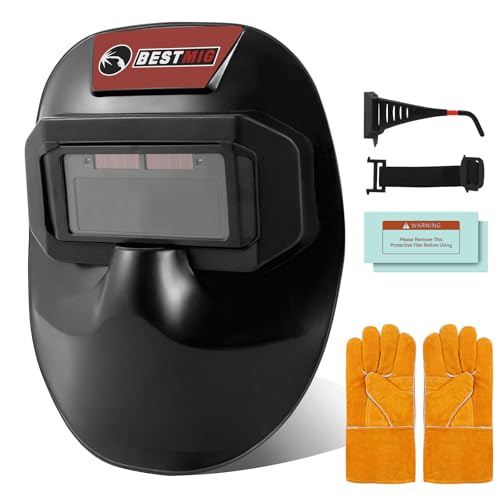
This kit is ideal for beginners and budget-conscious buyers who want an all-in-one setup. It includes an auto-darkening helmet, detachable mask, and gloves, enabling a quick-start experience with protective essentials in one purchase. The design emphasizes portability and simple adjustments for day-to-day use.
- All-in-one: Helmet, goggles, and gloves bundled for beginners
- Design: Lightweight helmet with auto-darkening features for easy use
- Limitation: May lack advanced programmable settings found in premium models
Who it’s best for: New welders or DIY enthusiasts seeking a single, convenient package to start welding safely.
WALKEREN WR01A True Color Helmet With LED Light
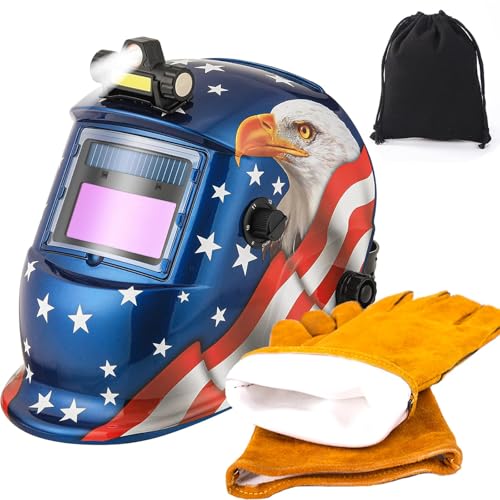
The WALKEREN WR01A stands out for low-light environments thanks to a built-in rechargeable LED light. It features a 1/1/1/1 optical rating and true color technology for better accuracy in TIG and MIG welding. Its four-sensor array helps ensure consistent shade control even during complex angles.
- Lighting: LED assist light for dark workspaces
- Optics: True color view with high-definition clarity
- Limitation: Light may drain battery with frequent use; plan charging accordingly
Who it’s best for: Welders who frequently work in dim shops, garages, or confined spaces and want improved visibility without external lighting.
Buying Guide
What to consider when choosing a welding mask
- Optical clarity: Look for 1/1/1/1 or 1/1/1/2 ratings for accurate color and detail. True color displays help with precision work, especially for TIG welding.
- Shade range: A broad range (e.g., 4-13) covers both low-amp and high-amp welding tasks. Some models add a grind mode for quick non-welding work.
- Sensors and response time: More sensors (2 or 4) and faster darkening times (as quick as 0.1–0.2 seconds) reduce eye strain and protect against flare.
- Comfort and fit: Lightweight shells, adjustable headbands, and proper padding improve all-day wearability, particularly for beginners.
- Additional features: Built-in LED lights, external grind mode, and blue light protection can improve comfort and safety, depending on your job.
What to consider when choosing welding gloves
- Heat resistance: For tasks up to 932°F (500°C), ensure the glove material is fully leather with reinforced seams.
- Dexterity vs. protection: Thicker gloves offer better protection but reduce dexterity. Choose a balance suitable for your tasks.
- Length and coverage: Sixteen-inch gloves protect forearms during splash and slag exposure but may be heavier. Shorter gloves allow finer control.
- Maintenance: Leather gloves require care to extend life; clean and condition as recommended by the manufacturer.
Frequently asked questions
- What’s the difference between true color and standard helmet optics? True color helmets provide more accurate color representation of the weld and base material, improving detail recognition and reducing eye fatigue during long sessions.
- Is a higher shade range always better? Not necessarily. Do most of your work at mid to high amperage? A wide shade range covers more tasks. For light TIG, a lower fixed shade can be convenient, but many find a variable range more versatile.
- Do I need multiple helmets or gloves for different tasks? If you perform varied tasks (TIG, MIG, grinding), a versatile helmet and a durable pair of gloves that handle heat across tasks can simplify your setup.
- How important are arc sensors? More sensors improve arc detection and shield the eye from stray arcs at different angles. Four sensors offer better coverage than two for complex positions.
- What maintenance is recommended for welding gloves? Regularly inspect seams and stitching; condition leather if recommended; avoid exposure to open flames for extended periods to preserve material integrity.
- Do helmets with LED lighting really help? LED lighting can improve visibility in dim environments and help you see puddles and joints more clearly, reducing misalignment in low-light shops.