Thin kerf saw blades are ideal for cutting with less material removal, reducing vibration, and achieving smoother finishes on wood projects. This guide highlights top options that balance kerf width, durability, and finish quality for American DIYers and professionals. The selections focus on 10-inch and 6-1/2-inch blades commonly used in home workshops, with a mix of crosscut, combination, and ripping designs. Each blade is chosen for its sharp edge, stability, and compatibility with standard 5/8-inch arbors. The buyer can expect better finish, faster cuts, and lower noise when choosing the right thin kerf blade for the task.
Product Summary
| Product | Blade Type | Kerf | Arbor | |
|---|---|---|---|---|
| FOXBC 10 Inch Thin Kerf Fine Finish Crosscut | Crosscut | 0.087″ | 5/8″ | Fine finish, multiple cuts in cabinetry and trim |
| CMT Orange Tools 256.050.10 | Combination | Not specified | 5/8″ | Versatile cuts in softwood and plywood |
| FOXBC 10-Inch Flat Tooth Ripping Blade | Ripping | 0.094″ | 5/8″ | Ripping in light-to-moderate hardwoods |
| FOXBC 6-1/2 inch Circular Saw Blade Ultra Fine Finish | Crosscut | 0.059″ | 5/8″ | Ultra-fine finish on small projects |
| Freud LU83R010 Industrial 10-in 50T | Combination | Not specified | Not specified | Durable all-purpose performance |
FOXBC 10 Inch Thin Kerf Fine Finish Crosscut Blade

Best for cabinetry and trim projects where a clean edge is essential. This 10″ blade features 60 teeth, ATB grind, and a 5/8″ arbor. Its thin kerf (0.087″) reduces waste and lowers motor load, promoting smoother cuts with less vibration and noise. Made from high-density tungsten carbide for durability and long life. Suitable for most 10-inch miter or table saws.
Why choose this: The fine finish crosscut design is optimized for precise end grain and veneer work. Caution: The thin kerf is ideal for softer materials; for very hard hardwoods or plywood with multiple veneers, ensure proper feed rate to avoid chipping.
CMT Orange Tools 256.050.10 Combination Blade

Best for general-purpose cutting across softwood and plywood. The combination blade blends ATB geometry for clean crosscuts with rip-like performance in several wood types. It’s a versatile choice for a workshop needing a single blade for frequent transitions between ripping and crosscutting tasks. Limitations: The listing notes material focus, but exact kerf and tooth count aren’t specified here, so verify compatibility for very fine work.
FOXBC 10-Inch Flat Tooth Ripping Blade
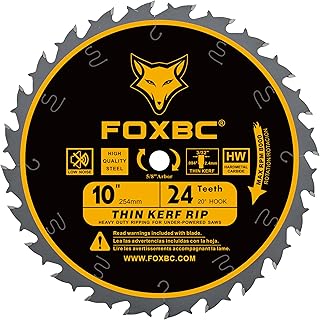
Best for wood ripping tasks with a thin kerf approach. This blade has 24 teeth, a 5/8″ arbor, and a thin kerf of about 0.094″. It’s designed for fast, durable cutting with minimal vibration and an excellent finish. The flat tooth geometry supports stable feed and clean edge results on softwood to light hardwoods. Caution: Not ideal for precise crosscuts or fine veneer work where many teeth contact the surface.
FOXBC 6-1/2 Inch Ultra Fine Finish Circular Saw Blade

Best for small projects where a precise, ultra-fine finish matters. This 6-1/2″ blade delivers 60 teeth with a 0.059″ kerf, designed for crosscuts in softwood, hardwood, plywood, and laminates. Compatible with both corded and cordless circular saws and features a 5/8″ arbor. Advantage: smoother finishes on small panels and furniture components. Limitation: Smaller diameter reduces depth of cut, which can limit some large sheet material tasks.
Freud LU83R010 Industrial 10-in 50T Blade
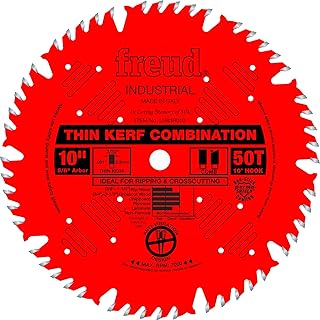
Best for heavy-duty all-purpose performance in a durable industrial blade. The LU83R010 features TiCo high-density carbide and a non-stick Perma-Shield coating along with an anti-vibration design. This combination blade aims to balance clean crosscuts with efficient material removal. Caution: It’s a 50-tooth blade, which may not be the ideal choice for ultra-fine finish tasks where higher tooth counts are preferred.
Buying Guide: Thin Kerf Blades For The Home Workshop
- What is a thin kerf blade? A blade with a narrower cut (kerf) than standard blades reduces material waste, lowers the load on the saw, and can improve cut accuracy and speed.
- Tooth geometry matters. ATB (Alternate Top Bevel) blades excel at crosscuts with smoother edges, while FT (flat-tooth) blades are often chosen for ripping where aggressive removal is needed.
- Arbor size compatibility. Most 10-inch blades use a 5/8″ arbor; ensure your saw’s arbor matches the blade to avoid alignment issues.
- Crosscut vs. combination vs. ripping. Choose based on primary tasks: crosscuts and fine finishes favor higher tooth counts; ripping blades emphasize aggressive material removal with fewer teeth.
- Finish quality vs. speed. A finer kerf and higher tooth count generally produce smoother edges, but may cut slightly slower; balance with your workflow demands.
- Coatings and coatings durability. Anti-stick and non-stick coatings can reduce gumming on plywood and resins, extending blade life in some environments.
- Material compatibility. Ensure blades are designed for wood, plywood, hard/softwoods, or laminates as needed. Some blades are optimized for specific material types.
Frequently Asked Questions
- What is the advantage of a thin kerf blade? It reduces waste, lowers motor load, and can provide smoother cuts with less vibration.
- Can I use a thin kerf blade for ripping? Some thin kerf blades are designed for ripping, but many are optimized for crosscuts. Check tooth geometry and kerf width before use.
- What blade should I choose for cabinet making? A fine finish crosscut or a high-tooth crosscut blade is often preferred for precise edges in cabinetry.
- Are thin kerf blades compatible with all table saws? Most standard 10-inch and 6-1/2-inch blades with a 5/8″ arbor fit common saws, but verify arbor compatibility and motor power for aggressive cuts.
- Do coatings affect cut quality? Coatings can reduce friction and heat buildup, potentially extending blade life in demanding sessions.
- Why would I pick a combination blade over a dedicated crosscut blade? For versatility when you perform both ripping and crosscut tasks in the same project or on a multi-purpose shop blade lineup.