Whether you’re a hobbyist, hobbyist turned hobby professional, or a seasoned woodworker, a planer-jointer combo helps streamline workflow by delivering flat boards and precise edge joints in a single workstation. This guide highlights five versatile machines that are well-suited for different shop sizes and projects. Each option balances power, accuracy, and ease of use to help you choose the right tool for your needs.
| Product | Brand | Best For |
|---|---|---|
| Hoteche 10-Inch Benchtop Jointer & Planer Combo | Hoteche | Small to mid-size shops needing adjustable depth and solid performance |
| WEN Thickness Planer (PL1337) & Jointer (JT630H) Bundle | WEN | Value-focused buyers wanting a bundled setup with versatile speeds |
| FORESTWEST 10416 12-Inch Planer & Jointer Combo | FORESTWEST | Durable die-cast table and reliable carbide blades for everyday use |
| FORESTWEST 10416H 12-Inch Planer & Jointer with Helical Cutterhead | FORESTWEST | Greater finish quality with a helical cutterhead for reduced tear-out |
| VEVOR 13-Inch Thickness Planer, Three-Blade | VEVOR | High-capacity benchtop option with dual rollers for long stock |
Hoteche 10-Inch Benchtop Planer and Jointer Combo

Best for compact workshops requiring a single, space-saving unit with adjustable depth ranges. The 13A motor delivers up to 9000 RPM for efficient material removal. The jointer supports 0-3 mm and the planer 0-2 mm, enabling precise thicknessing and edge finishing. A steady feed speed of 6 meters per minute aids consistent results. This model is a solid pick for DIYers and small shops that need flexibility without sacrificing portability.
Caution: Some users may prefer a dedicated tool for very high-volume production due to limited bed length.
WEN Thickness Planer and Jointer Bundle

This bundle suits buyers seeking two speed options and a larger work area. The planer supports quick dimensioning at 26 FPM and finishes at 16 FPM, while the jointer offers a 30-by-6-inch table and material removal up to 1/8 inch per pass. Boards up to 6 inches thick and 13 inches wide can be planed. It’s a practical choice for workflow efficiency in mid-sized workshops.
Limitation: The overall footprint is larger, so ensure adequate shop space for safe operation and dust management.
Acivirdde 1500W Planer Jointer Combo

Best for those prioritizing stability and precise depth control. This 220V benchtop unit features an integral body and a stable support frame, plus adjustable feed guards and clamping to secure stock during processing. The depth knob with a clear scale supports repeatable planing results. It’s suitable for diverse tasks from rough planing to finishing touches in medium-demand environments.
Limitation: Availability of 220V operation may require appropriate electrical setup in some shops.
FORESTWEST 10416: Professional 12-Inch Planer & Jointer

Best for daily shop use with robust construction. It features double-side SK5 carbide blades, a professional die-casting aluminum table, and a movable aluminum fence that locks at 90° and 135°. This setup provides reliable edge and face planing performance for general woodworking projects and production workloads.
Limitation: May be heavier and bulkier than lighter benchtop models, requiring stable mounting and adequate space.
FORESTWEST 10416H with Helical Cutterhead

The ideal pick for finish quality. The helix cutterhead with 28 blades provides smoother cuts and reduced tear-out. A 2.5HP motor supports durable performance, and the aluminum fence clamps securely at 90° and 135°. It’s best for shops that place a premium on finished surfaces and long-term reliability.
Caution: Helical heads can be more expensive to maintain or replace than straight-knife heads.
VEVOR 13-Inch Thickness Planer
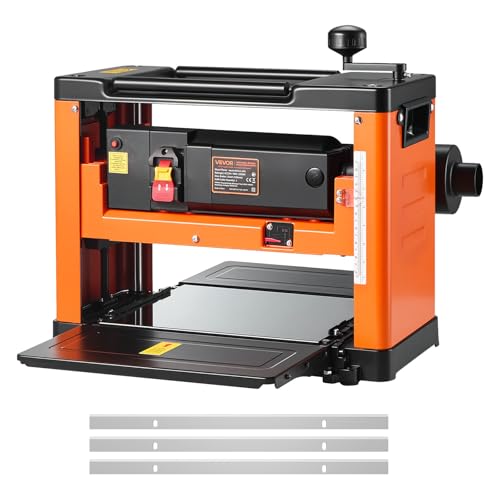
Best for long stock handling with dual rollers. The 2000W motor delivers up to 24,000 CPM, supporting fine to aggressive stock removal. A wide worktable and extended infeeding table help reduce snipe, making it suitable for longer boards and challenging projects.
Limitation: Higher power draw and footprint may require robust electrical and workspace planning.
Buying Guide
- Power and cutterhead: Higher horsepower and cutterhead design (straight-knife vs helical) affect cut quality and maintenance requirements. Helical cutters typically reduce tear-out but may cost more to replace.
- Bed size and worktable: A larger, stable bed reduces snipe and supports longer boards. Look for removable or adjustable fences for versatile setups.
- Depth adjustments: Independent depth controls for planing and jointing improve accuracy. Check scale clarity and repeatability.
- Speed and feed: Two-speed options provide faster material removal and finer finishes. Consider feed rate compatibility with stock length and thickness.
- Electrical requirements: Some models are 120V while others require 220V. Ensure your shop wiring and outlets match the unit’s needs.
- Size and portability: Benchtop models save space but may have limited capacity. Floor-standing or heavier machines offer more rigidity but require space planning.
- Maintenance and blades: Blade type, replacement cost, and ease of access influence long-term costs and downtime.
- Safety features: Look for blade guards, emergency stops, and sturdy clamps to hold stock during cutting and planing.
Frequently Asked Questions
- What should I look for in a planer-jointer combo for a home workshop? Prioritize motor power, bed size, cutterhead type, independent depth controls, and space requirements to match your projects and footprint.
- Is a helical cutterhead worth it for a benchtop model? Helical cutters offer smoother finishes and less tear-out, but come at a higher replacement cost; evaluate your finishing needs and budget.
- Can these tools handle hardwoods? Yes, many models are designed to plane both soft and hardwoods, but blade durability and motor power should be considered for frequent hardwood work.
- What safety practices are essential? Use proper dust collection, secure stock with clamps, and keep hands away from cutting surfaces during operation.
- How do I choose between 12-inch and 13-inch capacity? Larger widths accommodate wider boards and reduce grain matching steps, but require more space and power.
- Do these units require professional installation? Most benchtop or compact combos do not, but verify electrical requirements and ensure a stable tabletop or stand setup.