Looking for the best pin welder solutions for insulation installation? This guide highlights five reliable options designed for HVAC duct insulation and similar projects. Each product is chosen for different needs, such as compact handheld use, digital control, or high-speed pin welding. This overview helps buyers match a tool to their insulation thickness, material type, and workflow. Ideal buyers include HVAC technicians seeking durable welders for frequent duct work, DIY installers needing dependable performance, and workshop professionals integrating insulation into larger projects.
Summary table of selected products:
| Product | Best For | Key Strength | Notes |
|---|---|---|---|
| Capacitor Discharge Welder HVAC Duct Insulation Pin Nail CD Welding Machine 110V 60Hz | General HVAC insulation work | Fast, consistent CD welding | 0.5–5 mm thickness range |
| StudPro LiteXI Stud Welder Insulation Pin Welder | Precise control | Digital readout, cooling, dial-down voltage | Best for accuracy-heavy tasks |
| Welding Torch for HVAC Duct Insulation Pin Nail compatible with RSR1800 Welder | Compatibility with RSR1800 | Versatile torch accessory | Check compatibility with your welder |
| Marine Insulation Weld Pins & Fasteners Capacitor Discharge Stud Welder | Heavily insulated or marine-grade projects | Wide thickness range | 0.5–10 mm |
| PATIKIL 2 Inch Flat Head Thumb Tack Insulation Fasteners | Fast, easy installation | Cup head design for secure hold | Requires welding with compatible welder |
Capacitor Discharge Welder HVAC Duct Insulation Pin Nail CD Welding Machine 110V 60Hz
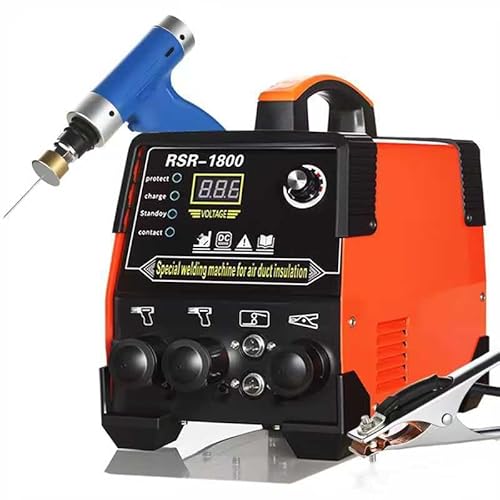
Best for versatile HVAC insulation projects requiring fast, consistent pin welds. Suitable welding thickness is 0.5–5 mm, with a welding speed of 10–30 pieces per minute. This model is useful for technicians handling standard duct insulation and general pin-nail work. Best for contractors who need a reliable CD welder with a moderate throughput and straightforward operation.
Who it’s best for: HVAC technicians and installers needing a dependable, fast-capacity capacitor discharge welder for duct insulation pins.
Caution: Confirm material compatibility with your insulation pins to avoid weld defects on thicker or non-standard substrates.
StudPro LiteXI Stud Welder Insulation Pin Welder

Best for precision-focused installations. It offers a digital DC voltage readout for accurate weld settings, a cooling fan to maintain efficiency, and a dial-down DC voltage setting for delicate materials. This makes it ideal when working with fragile insulation boards or variable thicknesses where tight weld control matters.
Who it’s best for: Professionals requiring precise control and clear readouts to ensure consistent pin welds across mixed insulation substrates.
Caution: If no digital readout is used, the tool’s accuracy may degrade under heavy use; ensure proper calibration before critical jobs.
Welding Torch for HVAC Duct Insulation Pin Nail compatible with RSR1800 Welder

Best as a compatible torch accessory for RSR1800 welders. It’s designed to work with the RSR1800 system, making it a sensible pick for shops already using that welder. Its main advantage is seamless integration, reducing setup time and compatibility risk.
Who it’s best for: Builders who already own an RSR1800 welder and need a compatible insulation pin-nail torch to extend versatility.
Caution: Confirm your existing machine’s compatibility with this torch model to avoid fit or performance issues.
Marine Insulation Weld Pins & Fasteners Capacitor Discharge Stud Welder

Best for tougher insulation setups, including marine-grade applications, thanks to its wider welding thickness range of 0.5–10 mm. It welds pins, studs, and fasteners with a capacitor discharge method at speeds of 10–30 pieces per minute, offering robust performance where thicker insulation layers are involved.
Who it’s best for: Projects requiring stronger pin welds on thicker insulation or demanding environments. Choose this if your work frequently hits the higher end of insulation thickness.
Caution: The broader thickness range may not be necessary for thin insulation tasks; select a model tuned for lighter work to optimize efficiency.
PATIKIL 2 Inch Flat Head Thumb Tack Insulation Fasteners (300 Pack)

Best for quick attachment of insulation boards once the pins are welded in place. The cup head design helps secure the fixation for long-term stability. Designed for use with insulation pin welders to ensure a smooth installation process.
Who it’s best for: Installers who need fast, secure fasteners after pin welding, especially on glass wool or foam board installations.
Caution: Ensure the pin length exceeds the insulation thickness to achieve a secure hold; using too short pins will reduce effectiveness.
Buying Guide: Key Considerations For Pin Welders
- Welding Technique: Decide between capacitor discharge (CD) and stud welding methods. CD welders excel at quick, consistent joints, while stud welders emphasize control and flexibility with different pin sizes.
- Material Compatibility: Check the insulation materials (glass wool, foam boards, marine insulation) and the recommended pin length and thickness. Pick a welder that supports the pin types you use most.
- Thickness Range: If your projects vary in insulation thickness, choose models that cover a broad range (e.g., 0.5–10 mm) to avoid tool limitations on thicker boards.
- Control and Readouts: Digital voltage readouts and adjustable settings help ensure consistent weld quality, especially on mixed material runs or when upgrading to a new workflow.
- Compatibility: For shops using existing welders (like RSR1800), consider compatible torches or accessories to expand capabilities without buying an entirely new system.
- Throughput vs. Precision: Balance speed (pieces per minute) with precision. Higher throughput is useful on large jobs, while precision controls prevent weld defects on delicate substrates.
- Ease of Use: Look for cooling features, straightforward calibration, and clear maintenance requirements to minimize downtime on ongoing projects.
- Installation Considerations: Ensure you have the correct insulation fasteners (cups, washers, or self-locking components) to maximize hold and reduce rework.
FAQ
- What is the main difference between capacitive discharge welders and stud welders for insulation pins?
Capacitive discharge welders provide fast, consistent welds suitable for standard insulation pins, while stud welders emphasize control over pin sizing and can handle varied thicknesses with different weld pins.
- Which tool is best for thick insulation boards above 5 mm?
Tools supporting thicker ranges (up to 10 mm) are preferable, such as models designed for wider thickness ranges, to ensure secure pin fixation.
- Do I need a digital voltage readout on a pin welder?
Digital readouts help with precise weld settings and repeatable results, especially across multiple jobs or materials.
- Can I use standard insulation fasteners with any pin welder?
Not always. Ensure the pin length, head design, and fastener type are compatible with your welder and insulation material.
- Is compatibility with my existing welder important when buying a torch or accessory?
Yes. Using compatible torches or accessories reduces setup time and helps ensure proper function with your current system.
- What should I consider when choosing between a 2 inch and a 4 inch pin length?
Longer pins are better for thicker insulation or when a strong anchor is needed, while shorter pins save time on thin boards and reduce penetration risk.