Answer: Non-contact voltage testers (NCVTs) are the go-to tools for electricians and DIYers who need fast, safe detection of live voltage without direct contact. These testers help identify live wires, outlets, and electrical components, reducing the risk of shock during troubleshooting. The top picks below are best for professionals needing reliable detection, homeowners handling basic wiring tasks, and technicians who want compact, pocket-sized options with clear indicators.
| Product | Best For |
|---|---|
| Klein Tools NCVT1P | Everyday electrical checks, quick live/non-live confirmation |
| KAIWEETS Voltage Tester | Flexible voltage ranges, adjustable sensitivity, visual + audible indicators |
| Fluke 1AC II VoltAlert | Industrial-grade reliability, broad detection with self-test |
| Klein Tools NCVT3P | Versatile, multi-range non-contact detection with flashlight |
| Klein Tools RT250KIT | Comprehensive outlet testing and non-contact voltage testing in one kit |
Klein Tools NCVT1P Voltage Tester

The Klein Tools NCVT1P offers non-contact AC voltage detection across 50V to 1000V, with a bright green LED to show power and red flashing alert plus audible beeps when voltage is detected. This tester is compact, with a pocket clip for everyday carry. It’s ideal for quick checks of cables, switches, outlets, and lighting fixtures. Best for: technicians seeking a simple, dependable tester for routine identification of live circuits. Limitation: does not display voltage magnitude, only presence/absence and an approximate indication.
KAIWEETS Voltage Tester with Screen

The KAIWEETS tester provides NCV detection with a dual-range capability (12V/70V-1000V) and an LCD display showing the detected voltage signal. It uses red/green indicators and audible alerts that intensify with higher voltage or closer proximity to the source. It supports detecting live vs. neutral wires and offers adjustable sensitivity for tasks like doorbells or thermostats. Best for: users needing a clearer readout of voltage magnitude and flexible sensitivity. Limitation: more complex controls may require a learning curve for casual users.
Fluke 1AC II VoltAlert Non-Contact Tester

The Fluke 1AC II VoltAlert is a pocket-sized NCVT with a wide detection range of 90–1000 V AC (and sometimes 200–1000 V in variations). It features continuous self-test to verify operation and an audible beeper with a red indicator when voltage is detected. Best for: professionals who want a trusted, rugged option with straightforward operation. Limitation: higher price point relative to basic models.
Klein Tools RT250KIT Non-Contact Tester Kit

This kit pairs a non-contact voltage tester with a GFCI receptacle tester, providing a combined solution for quick wiring checks and outlet safety testing. Best for: electricians and DIYers who prefer an all-in-one kit for both live-detection and wiring verification. Limitation: requires more storage space than single-function testers.
Klein Tools RT250KIT Non-Contact Voltage Tester and GFCI Receptacle Tester
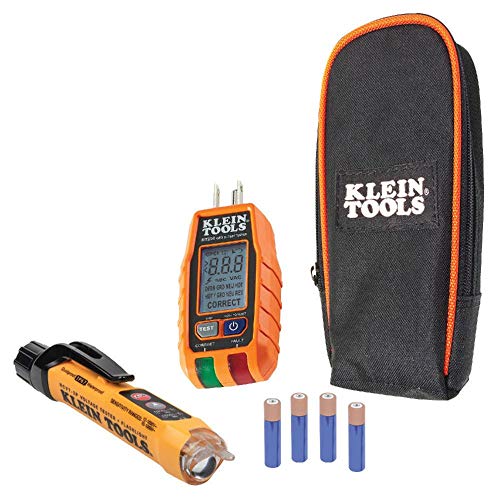
Note: This device emphasizes a large LCD readout on the GFCI tester and the accompanying non-contact tester provides quick voltage indication. Best for: rapid verification of GFCI wiring and presence of voltage in outlets. Limitation: may be bulkier due to the kit format.
Klein Tools NCVT3P Dual Range Tester

The NCVT3P offers dual-range non-contact detection from 12 to 1000V AC with an integrated flashlight. It uses a green LED for normal operation and red flashing alert with sound on voltage. Best for: professionals who need a broader detection range and an integrated light. Limitation: still requires careful handling in low-light environments where the flashlight may be used as the primary work light.
Buying Guide
What should you consider when choosing an NCVT?
- Voltage range: Look for a tester that covers your typical job range (commonly 12–1000V AC). Some models also offer low-voltage detection.
- Indicators: Prefer testers with both audible alerts and visible LEDs for quick confirmation in noisy environments.
- Display: A built-in LCD readout can help gauge voltage magnitude, beneficial for precise diagnostics.
- Range and sensitivity: Dual-range or adjustable sensitivity helps in differentiating live, neutral, and ground, and in testing small circuits like doorbells.
- Form factor: Pocket-sized tools are convenient, but kits with multiple testers can be more efficient on job sites.
- Safety and ratings: While not all products list certification specifics, prioritize reputable brands and models designed for standard electrical work.
- Extra features: Built-in flashlight, self-test functions, and the ability to test GFCI outlets in the same kit can save time on complex tasks.
FAQ
- Q: Do NCVTs measure voltage or only detect presence? A: Most NCVTs indicate presence with LEDs and sounds; some provide a voltage estimate or display, depending on the model.
- Q: Can I test live circuits with NCVTs? A: Yes, NCVTs are designed for live circuit detection, but always follow safety practices and use gloves and eye protection as needed.
- Q: How should I interpret red vs green indicators? A: Green typically means no voltage detected; red or flashing indicates voltage present. Some models use color intensity to convey voltage levels.
- Q: Is a higher-priced NCVT better? A: Not always; choose based on required ranges, display needs, and whether you benefit from a kit with additional testers.
- Q: Are NCVTs safe for electricians and homeowners? A: Yes, when used as directed and with proper safety precautions.
- Q: Should I trust self-test features? A: Self-test helps ensure the unit is functioning, but verify periodically with a known live source for reliability.
For quick references, keep in mind: if you need a simple yes/no voltage check, a compact NCVT like the Klein NCVT1P or Fluke 1AC II is often enough. If you require a readout and adjustable sensitivity, consider the KAIWEETS model. For broader tasks that blend testing with outlet verification, a kit like the Klein RT250KIT provides added value.