If you’re building or upgrading a miter saw station, a solid fence system is essential for repeatable, accurate cuts. This guide highlights adjustable, modular fences that fit standard miter stations or pair with existing cabinets. It is best for woodworkers seeking improved workholding, easy repeatability, and compatibility with a range of saws. The top picks below are designed for different workspace sizes and fence lengths, from 24 to 68 inches. Choose the fence that best matches your saw, cabinet setup, and preferred workflow.
Summary of chosen products
| Product | Best For | Fence Length | Key Benefit |
|---|---|---|---|
| O’SKOOL Miter Saw Fence System RTS024 | Longer runs and repeatable cuts | 68″ expandable | Flip stop with dual-scale tape |
| RED HOUSE TOOLS Precision Miter Station Fence Kit (48″) | Fully adjustable back fence | 48″ | Two 3″ x 48″ fences with tape |
| RED HOUSE TOOLS Precision Miter Station Fence Kit (36″) | Smaller back fence setup | 36″ | Two 3″ x 36″ fences with tape |
| BORA Portamate Miter Saw Stand PM-8000 | Portable rolling workstation | N/A | Sturdy stand doubles as worktable |
| POWERTEC Miter Saw Fence System (71742) | Versatile, multi-tool compatibility | Customizable | Flip stops, tapes, caps included |
O’SKOOL Miter Saw Fence System RTS024
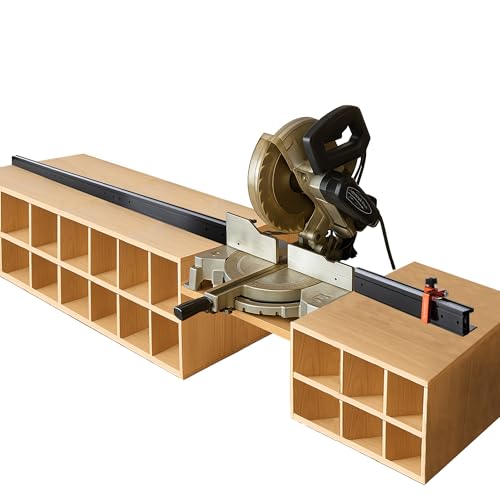
The O’SKOOL RTS024 fence system uses a modular 68″ aluminum track that can be configured to a single 68″ run or split for long-board support. It features a carbon steel dual-scale measuring tape for left-to-right and right-to-left measurements, improving setup accuracy on either side of the fence. A flip arm with an indexing cursor provides repeatable cuts and rapid removal for safe operation. Best for: woodshops needing long-range fence extension and repeatable cuts. Limitation: installation flexibility depends on existing workbench or cabinet space.
RedHouse Tools Precision Miter Station Fence Kit (48″)

RedHouse Tools’ 48″ back fence kit includes two 3″ x 48″ aluminum fences with mounting brackets, hardware, and a measuring tape. The fence is fully adjustable and removable, enabling repeat cuts and zero-clearance inserts when placed in front of the saw. Best for: users upgrading an existing miter station cabinet with a dedicated back fence. Limitation: larger kits require more mounting space and compatible cabinet surfaces.
RedHouse Tools Precision Miter Station Fence Kit (36″)

This kit provides two 3″ x 36″ fences with mounts and tape, suitable for smaller back fences. It remains fully adjustable and removable, allowing for versatile positioning and the creation of zero-clearance inserts. Best for: compact miter station layouts or smaller shop spaces. Limitation: shorter fence length may limit support for very long workpieces.
Bora Portamate Miter Saw Stand PM-8000

The Bora Portamate PM-8000 is a portable rolling table saw stand with folding wing extensions and a high weight capacity. It is a sturdy, universal-fit solution that can host a miter saw and other tools, functioning as a mobile work station. Best for: workshop owners needing a mobile, heavy-duty stand that can support multiple tools. Limitation: not a dedicated back fence system; requires integration with a separate fence setup for precise cut alignment.
POWERTEC Miter Saw Fence System (71742)

POWERTEC’s fence system includes a flip stop, multiple T-track components, and two self-adhesive tape measures with left-right readability. It is designed to mount on top of a fabricated Radial Arm Saw, Miter Saw, or Drill Press fence system and can be configured on both sides. Best for: builders seeking a versatile, modular fence with clear measurement tools. Limitation: assembly may be more complex for first-time users due to multiple parts.
GOINGMAKE Table Saw Miter Gauge With Extensible Fence

GOINGMAKE offers an extendable fence from 18 to 32 inches with a micro-adjust flip stop and a 13-position angle scale. The extenda fence is designed to read scales precisely via a magnifier. Best for: table saw users who need a precise, adjustable fence with fine-tuning capability. Limitation: focused on gauge-style fencing rather than a full back fence system for larger station setups.
Buying Guide
What should you consider when selecting a miter saw station fence?
- Fence length and extension: Match the fence length to your typical material widths, and consider expandable options for longer boards.
- Mounting compatibility: Check whether the fence fits your existing cabinet, workstation, or stand. Some kits are designed for built-in miter station cabinets, while others are portable or add-on systems.
- Measurement tools: Look for dual-scale tapes, flip stops, and easy-read scales. Tools with magnifiers or bright indicators help reduce misreads.
- Adjustability and repeatability: A good fence should lock securely, resist wobble, and offer repeatable measurements for consistent cuts.
- Versatility: Some fences work with multiple tools (miter saws, drill presses, radial arms). If you have a mixed shop, a multi-tool fence can save space and time.
- Installation footprint: Consider how much bench or cabinet space the fence requires. Larger systems may require reconfiguring your workspace.
What are common fence configurations?
- Back fence kits: Provide an adjustable rear boundary to support long boards and improve accuracy.
- Front fence inserts: Add zero-clearance inserts for clean, precise cuts with delicate materials.
- Flip stops: Allow repeatable cuts by locking a stop block in place, then flipping away when not needed.
How to install and use a modular fence?
- Mount the rails to a solid surface or cabinet top using included brackets or fasteners.
- Attach the back fence or primary fence run, ensuring it is perfectly square to the blade path.
- Set zero or reference points with the tape measures and test with a scrap piece before making finished cuts.
- Use flip stops for repeat cuts and re-check alignment after changing workpieces.
What about compatibility with different saws?
Most modular fences are designed to adapt to standard miter saws, drill presses, radial arms, and other workshop tools. For best results, verify mounting dimensions, track width, and any required brackets before purchase.
FAQ
- Q: Do these fences work with built-in miter stations?
A: Many are designed to mount alongside or in front of built-in cabinets; confirm compatibility with your specific cabinet depth and mounting surface. - Q: Is longer fence length always better?
A: Longer fences support longer stock and improve accuracy for wide boards, but require more space and sturdier mounting. - Q: Are flip stops essential?
A: Flip stops significantly improve repeatability and speed for repetitive cuts, especially on long runs. - Q: Can I mix fences from different brands?
A: Mixing can be possible if mounting systems and rail widths match, but may reduce overall alignment reliability. - Q: Do these fences require professional installation?
A: Most kits are designed for DIY installation with common tools; follow manufacturer instructions for best results.