Looking for a miter saw auxiliary fence to improve accuracy, repeatability, and safety? This guide highlights five top options, each well-suited to different tasks—from mobile job sites to home workshops. Whether you need a long, expandable fence, a zero-clearance design for clean cuts, or flexible flip-stop functionality, there’s a fence system here for you. The best fit depends on your saw type, project size, and how often you need repeatable cuts. The table below compares key details to quick-pick the right accessory for your setup.
| Product | Best For | Length | Notes |
|---|---|---|---|
| O’SKOOL Miter Saw Fence System (68″ expandable) | Big projects, repeatable cuts | 68″ | Flip stop, dual-scale tape |
| Infinity Cutting Tools Pro Miter Saw Fence System | Durable, multiple designs | 48″ | Two flip-stop styles |
| Fulton Aluminum Miter Gauge Fence | Table saw precision with safety | — | Dual 17″ tapes, angled ends |
| Woodpeckers Auxiliary Rip Fence | Job-site compatibility | 36″ | 3-1/2″ tall, built-in slots |
| Carve Tech Aluminum Miter Saw Zero Clearance Fence | Zero-clearance precision | — | Stairstep cutout design |
O’SKOOL Miter Saw Fence System
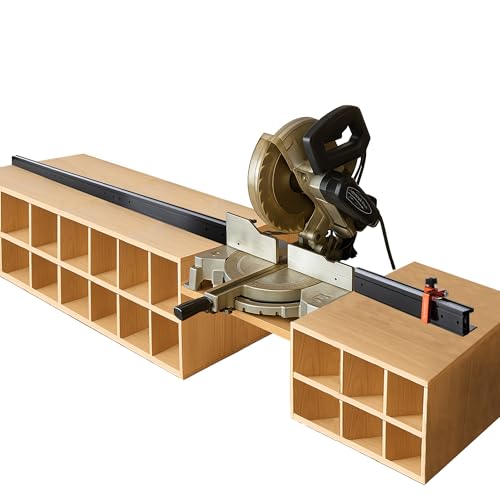
The O’SKOOL RTS024 is a modular 68″ expandable aluminum fence system. It links seven 17″ rails to create a single long fence or divides for extended support on both sides. It includes a carbon steel measuring tape with dual scales for left-to-right and right-to-left measurements, aiding accurate setup for long-board work and door trim tasks. The flip arm with an indexing cursor allows repeatable cuts, then flips away to clear the cutoff path. Best for: workshop setups needing a long, adjustable fence with repeatable stop capabilities. Limitation: assembly and alignment can require initial calibration to ensure consistent repeatability.
Infinity Cutting Tools Pro Miter Saw Fence System

Infinity Cutting Tools offers a robust 48″ fence system with a 3/4″ thickness and 3″ height. It provides two flip-stop designs: a traditional straight body and a curved body, giving versatility for different workpieces. The hardware pack supports sacrificial fence faces for additional protection and cleaner cuts. Best for: users who value multiple stop configurations and compatibility with sacrificial fencing. Limitation: shorter overall length compared to longer fence kits, which may impact very long boards.
Fulton Aluminum Miter Gauge Fence
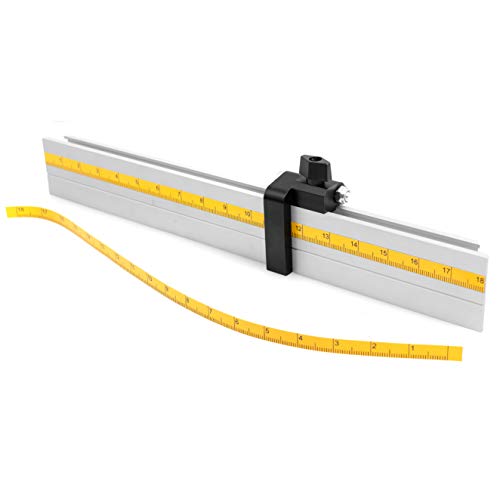
The Fulton Miter Gauge Fence provides precision cuts with aluminum construction designed to improve repeatability. It features 45° end components to reduce gaps and enhance safety by allowing closer material positioning to the blade. Its built-in flip stop supports repeatable length cuts, making it suitable for projects requiring consistent results. Best for: table saw users who prioritize tight tolerances and safer handling near the blade. Limitation: fence may be less modular for very long boards compared to expanding systems.
Woodpeckers Auxiliary Rip Fence

The Woodpeckers ARF-BSCS 36″ fence extension adds compatibility for job-site table saws and router tables, with built-in T-track slots and clamping blocks. It measures 3-1/2″ tall and includes 7″ material support, with exact 2″ fence and clamp block thickness. Best for: compact machines where a sturdy, portable fence extension is required. Limitation: compact length may limit use with very long boards or heavy stock on larger saws.
Carve Tech Aluminum Miter Saw Zero Clearance Fence

The Carve Tech Zero Clearance Fence emphasizes safety and clean cuts. It features a high 6-1/4″ fence height with a stairstep cutout design to preserve full sliding functionality across all miter angles. The zero-clearance approach reduces tear-out and splintering while allowing precise blade alignment. Best for: ensuring tight clearance near the blade for larger crown molding or detailed trim work. Limitation: may require more careful setup to maintain the zero-clearance seal across angles.
Buying Guide
What should I consider when choosing an auxiliary fence?
Project length and board width determine fence length needs. Longer fences improve long-board accuracy, while shorter fences offer portability for job sites. Consider whether you need flip stops for repeatable cuts, or a zero-clearance design for cleaner results near the blade.
Material and construction: aluminum versus steel
Aluminum fences are lightweight and corrosion-resistant, ideal for frequent transport and general use. Steel fences may offer extra durability for heavy workloads but can be heavier and harder to handle.
Adjustment features: flip stops, tapes, and clamping
Flip stops provide repeatable angles and lengths, while dual-scale tapes help with measurements from both directions. Clamps and sacrificial faces extend fence life and protect your working surface.
Compatibility and installation
Check that the fence is compatible with your saw model or mounting track. Some fences install with existing miter gauges, while others require detachable rails or router-table compatibility.
Budget and versatility
Higher-end kits offer more adjustable options and long lengths but at a higher cost. Consider whether a modular system or a dedicated fence best matches your typical projects and storage space.
FAQ
- What is an auxiliary fence? A fence accessory that extends or enhances a miter gauge or table saw fence to improve accuracy, support, and repeatability for cuts.
- Do these fences fit all miter saws? Most are designed to work with common bench and cabinet saw configurations, but always verify compatibility with your model and track system.
- When is a zero-clearance fence best? When you need clean, splinter-free cuts and maximum blade-to-stock clearance, especially with large or delicate trim stock.
- Are flip stops necessary? Flip stops are convenient for repeatable cuts and consistent lengths, reducing measurement errors during production runs.
- How do I install an auxiliary fence? Follow the manufacturer’s instructions for mounting rails or rails-to-base adapters, level alignment, and securing clamps or tapes for stability.
- Can I use these on job sites? Some models are designed for portability and compact machines, while others are geared toward stationary shop setups.