Direct answer: For large-format tile projects, a rail-guided or long-cut system helps maintain straight, accurate cuts. This guide highlights five top picks that balance rail strength, cutting capacity, and portability. Best for professional contractors, remodelers, and serious DIYers working with ceramic or porcelain tile.
Overview of top picks for large rail tile saws and related capabilities:
- DEWALT Wet Tile Saw with Stand, 10-Inch, D24000S — Strong all-in-one kit with a 28″ rip capacity and a sturdy stand.
- DEWALT Wet Tile Saw with Stand, 10-Inch, D36000S — Higher horsepower with precise cutline indicators for bigger jobs.
- DU-200 EVO 650 Rail Saw by RUBI — Portable, foldable head with a robust water-cooling system for ceramic and porcelain tiles.
- Professional Large Format Tile Cutter by DYBEDA — Manual cutting for precise straight lines on large formats.
- ROJOO 48″ Double Guide Rails Tile Cutter — Long rail widening options for wide-format tile projects.
| Product | Best For | Key Advantage |
|---|---|---|
| DEWALT D24000S | General contractors, tile installs with stand | Complete stand setup and 28″ rip capacity |
| DEWALT D36000S | Large-format projects, higher throughput | Higher horsepower and precision indicators |
| RUBI DU-200 EVO 650 | Renovations, mobile jobs | Foldable legs and external water tank |
| DYBEDA Large Format Tile Cutter | Manual precision for large tiles | Extendable rails, high accuracy |
| ROJOO 48″ Rails | Wide-format tiles, long cuts | Very long cutting length with strong rails |
DEWALT Wet Tile Saw With Stand (D24000S)
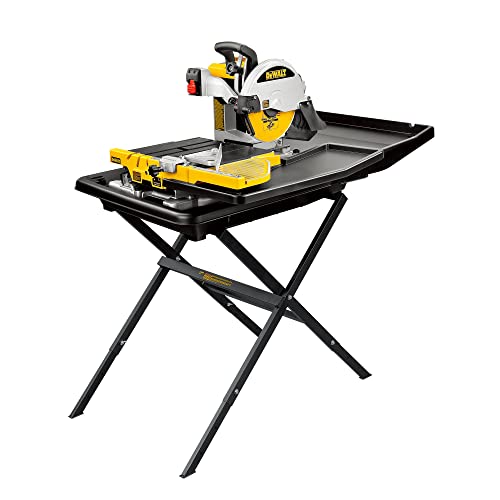
The DEWALT D24000S combines a 10-inch wet tile saw with an included stand and ancillary components. Best for projects requiring a ready-to-go setup and solid wet cutting performance. The saw offers a 18-inch diagonal cut capacity and a maximum rip capacity around 28 inches with plunge capability. It suits professional contractors and serious DIYers who value setup simplicity and a complete kit that travels as a single unit.
Who it’s best for: contractors handling medium- to large-format tile jobs, installers who want a reliable, all-in-one system, and DIYers building a tiled space with consistent, straight cuts.
Why selected: It provides a robust cutting platform, integrated stand, and a full accessory set for immediate use on-site. The included accessories support edge trimming, beveling, and water management for continuous operation.
Caution: Weight (about 69 lbs) may require two-person setup; not ideal for frequent single-person transport without proper lifting equipment.
DEWALT Wet Tile Saw With Stand (D36000S)

This model emphasizes precision through a cutline indicator, rigid frame, and stainless-steel rollers. It offers a notably generous cut clearance and rip capacity, enabling large tiles to be handled with accuracy. The tool is suitable for commercial tile installers and advanced DIY projects that require repeated, precise 30-inch-long cuts and efficient crosscuts.
Who it’s best for: professionals who need precise, repeatable cuts on large tiles and homeowners upgrading to larger-format tile installations.
Why selected: The combination of precise indicators and a strong frame supports straight-line accuracy over long cuts, reducing waste and rework.
Caution: Higher horsepower and footprint require a stable workspace; ensure sufficient bench space and security during operation.
DU-200 EVO 650 Rail Saw by RUBI
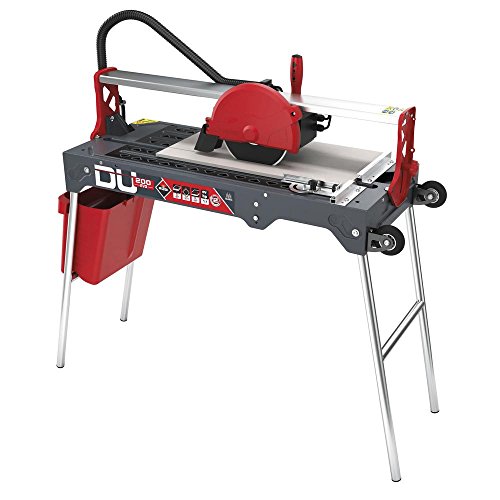
The RUBI DU-200 EVO 650 is a versatile rail saw suited for renovations and light-to-medium tile work. It is highly portable thanks to foldable legs and wheels, making it a practical choice for crews that move between sites. It includes an external water tank and a C³ cooling system for improved blade performance and cooling during longer cuts.
Who it’s best for: contractors or DIYers who need mobility and a capable rail saw for ceramic and porcelain tiles on job sites with limited access to permanent setup areas.
Why selected: Its mobility features, combined with an efficient cooling system, help sustain cutting performance during extended tasks.
Caution: As a portable system, it may have a smaller maximum cut capacity compared to heavier, fixed-frame options.
DYBEDA Large Format Tile Cutter
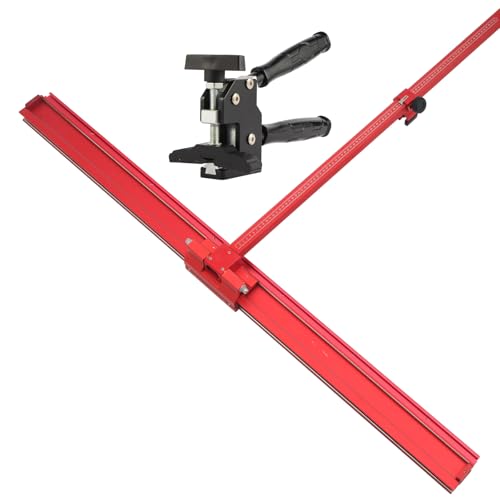
This manual cutter focuses on straight cuts for ceramic, porcelain, and glass tiles. It features an adjustable ruler and an extendable rail, enabling precise alignment for large-format projects. The tool is best for finish-oriented work where electric power is not required, and clean, accurate cuts are essential for layout planning.
Who it’s best for: professional tile installers and DIYers working with large-format tiles on straightforward straight cuts, especially when portable, non-powered tools are preferred.
Why selected: The extendable rail and adjustable blade height support accurate cuts across varied tile sizes without a power source.
Caution: Manual cutting requires more physical effort and could be slower for very large jobs compared with powered rails.
ROJOO 48″ Double Guide Rails Cutter

The ROJOO 48″ Double Guide Rails Cutter provides a long cutting length for wide tiles, supported by a 25mm steel slide rail and reinforced aluminum base. This setup improves stability and allows for smoother, straighter cuts on wide-format ceramic or porcelain tiles. It is well-suited for renovations and installations demanding long, precise straight cuts.
Who it’s best for: installers handling wide-width tiles or large slabs who require dependable rail guidance and robust construction.
Why selected: The extended 48″ rail and sturdy base help reduce deflection and improve cut accuracy on long runs.
Caution: The rail system is heavy; plan for proper handling and storage to avoid workspace congestion.
Buying Guide: Large Rail Tile Saw Considerations
- Cutting capacity and tile size: Choose a saw with rip and diagonal capacities that match your largest tile sheet. For large-format tile, ensure the rail length supports long, straight cuts without repositioning.
- Portability vs. stability: Portable rail saws excel on job sites with limited space, while fixed-frame models offer higher stability for repeated long cuts. Consider whether foldable legs, wheels, or a stand are essential.
- Water management: Wet tile saws require effective water cooling. External water tanks or integrated pans help manage splash and blade cooling for consistent performance.
- Bevel and plunge features: Bevel capacity allows angled cuts; plunge capability helps with deep cuts without moving material. Confirm supported angles and depths for your common projects.
- Blade type and compatibility: 10-inch blades are common for porcelain and ceramic tile. Check arbor size and compatibility with standard blade types to avoid mid-project blade changes.
- Durability and build quality: A rigid frame, stainless or high-grade materials, and robust support rails reduce vibrations and improve long-term accuracy.
- Maintenance and parts availability: Look for models with accessible spare parts and straightforward maintenance, especially for cooling systems and water management components.
Frequently Asked Questions
- What is the advantage of a large rail tile saw over a standard wet saw?
A large rail system provides longer, straighter cuts with reduced deflection, which is essential for wide-format or high-precision installations. - Is a stand necessary for tile saws?
Stands offer ergonomic height, stability, and space for accessories, but portable, rail-only configurations can be used for small sites with proper support. - Can I cut porcelain efficiently with these saws?
Yes, many models provide good performance for porcelain with appropriate blade selection and cooling. - What should I consider for outdoor or dusty work?
Look for sealed components, easy water management, and portability to maneuver around debris while maintaining blade cooling. - How important is the blade’s diameter and arbor size?
It determines compatibility with common blades and affects cut depth and overall performance; match to tile thickness and material type. - When is manual cutting preferable?
For small-scale jobs or where power access is limited, manual rail cutters offer precise cuts without electricity.