Choosing the right jig saw depends on your project type, power needs, and whether you prefer corded or cordless operation. The following five models cover corded and cordless options, targeting DIYers, hobbyists, and pro users. Each selection highlights who it’s best for, why it stands out, and a practical limitation to consider. A quick buyer’s table is included to compare core specs at a glance.
Quick Buyer’s Table
- — Best for budget-friendly versatility; corded, 3,000 SPM, 4-stage orbital, bevel up to 45°
- — Best for cordless reliability; 20V MAX XR, brushless motor, LED light
- — Best for feature-rich beginner kits; 3,000 SPM, tool-less blade clamp, ±45° bevel
- — Best for curve control; 5-amp, 3/4″ orbital, 45° bevel
- — Best for built-in illumination; 6.6-amp, laser, LED, 0–3,300 SPM
Hammerhead 4.8-Amp Jig Saw HAJS048

The Hammerhead HAJS048 is a corded jig saw rated at 3,000 SPM with variable speed control and a four-stage orbital setting. The metal base supports bevel cuts up to 45°, and a brake function helps achieve precise finishes. This model is best for budget-conscious buyers who need consistent wood-cutting performance without the need for cordless portability. A potential limitation is that it lacks a cordless option if you need battery-powered operation for tough-to-reach areas.
DEWALT 20V MAX XR Jig Saw DCS334B
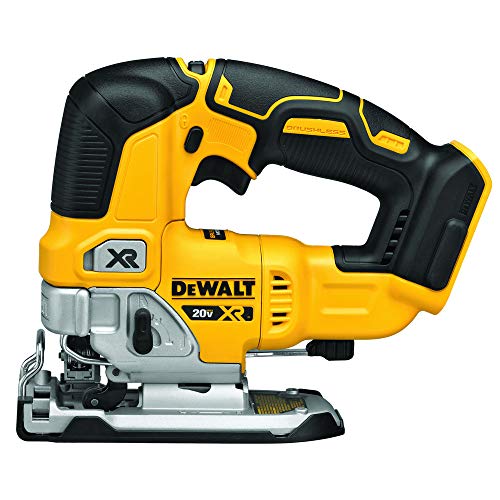
The DEWALT DCS334B is a cordless jig saw with a brushless motor designed for longer runtime and efficient performance. Its compact form enhances grip and control, while the integrated LED lighting illuminates dim work surfaces. This model is best for users who value cordless convenience and extended battery life for mid-scale cutting tasks. The limitation is that blade runtime depends on battery charge, so plan for field projects without frequent recharges.
DEKOPRO Electric Jig Saw Tool Kit

The DEKOPRO kit offers a 3,000 SPM corded jigsaw with variable speed and four orbital settings for smooth or rapid cuts. It includes a tool-less blade clamp and a bevel-capable base plate that tilts up to 45° for precise bevels. This option is best for entry-level woodworkers who want easy blade changes and versatile bevels. A downside is that the included blades may require upgrading for specialty materials.
BLACK+DECKER Jig Saw BDEJS600C

The BLACK+DECKER BDEJS600C is a 5-amp corded jig saw with a 3/4″ orbital action for precision and four curve settings for rounded cuts. It supports 45° bevel cuts, making it a practical choice for users who need versatile curve control on wood projects. A caution is that, as a corded tool, it requires access to a power outlet and may feel heavier during extended use.
WEN 33606 Jig Saw with Laser and LED
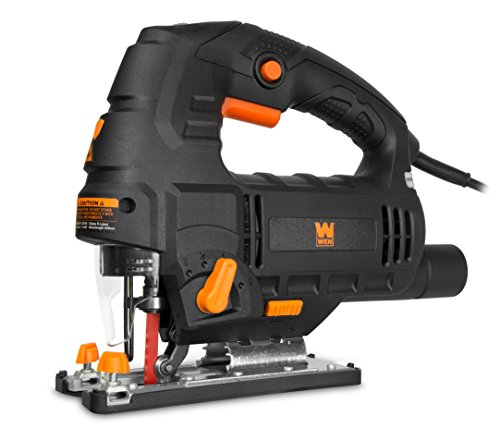
The WEN 33606 combines a 6.6-amp motor with four-position orbital settings, plus onboard laser and LED illumination to improve accuracy on dark or low-contrast cuts. It reaches up to 3,300 SPM, offering strong performance for a variety of materials. This option is best for users who want integrated lighting and precise guides for complex cuts. A limitation is that heavier use may reduce maneuverability compared to lighter models.
Buying Guide
What should you consider when choosing a jig saw?
- Power source: Corded vs. cordless. Corded models (Hammerhead, DEKOPRO, BLACK+DECKER, SKIL, WEN) provide consistent power but require outlets. Cordless (DEWALT DCS334B, in kit form) offer portability for job sites without power access.
- Speed and control: Look for variable speed and orbital settings. Higher SPM helps with quick cuts, while orbital settings adjust aggressiveness for different materials.
- Bevel capacity: A base that tilts to 0–45° enables bevel cuts which are essential for mitered edges and angled joints.
- Blade change: Tool-less blade clamps save time and reduce downtime during projects. This is especially helpful for beginners switching blades frequently.
- Built-in features: LEDs, lasers, and lightweight designs improve accuracy and comfort. Consider these if you work in dim areas or need extended use without fatigue.
- Accessories: Blades, batteries, and cases add long-term value. Check what’s included if you want a ready-to-use kit.
FAQ
- What is the difference between orbital and straight blade motion?
Orbital motion moves the blade in a slightly circular path, enabling faster cuts in softer materials and more aggressive cutting. Straight action is better for precise, clean cuts in hard materials. - Is a cordless jig saw as powerful as a corded one?
Cordless tools offer portability but may have shorter run times between charges. Corded models typically provide constant power for longer sessions. - Do jig saws require special blades?
Yes, use blades appropriate for wood, metal, or composite materials. Faster teeth per inch usually cut wood more smoothly. - When should I prefer a tool with a laser or LED light?
Choose laser/LED options if you work in low-light environments or need clear line-of-cut guidance for accuracy. - What is a tool-less blade clamp?
It lets you swap blades quickly without tools, reducing downtime—especially on projects requiring multiple blade changes. - Which jig saw is best for beginners?
Models with tool-less blade changes, a comfortable grip, and adjustable bevels are ideal for beginners tackling a range of cuts.