Looking for a high speed air grinder that delivers power in tight spaces? This guide highlights top options that balance speed, control, and durability. Best for automotive and fabrication professionals, hobbyists tackling heavy grinding, or anyone needing precise material removal in confined areas. The selections below focus on 1/4″ collets and 90-degree or straight configurations to fit a range of setups. The table next to the intro compares key strengths to help you pick quickly.
| Product | Best For | Why It Stands Out |
|---|---|---|
| Ingersoll Rand 301B 1/4″ Collet | Automotive and tight-space grinding | Compact, lightweight, precise throttle control |
| TOOLPEAK 1/4″ Angle Die Grinder | Accessible in tight angles | 90-degree head and built-in speed regulator |
| Hoteche 4-Inch Angle Grinder | Heavy material removal | High torque at 10,000 RPM with 4-inch wheels |
| CILEONBE 1/4″ Die Grinder | Compact polishing and detailing | Two collets; low weight for single-handed use |
| KJE Right Angle Die Grinder Kit | All-in-one kit for beginners and pros | Includes multiple discs and two collets |
Ingersoll Rand 301B 1/4″ Collet Air Die Grinder

The 301B is a compact right-angle die grinder powered by a 0.25 hp motor, delivering up to 21,000 rpm. It excels in automotive work, fabrication, and industrial tasks where access is restricted. The tool is sold individually, with no air compressor included. Best for mechanics who need a light, fast grinder for crammed spaces or overhead work.
Reference features include a self-locking throttle for precise control, a right-angle design that improves reach in tight areas, and a lightweight 1.02-pound body to reduce fatigue during extended use. Durable aluminum housing and precision ball bearings support long-term reliability, while a front exhaust helps keep the workspace clean and minimizes vibration.
Best for: automotive technicians and fabricators who value control and maneuverability in cramped quarters. Limitation: no compressor is included, so plan for a compatible air source.
1/4 Inch Angle Die Grinder With 22 Pcs 2-Inch Discs

This TOOLPEAK 1/4″ angle die grinder features a 0.32 HP motor and up to 20,000 RPM free speed. The 90-degree head helps reach tight or angled grinding jobs, making it suitable for fast material shaping and finishing in narrow spaces. A built-in speed regulator enhances control, and the lightweight aluminum body with low vibration design minimizes fatigue during use.
Best for: users who need a compact, powerful grinder with an extensive accessory set for immediate projects. Limitation: performance is tuned for small-to-medium tasks; heavier metal removal may require higher torque grinders.
Hoteche 4-Inch Air Angle Grinder

The Hoteche 4-Inch air angle grinder is designed for heavy-duty material removal, delivering a steady 10,000 RPM free speed. Its 4-inch wheel capacity accommodates standard grinding and cutting discs, making it a strong choice for fabricators and metalworkers who need rapid stock removal. A compact 220 mm body and durable gearing provide reliability in busy shop environments.
Best for: professional shops performing rust removal, weld prep, or structural work requiring faster stock removal. Limitation: attention to wheel compatibility is necessary since 4-inch wheels are larger than typical 2- or 2.5-inch discs used on smaller tools.
CILEONBE 1/4 Inch Air Die Grinder
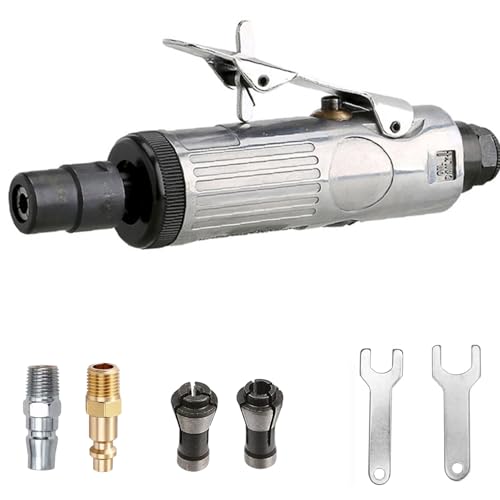
The CILEONBE 1/4″ air die grinder runs at up to 25,000 RPM with two included collets (1/4″ and 1/8″). Its compact 15 cm length and sub-one-pound weight promote one-handed operation and reduce operator fatigue. Rear exhaust directs airflow away from the work surface for cleaner operation. Suitable for polishing, deburring, and fine grinding on metal and other materials.
Best for: detail work and polishing in tight spots. Limitation: extremely high speed requires careful control and proper safety gear to prevent gouging softer materials.
KJE Right Angle Die Grinder Kit

The KJE Right Angle Die Grinder Kit operates at 20,000 RPM and includes 29 sanding discs, two collets, and multiple chuck keys. Constructed from aluminum alloy, it is lightweight with low vibration for smoother operation in confined spaces. The kit’s one-handed, compact design makes it ideal for beginners experimenting with different finishes or professionals needing quick setup tweaks.
Best for: those seeking an all-in-one starter kit with a broad disc selection and flexible use. Limitation: bundled accessories may not all match every application, so check compatibility with your project requirements.
Buying Guide
What speed matters for my project?
Higher speeds (20,000–25,000 RPM) remove material quickly on metal surfaces but require careful control and protection. Slower high-torque grinders (around 10,000 RPM) are steadier for deburring and finishing in tight spaces. Choose based on material type, desired finish, and operator experience.
Is weight or ergonomics important?
Lightweight tools reduce hand and arm fatigue during extended use. Right-angle designs improve accessibility in cramped areas. If you work overhead or in tight spots, prioritize ergonomic grips and low vibration features.
What about discs and accessories?
Consider whether a kit includes enough compatible discs or if you must purchase extras separately. Look for included collets (1/4″ and 1/8″) for flexibility across grinding and polishing tasks. Rear exhaust helps keep the workspace cleaner.
Torque versus speed: which to pick?
High speed supports rapid material removal, while higher torque helps maintain control during aggressive grinding. In some cases a regulator or adjustable speed helps tailor performance to the task and material hardness.
Why choose a right-angle grinder?
Right-angle grinders reach into corners, along seams, and behind fixtures where straight tools cannot. They excel in automotive body work, exhaust fabrication, and heavy-duty metal finishing where space is restricted.
Safety and maintenance considerations
Always wear eye and ear protection, and use the appropriate grinding discs for the material. Keep the tool angled to avoid gouging. Regularly inspect hoses and fittings for air leaks, and perform routine lubrication or maintenance per the manufacturer’s guidelines even when the tool is labeled as lube-free.
FAQ
- What grinder is best for tight spaces? A compact or right-angle grinder with a small head or 90-degree geometry is typically best for confined areas, allowing reach without excessive hand movement.
- Do I need a compressor with these grinders? Yes. All listed tools are air-powered and require an air compressor with adequate CFM and pressure to operate effectively.
- Can I use a grinder for metal cutting? Some grinders are suitable for cutting with the appropriate wheel or disc. Always verify the wheel type, speed rating, and manufacturer guidance for cutting versus grinding tasks.
- Are high RPMs dangerous? Higher speeds can increase kickback risk and heat. Use proper PPE and a firm grip, and start with light pressure to gauge material response.
- Should I buy a kit or individual tools? Kits provide variety and immediate options for different tasks, while individual tools let you tailor gear to specific projects and budgets.
- How do I maintain these tools? Regularly check for air leaks, clean exhaust paths, replace worn discs, and follow the manufacturer’s maintenance schedule to extend lifespan.