If you’re seeking accurate half-lap joints and reliable joints for frames or furniture, these five router jigs offer strong precision, durable construction, and clear setup guides. They’re ideal for woodworkers who want repeatable results, minimal tear-out, and faster workflow. The top picks cover half-lap specific jigs, box joints, coping sleds for end-grain work, slotting and positioning aids, and circle/arc guides for rounded joints. The brief buying table below highlights each product’s core strengths to help compare at a glance.
| Product | Best For | Key Strength |
|---|---|---|
| Rockler Half Lap Jig | Frames and decorative projects | Precise half-lap joints, integrated reference pins |
| Router Table Box Joint Jig (Rockler) | Small to medium boxes | Uniform finger spacing with interchangeable widths |
| O’SKOOL Rail Coping Sled | End-grain joints and profiling | Stable coping with safe hand guidance |
| 2-in-1 Router Jig for Slotting & Positioning (ZMJY) | Invisible fasteners and decorative grooves | Dual-function precision with micro-adjustment |
| Sigerio Circle Cutting Jig (DeWalt/Bosch/Milwaukee compat.) | Large circles and arcs | 4-in-1 adjustable circle cutting with wide compatibility |
Rockler Half Lap Jig

The Rockler Half Lap Jig is built for precision joint cutting on a portable router table. It supports tight half-lap joints and miter joints, enabling strong frame construction and decorative panel work. The setup uses a phenolic base, replaceable zero-clearance inserts, and a 15″ aluminum miter bar to minimize movement and ensure accuracy. The integrated 90° and 45° reference pins and built-in router guide rail help ensure consistent alignment and tear-out-free cuts. This jig is best for woodworkers who need reliable, repeatable half-lap results for frames or furniture components.
Best for: frame builders, hobbyist furniture makers, and decorative project builders who require repeatable, accurate half-lap joints. The combination of a durable base and precise references reduces setup time and increases joint quality.
Why selected: It directly addresses half-lap joint accuracy with a stable platform and fixed reference points, which helps prevent misalignment after the cut and improves glue bonding surfaces.
Caution: It relies on a router table setup; users without a stable table may find alignment variability and longer setup times.
Router Table Box Joint Jig

Box joints offer strong, visually appealing confinement for small to medium boxes and narrow carcasses. This Rockler jig uses interchangeable indexing keys for ¼”, ⅜”, and ½” finger widths, enabling uniform spacing across multiple pieces. The smooth-sliding sled design keeps the workpiece square to the router bit, while comfortable locking knobs secure the platform to the miter slot. It’s best for cabinetry components or small boxes where precision and repeatability are critical.
Best for: woodworkers building boxes, drawers, or small furniture pieces that require precision finger joints with repeatable widths.
Why selected: The interchangeable brass indexing keys simplify setup for different box sizes, reducing misalignment risk and improving consistency between pieces.
Caution: The design emphasizes finger joints on a sled; larger panels might require additional support to prevent flex or drift during cuts.
O’SKOOL Rail Coping Sled
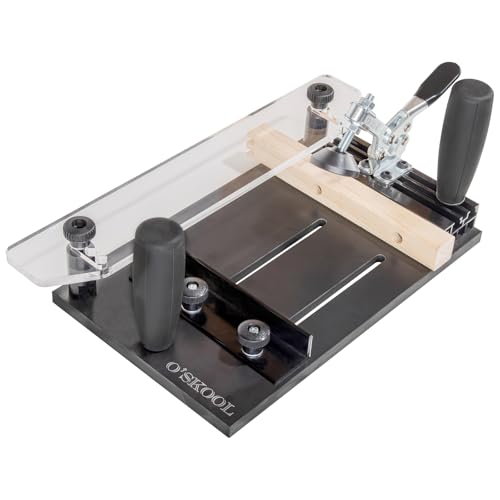
The O’SKOOL coping sled is designed for end-grain routing tasks, making it suitable for stile and rail joints, raised panels, and half-lap joints. It securely holds workpieces on a router table, guiding them along the fence for safe, precise cuts. The phenolic base adds durability, resisting moisture and warping, which helps maintain accuracy in repeated end-grain work. This sled is best for safer end-grain routing and stable coping in cabinetry or door assemblies.
Best for: cabinetmakers and door builders who frequently work with end-grain joints and need safer guiding for coping and profiling cuts.
Why selected: The coping sled provides improved accuracy and safety when routing end grain, a common challenge in half-lap and rail work.
Caution: It’s designed for coping-specific tasks; for general routing, other jigs may offer quicker setup for non-end-grain work.
2-in-1 Router Jig for Slotting & Positioning

This versatile tool combines slotting for invisible fasteners with a stable positioning bracket for decorative grooving. It enables precise slotting and dado work for hardwoods, plywood, and composites, expanding capabilities in cabinetmaking and furniture assembly. The micro-adjustable clamp supports a 0-2 inch capacity, securing varying material thicknesses and reducing movement during cuts. The base uses heavy-duty aluminum alloy, delivering rigidity for repeatable results.
Best for: professionals and serious hobbyists who need a single tool to perform both slotting for fasteners and precise positioning for grooves or decorative work.
Why selected: The dual-function design reduces tool clutter and enables precise, repeatable results across multiple joinery tasks.
Caution: Setup complexity can be higher than single-purpose jigs; ensure you understand both modes before starting a project.
Sigerio Circle Cutting Jig (DeWalt/Bosch/Milwaukee)

This round cutting jig provides 4-in-1 circle cutting for large and small routers, compatible with DeWalt, Bosch, and Milwaukee compact units. It supports circle sizes from 10″ to 58″, enabling arcs, circles, and groove work for tabletops, panels, and trim. The base bolts securely on, and its extendable arm enables long-radius cuts with stable, accurate pivot points. It’s best for projects requiring large-radius circles or arcs on installed hardware or tabletops.
Best for: woodworkers performing large circular or arc cuts on tabletops or panels with compact routers.
Why selected: Wide circle range and direct bolt-on compatibility offer flexibility for a variety of routers without adapters or extra equipment.
Caution: Larger arcs require careful bit selection and stable working space to prevent chatter at extreme radii.
Buying Guide: Key Buyer’s Considerations
- Joint type and project scope: If you primarily build frames and frames-only joints, prioritize half-lap-specific jigs with strong alignment references. For boxes or drawers, prefer box-joint-focused jigs with uniform finger spacing.
- Base material and durability: Look for phenolic bases or metal sleds for reduced wear and better resistance to warping and moisture, especially for end-grain work.
- Setup speed vs. flexibility: Some jigs offer rapid setup for repeat cuts; others provide multi-function capabilities that reduce tool clutter but may require more initial alignment.
- Compatibility: Ensure the jig fits your router model and table setup. Circle jigs should work with a broad range of routers or specify compatible brands.
- Safety and accuracy features: Integrated reference pins, stops, and locking mechanisms help maintain consistent cuts and reduce tear-out.
- Portability vs. bench use: If you move between sites, consider portable options like the Rockler Half Lap Jig and Sled combos; for a fixed workshop, heavier, stable sleds may be preferable.
Frequently Asked Questions
- What is a half-lap router jig best used for? It excels at creating strong, precisely aligned half-lap joints in frames and furniture components.
- Do I need multiple jigs for different joints? Not necessarily; some jigs offer dual or multi-function capabilities, but dedicated jigs improve efficiency for specific joint types.
- Can I use these jigs on any router table? Most are designed for common router tables but verify base compatibility with your model and miter slot width.
- Are brass indexing keys important for box joints? They help maintain uniform finger spacing, improving repeatability across multiple boxes.
- Is a coping sled safer for end-grain work? Yes, coping sleds guide workpieces along the fence, reducing hands near the bit and improving accuracy on end grain.
- What determines the best circle-cutting jig size? Consider the largest circle you need in your typical projects and the router’s base compatibility for stability.