Answering the core buyer question: which half-inch belt sander best fits precision tasks, compact spaces, and versatile maneuvering? This guide highlights five top options that excel at detail work, rust removal, spot-weld prep, and tight-curved surfaces. It’s ideal for hobbyists, woodworkers, auto body enthusiasts, and professionals who need controlled belt access and reliable performance. Below, compare who each sander is best for, plus a concise buying table to help you choose quickly.
| Product | Best For | Why It Stands Out |
|---|---|---|
| WEN 6307 | Detail work and angled surfaces | Variable speed 1080–1800 fpm with auto-tracking and 55° belt pivot. |
| Ingersoll Rand 360-418 | Professional rust removal and spot-weld prep | Right-angle air sander with 0.6 HP, 20,000 rpm, tool-free belt change. |
| DEWALT DCM200B | Cordless convenience for small projects | Brushless motor, high power, 700 MWO, 5,600 fpm, rotating arm. |
| Heavy-Duty Zirconia Belts | Budget-friendly belt options for varied materials | Six grit range with durable seams and long belt life. |
| 20V Cordless Belt Sander (VERVEWAVE) | Battery-powered versatility for metals and wood | Compatible with DEWALT 20V batteries, up to 3268 ft/min, six speeds. |
WEN 6307 Variable Speed Detailing File Sander

The WEN 6307 is a compact, 1/2-by-18-inch belt sander designed for controlled detail work. It offers a variable speed dial that powers the belt from 1080 to 1800 feet per minute and an auto-tracking belt system that eliminates tensioning or adjustments. The belt can pivot up to 55 degrees for efficient sanding on complex angles. Best for: hobbyists and professionals who need precise speed control and flexible belt orientation in tight spots. Limitation: belt tracking may require occasional calibration with heavier workloads.
Ingersoll Rand 360-418 1/2″ x 18″ Air Belt Sander

This compact right-angle air belt sander runs on a 0.6 HP motor with up to 20,000 rpm and 4,700 sfpm, making it strong for rust removal, spot-weld preps, and finishing. It’s sold individually and requires an air compressor. Best for: professional shop use where quick belt changes and right-angle access are priorities. Limitation: requires a compatible air supply and may be heavier for long sessions.
DEWALT 20V MAX XR Cordless Bandfile Belt Sander

The DEWALT DCM200B offers cordless convenience with a brushless motor and 700 MWO, delivering belt speeds up to 5,600 fpm. The rotating arm allows flexible storage and reach, with tool-free belt changes for efficiency. Best for: users who value mobility and quick belt changes for small to medium tasks. Limitation: bare tool; battery and charger are not included, and higher-cost batteries are required for peak performance.
Heavy-Duty Zirconia Sanding Belts (42 Pcs)
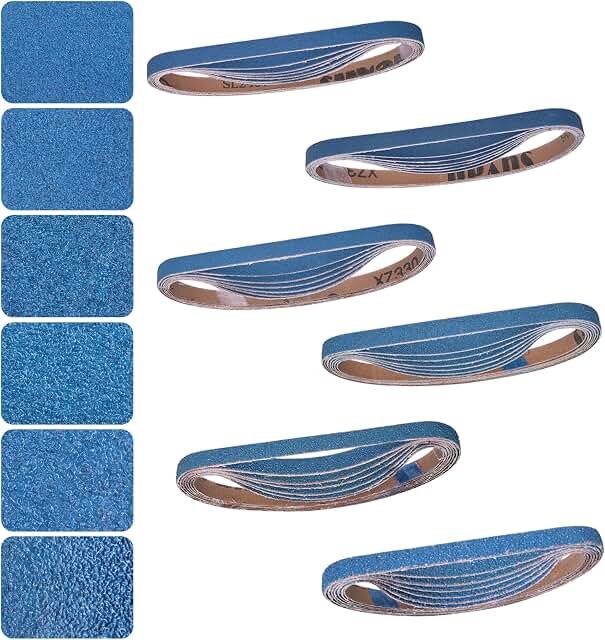
This belt set provides 42 pieces across six grits (40/60/80/120/150/240), ideal for projects requiring varied abrasiveness on wood, metal, and more. Features blue zirconia particles for sharpness and longevity, plus seamless joints with a diagonal lap splice for reduced tearing. Best for: budget-minded shoppers who want a broad grit range in a single purchase. Limitation: not a sander itself; requires a compatible belt-sander body for use.
20V Cordless Belt Sander Bandfile (DEWALT Compatible)

VerveWave’s cordless belt sander is compatible with DEWALT 20V MAX batteries, using a brushless motor that reaches up to 3268 ft/min with six adjustable speeds. It’s designed for heavy-duty metal and wood work, offering precise power regulation. Best for: tradespeople and DIYers who need a portable option with strong speed control. Limitation: battery and charger are not included; depends on own battery stock for performance.
Buying Guide
What to consider when choosing a half-inch belt sander?
- Power source: corded vs. cordless. Corded tools deliver consistent performance; cordless models offer mobility for tight spaces but rely on battery life.
- Speed and control: variable speeds help tailor aggressiveness to material, finish, and project type. Look for a reliable speed range and a simple dial or controls.
- Belt tracking and tension: auto-tracking or tool-free belt changes reduce downtime and improve accuracy on angled surfaces.
- Ergonomics and reach: right-angle bodies and pivoting belts are essential for corners, curves, and relief work.
- Compatibility and belts: ensure belts are readily available and compatible with your used brand or model, plus grit options that match your material tasks.
- Weight and balance: lighter units reduce fatigue during extended sessions, especially in detail work.
Practical buying questions
- Which half-inch belt sander is best for intricate trim work? The WEN 6307 offers 55-degree belt pivots and a broad speed range, making it well-suited for curved or tight-area detail work.
- Do I need an air-powered sander for metal finishing? If you prefer quick belt changes and high rpm, the Ingersoll Rand 360-418 provides robust performance for rust removal and spot-weld prep, with tool-free adjustments.
- Is a cordless option enough for precision sanding? The DEWALT 20V MAX XR provides mobility and strong power, good for small projects and spots where a cord is inconvenient.
- Are sanding belts included or sold separately? Belts in the Zirconia set cover multiple grits; however, many individual sanders require compatible belts from the same brand or compatible series.
FAQs
- What is the benefit of a 1/2″ belt? It provides a balance between precision and material removal, ideal for detailing versus bulk sanding.
- Can I use these with metal, wood, or plastic? Most 1/2″ belts are versatile but verify grit and material compatibility for best results.
- Do cordless options have enough speed for heavy-duty work? Some do; however, battery capacity and motor design influence performance under load.
- Are tool-free belt changes essential? Yes for efficiency, especially when switching abrasives during a project.
- Is belt tracking a concern? Auto-tracking designs help prevent belt wandering, enabling cleaner finishes.
- Which accessory matters most for detailed work? A rotating or pivoting belt and a comfortable grip can substantially improve accuracy.