Dual action air sanders are ideal for quick material removal with a swirl-free finish across metal, wood, and fiberglass. This guide compares five popular models to help buyers choose the right tool for auto body prep, furniture refinishing, or shop projects. The top picks vary by noise level, weight, speed control, and pad size. For tight spaces, consider smaller, lighter options; for large surfaces, opt for higher RPM and robust builds. The table below highlights the best-fit scenarios for each product.
| Product | Best For | Pad Size | Key Benefit |
|---|---|---|---|
| Ingersoll Rand 311A Dual-Action | Body filler prep and bodywork | 6″ | Silenced operation with smooth finishes |
| KUIMIT 6″ Air Sander Kit | Garage workers needing real-time RPM control | 6″ | Real-time regulator; lightweight |
| Asabocai Professional Air Random Orbital | Pro-grade polishing and sanding | 6″ | Balanced, low vibration with high speed |
| HUAXIU 6″ Pro Dual Action | General purpose sanding | 6″ | Low vibration and easy speed adjustment |
| Chicago Pneumatic CP870-6 | Finishing and feather edging | 6″ | Versatile rotary or random orbital option |
Ingersoll Rand 311A Dual-Action Angle Air Sander

Best for users who need a balance of power and control with quiet operation. The 6″ adhesive pad delivers swirl-free finishes on body filler and metal prep tasks. It delivers 0.25 hp and 12,000 RPM, with a built-in silencer for reduced noise. A compact size helps access tight spaces, and the adjustable regulator supports positive speed control for feather-edged work. Best for auto body techs and metal preparers who value stability and less fatigue from vibration.
Who it’s for: Auto body technicians, metal finishers, and hobbyists tackling dense materials where steady speed and finish quality matter. Limitations: Heavier hand use may still cause fatigue on long sessions; consider lighter models for all-day use.
KUIMIT 6″ Air Sander Kit

This 6″ dual-action sander targets users seeking precise RPM control and portability. It features a precision-balanced motor delivering up to 12,000 RPM with minimal vibration and a built-in regulator for real-time RPM adjustment (2,500–12,000). The palm-sized, light design (about 3.1 lbs) supports one-handed operation, making it suitable for detailed work or extended sessions where fatigue is a concern.
Who it’s for: Garage enthusiasts, woodworkers, and detail-focused pros who need quick changes in speed and a compact tool. Limitations: For very aggressive material removal, this model’s fine control may require extra passes with heavier stock materials.
Professional Air Random Orbital Palm Sander (Asabocai)

Designed for professionals who demand balanced performance and comfortable control. It includes a built-in regulator for speed control and a 6″ dual-action pad that minimizes vibration while maintaining high-speed sanding up to 12,000 RPM. The device emphasizes consistent polishing and finishing through its dual-action rotation and smooth power delivery.
Who it’s for: Body shops and wood shops needing long-term reliability with reduced user fatigue. Limitations: The tool’s efficiency depends on a compatible backing plate; ensure pad compatibility before use.
HUAXIU 6 Inch Pro Dual Action Sander (Red)
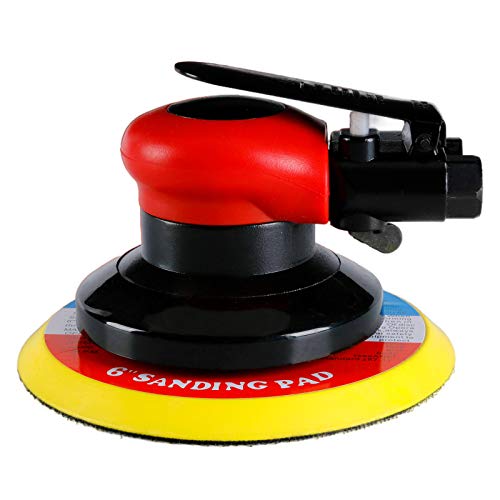
Best for general-purpose sanding with a focus on ease of speed adjustment. The sander offers a built-in regulator to tailor speed for different materials and finishes. It combines lightweight design with a low center of gravity to reduce fatigue and improve stability during longer sessions.
Who it’s for: Beginners and intermediate users looking for a straightforward dual-action tool for woodworking and light metal prep. Limitations: Some users may prefer a higher maximum RPM for aggressive sanding tasks.
Chicago Pneumatic CP870-6 Inch Sander

Versatile and well-suited for finishing and feather edging. It supports rotary or random orbital operation, making it a flexible choice for different surfaces. The sander emphasizes insulation and a lock-off throttle to prevent accidental starts, adding a safety layer for beginners.
Who it’s for: Professionals and DIYers who need an adaptable tool for multiple finishing tasks. Limitations: Non-vacuum design means dust collection relies on external systems or shop vacuums.
Buying Guide
What to consider when choosing a dual-action air sander:
- Pad size and orbit: Most 6″ pads are standard for body work and woodworking; larger surfaces benefit from bigger pads for faster coverage.
- Power and speed control: Look for tools with a regulator that allows real-time RPM adjustments for different materials and finishes.
- Weight and balance: Lighter tools reduce user fatigue; a well-balanced tool with low vibration improves control and finish quality.
- Noise and ergonomics: Built-in silencers or low-noise designs help with long sessions; ergonomic handles reduce strain on the hand and wrist.
- Durability and maintenance: Ball-bearing or balanced construction supports longevity and stability during heavy use.
- Versatility: If you need both finishing and feathering, consider models offering stable dual-action motion and compatibility with various backing plates.
What’s the best choice for auto body prep?
For auto body prep, prioritize models with good speed control, a robust regulator, and a comfortable grip. The Ingersoll Rand 311A and Chicago Pneumatic CP870-6 offer reliable performance for metal prep and feather edging, with options for steady control and low vibration.
What’s best for woodworking and detailing?
Woodworking benefits from models with smooth operation and minimal vibration. The KUIMIT 6″ and the Asabocai Professional Sander provide steady RPM control and balanced feel to reduce fatigue during extended sanding sessions.
Is 6″ the right pad size?
For most project scales, a 6″ pad is the standard and versatile choice that balances surface coverage with control. Larger sheets can accelerate material removal, while smaller pads offer precision on edges and tight corners.
How important is a built-in regulator?
A built-in regulator improves control during delicate finishing. Models with adjustable speed support slower passes for smoother finishes and faster passes for initial stock removal, reducing the risk of gouging.
Safety and maintenance tips
- Always wear eye and respiratory protection when sanding.
- Keep the work area clean to prevent dust buildup that can affect tool performance.
- Check the backing plate and pad for wear; replace as needed to maintain even finishes.
- Lubricate air fittings as recommended by the manufacturer to prevent corrosion and ensure consistent performance.
FAQ
- What RPM range is typical for dual-action sanders?
- Is a 6″ pad better than a 5″ pad?
- Do I need a vacuum attachment?
- Can I use these sanders for metal and wood interchangeably?
- How do I prevent vibration fatigue?
- Are these tools suitable for beginners?
Most models reach up to 12,000 RPM, with regulators allowing lower speeds for fine finishing.
Six-inch pads maximize coverage on flat surfaces and are common for body work; five-inch pads offer more control in tight areas.
Non-vacuum models are common; consider a shop vacuum or dust collection system to manage debris for indoor use.
Yes, most dual-action sanders work well on both, but check the pad and backing plate compatibility for each material.
Choose lighter models with balanced construction and use proper grip techniques; take frequent breaks during long sessions.
Yes, but beginners should start with models offering clear speed control, comfortable grips, and straightforward maintenance.