Double expansion concrete anchors provide strong, secure fastening in masonry by expanding at both ends as you tighten screws. This guide highlights top choices suitable for DIY and professional projects, explains who each product fits best, and helps you compare options quickly. Use this to choose anchors for masonry screws or bolts, cast-in-place anchors, or retrofit installations in concrete slabs, brick, and block walls.
Buyer-focused summary table of selected products
| Product | Best For | Key Benefit | Approx. Size |
|---|---|---|---|
| Wensilon 25 pcs 1/4×1-1/4 | Small fixtures in masonry | Compact, dual-end expansion | 1/4 internal, 1-1/4 length |
| Wensilon 25 pcs 3/8×2 x3/4 | Medium hardware in concrete | Versatile for masonry screws/bolts | 3/8 internal, 2″ length |
| Sieqioor 100-Pack 1/4″ x 1-1/4″ | Bulk projects, repair parts | High-density pack, corrosion resistance | 1/4 internal, 1-1/4 length |
| Wensilon 25 pcs 5/16×1-5/8×5/8 | Heavier fixtures in masonry | Dual-end expansion for strong hold | 5/16 internal, 1-5/8 length |
| Sieqioor 10-Pack 1/2×2-1/2″ | Secure long bolts in concrete | Copper-free zinc alloy for durability | 1/2 internal, 2-1/2 length |
Wensilon 1/4×1-1/4 Double Expansion Anchor

Best for compact installations in masonry that require reliable dual-end expansion. The 1/4 internal thread and 1-1/4 overall length fit small fasteners or lightweight brackets. The shield involves a hollow wedge cone and wedge nut that expand at both ends as you tighten the screw. Best for small fixtures in concrete, brick, or block. Use with a 1/2″ hammer drill for best results. Caution: Suitable for light-to-moderate loads; avoid oversized anchors in thin sections.
Wensilon 3/8×2 x3/4 Double Expansion Anchor

This item is sized for medium-duty applications in masonry, with a 3/8 internal thread and a 2″ length, external diameter 3/4″. It uses dual-end expansion to improve load distribution and grip. Best for medium fixtures such as brackets or anchors in concrete or brick. Choose this if you need more length for thicker walls or deeper embedment. Limitation: installation may require a larger hammer drill and precise hole sizing.
Sieqioor 100-Pack 1/4″ x 1-1/4″ Double Expansion
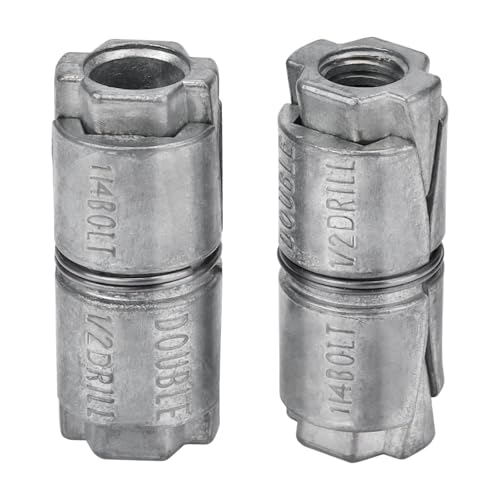
High-volume option for projects requiring many anchors in concrete or brick. The 1/4″ internal thread and 1-1/4″ length with a 1/2″ external diameter provides strong dual-end expansion. Best for bulk installations such as electrical or plumbing mounts and retrofit jobs. Better for projects needing many uniform anchors; caution: check the substrate thickness to ensure adequate embedment before installation.
Wensilon 5/16×1-5/8×5/8 Double Expansion Anchor
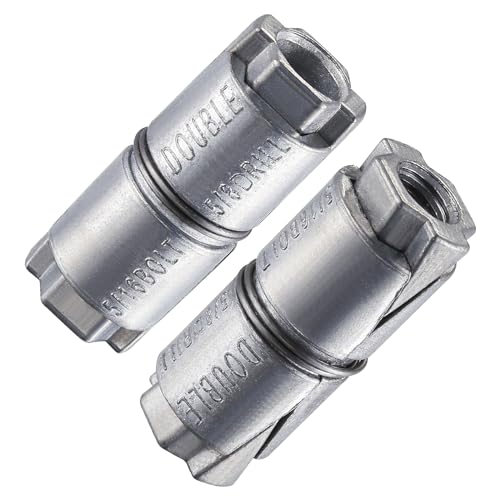
Designed for heavier fixtures, this anchor uses a 5/16 internal thread and 1-5/8″ length with a 5/8″ outer diameter. Dual-end expansion provides stronger grip for thicker embeds in masonry. Best for mounting heavier equipment or brackets in concrete or brick. Limitation: longer embeds require a deeper drill hole and careful alignment to avoid misdrill.
Sieqioor 1/2×2-1/2″ Double Expansion Anchor

Best for heavy-duty installations requiring long embedment in concrete, brick, or block. The 1/2″ internal thread and 2-1/2″ length with a 7/8″ external diameter encourage robust dual-end expansion. Best for anchors that need to handle substantial loads. Caution: ensure the hole is drilled to the exact size to prevent poor expansion and reduced holding power.
Buying Guide
What size should I choose?
Select by internal thread size and embedment depth. Smaller sizes fit light fixtures and shelves; larger sizes are suited for heavy brackets or motors. Ensure the hole diameter matches the anchor’s external diameter and that the drill bit size is compatible with the hammer drill you own.
What materials and substrates work best?
All listed anchors are zinc alloy or zinc-plated and designed for masonry, concrete, brick, and block. They perform best in solid masonry with adequate embedment depth. Avoid installing anchors in hollow or crumbling sections where the substrate cannot hold expansion pressure.
Installation considerations
- Use the recommended drill bit size for precise holes to prevent anchor looseness.
- Install with the appropriate hammer drill setting to achieve clean, straight holes.
- Tighten gradually to ensure dual-end expansion without over-torquing, which could damage the anchor or substrate.
- Check for proper alignment and ensure the fixture weight aligns with the anchor’s load class for masonry.
Where to use different anchor types?
- Small fixtures in finished walls: choose the 1/4″ or 1/4″ x 1-1/4″ anchors.
- Medium brackets or electrical boxes: 3/8″ or 5/16″ options work well.
- Heavy-duty mounts or long bolts: consider 1/2″ x 2-1/2″ anchors.
Practical considerations
- Bulk packs are cost-effective for larger jobs with many identical anchors.
- Bulk options may be preferable for contractors needing replacement parts on hand.
- Ensure anchors are compatible with the screws or bolts you plan to use.
Quick comparison at a glance
- Best for compact fixtures: 1/4″ anchors (Wensilon 1/4×1-1/4).
- Better for mid-weight loads: 3/8″ anchors with longer embedment (Wensilon 3/8×2).
- Bulk supply and replacements: Sieqioor 100-pack 1/4″ x 1-1/4″ or 24-pack 1/4″ x 1-1/4″
- Heavier duty: 5/16″ and 1/2″ anchors for thicker substrates or long bolts
FAQ
- What is a double expansion anchor? A shield-style anchor that expands at both ends as the screw is tightened, increasing grip in masonry.
- Which anchor family is best for concrete walls? Double expansion anchors in zinc alloy are well suited for concrete and brick substrates.
- Can I reuse anchors after removal? Generally not recommended; reusing may reduce holding power and security.
- Do I need a special drill bit? Use the drill bit size specified for each anchor; typically 1/4″, 3/8″, 1/2″ bits, depending on the anchor.
- Are these anchors suitable for outdoor use? Zinc-plated anchors offer basic corrosion resistance, but consider weather exposure and potential rust in aggressive environments.
- Is there a limit on load capacity? Each anchor has a load capacity dependent on substrate, embedment depth, and screw size; consult the manufacturer’s guidelines for exact figures.