Looking for a reliable air-powered concrete nailer to speed up furring, decking, or masonry work? This guide highlights top 5 options that balance power, safety, and ease of use for professional and DIY projects. Each pick is best for specific tasks, from tight spaces to high-volume nailing. Use the buyer tips below to compare features like nail length range, magazine capacity, and safety mechanisms to decide which model fits your job best.
| Product | Best For | Key Benefit |
|---|---|---|
| Meite ST64E Concrete Nail Gun | General purpose decking and furring | Transparent magazine, 360° exhaust, safety lock |
| Air Locker CN64A3 | High-volume framing and subflooring | High-capacity side magazine, dual-fire mode |
| Meite ST64L Concrete Nail Gun | Hard-to-reach spaces | Extended muzzle for tight areas |
| WOODPECKER ST64 Pneumatic Nail Gun | Budget-friendly heavy duty use | Die-cast aluminum, large capacity magazine |
| CREWTOWER Concrete Nailer | Versatile 3/4″ to 2-1/2″ nails | Selective actuating mode for different applications |
Meite ST64E Concrete Nail Gun

The Meite ST64E is a pneumatic concrete nailer designed to drive 14-gauge, 1-1/4″ nails into concrete, steel, or wood at 85-120 PSI. It ships with 400 nails and a 100-nail magazine, along with a see-through window to monitor ammo. It’s best for furring strips, siding, decking, and subflooring in one-squeeze operations. A safety switch lock helps prevent accidental ignition, prioritizing on-site safety. A potential limitation is that nail length is fixed within the included range, so extraordinary long or short nails may require a different model.
Best for: Projects requiring solid safety features and straightforward operation on wood-to-concrete installs.
Air Locker CN64A3 5/8″ to 2-1/2″ Nailer
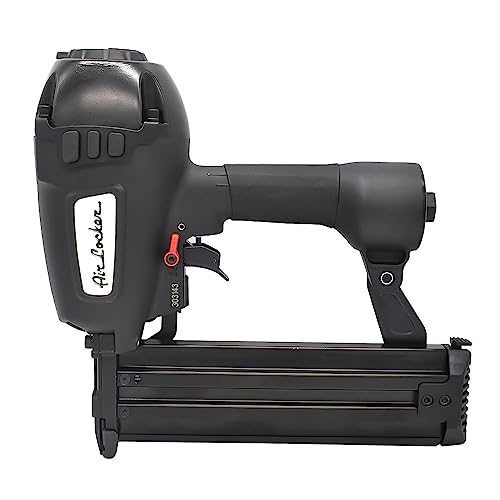
This model targets heavy-duty framing tasks, handling nails from 5/8″ to 2-1/2″. It features a UNI-LOK forged steel driver for durability, a high-capacity side load magazine for easier nail replenishment, and a dual-fire mode with safety to prevent misfires. The aluminum housing keeps weight manageable for long sessions. Consider this if you need a robust tool for frequent high-volume nailing, but watch for the slightly taller profile in tight spaces.
Best for: Continuous framing, decking, and subflooring where speed and durability are essential.
Meite ST64L Concrete Nail Gun

The ST64L offers an extended 4-inch muzzle design to reach tight spaces that standard nailers miss. It ships with 400 nails and supports 14GA, 1-1/2″ nails within 3/4″–2-1/2″ (18–64 mm) lengths. Ideal for cable raceway installation or complex furring strip work where access is restricted. A trade-off is that extended reach can slightly increase tool length, potentially affecting maneuverability in very confined spots.
Best for: Tight spaces and hard-to-reach installations where standard nailers struggle.
WOODPECKER ST64 Pneumatic Nail Gun

The WOODPECKER ST64 is a budget-friendly option with a heavy-duty capability. It uses 14-gauge nails from 3/4″ to 2-1/2″ with a durable die-cast aluminum body and a large-capacity magazine of up to 100 nails. A safety frame reduces the risk of accidental discharge. It’s best for occasional or semi-professional use where cost is a priority, though it may lack some premium features of more expensive models.
Best for: Budget-conscious projects that still require reliable performance on wood-to-concrete installations.
CREWTOWER Concrete Nailer

The CREWTOWER nailer accepts 14-gauge collated nails from 3/4″ to 2-1/2″ and includes a selective actuating mode for sequential or contact nailing. It’s designed to handle masonry, plywood-to-concrete, and subflooring with air-powered performance. A noted limitation is that power and balance can vary with low-pressure setups, so maintaining a steady 85-120 PSI is recommended for consistent results.
Best for: Mixed-material projects requiring flexible actuation modes and broad nail compatibility.
Buying Guide: Key Purchase Considerations
- Nail length range: Ensure the tool supports the lengths you need (commonly 3/4″ to 2-1/2″).
- Magazine capacity: Higher capacity reduces reloading interruptions on large jobs.
- Safety features: Look for dual safety triggers, muzzle-contact safety, and lockable ignition to prevent accidents.
- Weight and balance: Lighter tools reduce fatigue; check for ergonomic grips and controllable exhaust.
- Air requirements: Most models operate around 85-120 PSI; confirm compatibility with your compressor.
- Special extensions: Some models offer extended muzzles for tight spaces—evaluate space constraints on your site.
- Construction quality: Aluminum or magnesium bodies balance durability against weight.
FAQ
- What is a concrete T-nailer best used for?
– It is ideal for attaching furring strips, plywood to concrete, deck components, and similar installations where nails must penetrate masonry or concrete. - Can I use a standard pneumatic nailer for concrete?
– No. Concrete nailers are designed to drive specially collated nails that can penetrate masonry safely and effectively. - What PSI should I use?
– Most models perform best around 85-120 PSI; consult the manufacturer guidelines for your specific tool. - Are extended muzzles worth it?
– Yes, in tight spaces, extended muzzles help reach restricted areas without repositioning the tool. - Is a larger magazine always better?
– A larger magazine reduces reloads, but weight and balance may be affected; choose based on job length and your comfort. - Do these tools require special nails?
– Yes, use nails designed for each tool’s gauge and length specifications to ensure proper operation and performance.