Answering common contractor and DIY questions, the best adjustable drywall hole cutters let you punch perfect circles in drywall, ceiling tiles, and similar substrates without overcutting or chipping. These tools are ideal for electricians, HVAC installers, homeowners doing recessed lighting, or anyone creating clean, round openings. The top picks below cover a range of sizes, materials, and features to help you choose the right cutter for your project. A quick buyer’s table follows to compare essentials at a glance.
Buyer’s quick-reference table
| Product | Adjustable Range | Best For | Notes |
|---|---|---|---|
| Klein Tools 53710 | 2″ to 7″ | Precise drywall and ceiling tile cuts with integrated dust control | Auto-Set arms, dust bowl, vacuum port |
| LifCratms Adjustable Hole Saw (30–200 mm) | 1-3/16″ to 7-7/8″ (30–200 mm) | DIY and light professional work across many materials | Carbide blade, versatile across boards and plastics |
| Jonard Tools AHC-10 | 2.2″ to 10″ (55–254 mm) | Versatile, with a rugged case for professional settings | Thick-cut depth up to 1-1/16″ (27 mm) |
| AeKeatDa Adjustable Hole Saw Kit | 1-5/8″ to 8″ (40–200 mm) | Comprehensive kit for drywall and similar materials | Includes bits, blades, pencils, tape measure |
| HAUTMEC Adjustable Kit | 40 mm to 300 mm (1.6″–11.8″) | Large, heavy-duty openings in multiple materials | Dust shield, multiple blades, complete toolkit |
Klein Tools 53710 Hole Saw Adjustable Circle Cutter

The Klein Tools 53710 offers adjustable cutting from 2 to 7 inches with integrated gearing for quick size changes. A spring-loaded collar helps keep the tool perpendicular to the surface, enabling controlled, accurate cuts in drywall and ceiling tiles. This cutter is best for professionals who need consistent results with minimal setup, and it includes a dust bowl and vacuum port to manage debris during installation. Use this when precision and a clean worksite are priorities, especially in tight ceiling spaces.
Best for: Electricians, drywall installers, and ceiling tile work where consistent circle dimensions and clean edges matter. Choose this if you want quick, tool-free resizing and integrated dust control. Caution: ensure the surface is stable to avoid drift during the cut.
LifCratms Adjustable Hole Saw 1-3/16″–7-7/8″
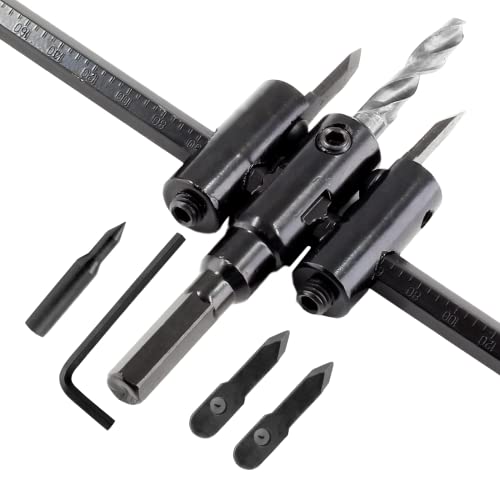
This LifCratms model covers a wide diameter range (30–200 mm) and uses carbide-tipped blades for durability. It’s designed for DIY enthusiasts and light pro use, capable of cutting through gypsum boards, plywood, plastic, and more. The tool promises stable operation and consistent cutting depth, making it a reliable option for multiple project types. Best for: Home improvement projects that require several hole sizes without swapping tools. Limitation: while versatile, it may require careful handling on very thick or dense materials.
Jonard Tools AHC-10 Professional Round Hole Saw Cutter

The Jonard AHC-10 is a professional-grade cutter offering adjustable sizes from 2.2″ to 10″ and a 1-1/16″ cutting depth. It includes a polycarbonate dust shield and rugged case, supporting convenient transport and durable performance on plywood, sheetrock, and plasterboard. Best for: Pros needing a large range and robust protection for field use. Better for: users prioritizing a high-quality carry case and dust shielding. Caution: ensure your drill matches the tool’s speed and torque for clean results.
AeKeatDa Adjustable Hole Saw Kit

The AeKeatDa kit presents a comprehensive approach with twin blades and a depth-adjustable design that supports 1-5/8″ to 8″ holes. It includes pilot bits, blades for wood and masonry, a tape measure, and a carpenter pencil, making it a versatile option for drywall, plywood, and cement board tasks. Best for: DIYers who want an all-in-one kit for varied drywall projects. Caution: bulkier setup means more storage space is needed than single-blade cutters.
HAUTMEC Adjustable Hole Saw Cutter Kit

The HAUTMEC kit delivers a large adjustable range of 40–300 mm with 1-1/8″ cutting depth, a PC dust shield, and multiple blade types for wood, drywall, and plastic. It’s designed for heavy-duty tasks and bulk projects where a single tool can cover many sizes. Best for: Professionals and ambitious DIYers tackling large openings. Limitation: the size range requires careful handling to prevent blade drift on the largest cuts.
Buying Guide: Key Considerations For Your Cutter Choice
- Cutting range: Choose a model that covers your typical hole sizes. If you frequently need 2–7 inches, a mid-range tool may be best; for larger openings, consider a cutter with up to 10 inches.
- Material compatibility: Look for carbide or high-strength blades for drywall, plywood, vinyl, and concrete-backed materials. Some kits include blades for wood and masonry.
- Depth and stability: Depth limits determine how deep you can cut and how much material remains around the edge. A spring-loaded or hex-locked mechanism can improve stability.
- Dust management: Dust shields, bowls, or vacuum ports help maintain a clean worksite and improve visibility during cuts.
- Portability vs. kits: Single-purpose hole cutters are compact, while multi-blade kits offer versatility but require more storage and setup time.
- Drill compatibility: Verify that your drill’s chuck size and speed are compatible with the cutter. Variable-speed drills are typically best for controlled cutting.
FAQ
- What is the main advantage of an adjustable hole cutter? It eliminates the need to switch blades for different hole sizes, saving time on prep and increasing accuracy across varied openings.
- Which cutter is best for drywall ceiling tiles? A model with a dust shield or integrated dust port helps manage debris and maintains a clean cut line on ceilings.
- Should I choose a kit or a single cutter? A kit provides broader material compatibility and more size options, while a single cutter is lighter and easier to store for small projects.
- Can I use these cutters with any drill? Most are designed to work with standard variable-speed drills, but verify the shank size and the maximum RPM compatibility for best results.
- What cutting depth matters most? Deeper cuts allow cleaner holes in thicker materials, but shallower cuts can reduce burrs and splintering on delicate surfaces.
- Are carbide blades worth it? Yes, carbide blades resist wear longer and stay sharper through repeated cuts in drywall, plywood, and other common build materials.