Choosing the right 96-tooth miter saw blade improves finish quality and reduces rework when cutting aluminum, non-ferrous metals, and plastics. This guide highlights five durable options, explains who each blade is best for, and notes practical limitations to consider before buying.
| Product | Brand | Teeth | Arbor | Best For |
|---|---|---|---|---|
| Diablo Saw Blade — 12″ Diameter, 96 TCG Teeth, 1″ Arbor | Diablo | 96 | 1″ | Aluminum, Copper, Plastics, Brass, Fiberglass; clean burr-free cuts |
| FOXBC 12 Inch Saw Blade 96-Tooth TCG | FOXBC | 96 | 1″ | Aluminum and non-ferrous metals; versatile for thin to medium cuts |
| TWIN-TOWN 12-Inch 96 Tooth TCG Blade | TWIN-TOWN | 96 | 1″ | Aluminum, Plastics, non-ferrous metals; long-lasting sharpness |
| CMT P12096 1″ Bore ITK Melamine & Ultra Finish Blade | CMT ORANGE TOOLS | 96 | 1″ | Hardwoods, MDF, Melamine, Plywood; crosscuts and finish work |
| CMT Orange Tools P12096N ITK Plus | CMT ORANGE TOOLS | 96 | 1″ | Aluminum, Brass, Copper, Laminates; versatile non-ferrous use |
Introduction: Best 96-tooth blades balance smooth finish with efficient cutting across aluminum and non-ferrous materials. The following picks emphasize clean cuts, durability, and low vibration for miter and table saw work. They’re suitable for professionals and serious hobbyists tackling metal and composite projects.
Diablo 12″ 96-Tooth TCG Blade

The Diablo blade uses a Triple Chip Grind (TCG) tooth design for burr-free finishes and precise cuts through aluminum, copper, plastics, brass, and fiberglass. The blade features Tri-Metal Shock-Resistant Brazing for durability in impact-heavy metal cutting. Best for: those seeking a clean, repeatable finish on metal and composite work. Caution: performance may vary on very thin plastics or laminates; ensure proper feed rate to avoid chatter.
FOXBC 96-Tooth TCG Aluminum Blade

This 12-inch blade is designed for aluminum, non-ferrous metals, and plastics, with a 1″ arbor and a thin kerf. Laser-cut stabilizer vents help reduce noise and vibration for improved accuracy. Best for: projects demanding precise, smooth edges in metal and plastic. Limitation: thin workpieces may require slower feeds to prevent deflection in deep cuts.
TWIN-TOWN 96-Tooth Aluminum Blade
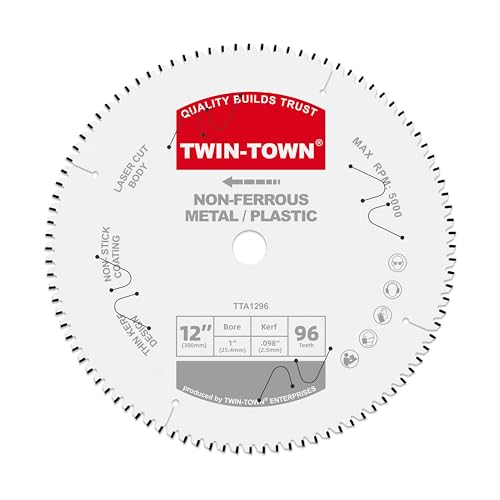
TWIN-TOWN offers a 12-inch blade with 96 teeth, optimized for aluminum and non-ferrous metals. It emphasizes long-lasting sharpness due to C4 ultra-fine grain carbide teeth and an electrophoretic coating to resist rust. Best for: users who want consistent cuts over many cycles in metal and plastic work. Caution: coating effects may differ on humid jobsites or with certain metal alloys.
CMT P12096 1″ Bore ITK Melamine Blade

The CMT P12096 ITK blade targets hardwoods, melamine, paneling, and plywood with a 96-tooth arrangement. It supports miter and slide miter saws and is designed for clean crosscuts with minimal finish work. Best for: projects that mix wood panels with laminated surfaces. Limitation: not optimized for heavy metal cuts; use on wood-based materials as intended.
CMT Orange Tools P12096N ITK Plus Blade

This ITK Plus blade is designed for non-ferrous metals and laminates, with a laser-cut steel plate and tri-metal brazing for durability. Best for: mixed-material work where non-ferrous metals and laminate surfaces are common. Caution: the blade’s non-wood focus means it’s not ideal for high-density hardwoods or thick plywood where wood-specific blades excel.
Buying Guide: Key Purchase Considerations
Why choose a 96-tooth blade? A higher tooth count yields finer finishes and smoother edges, especially in aluminum and non-ferrous metals. Consider material compatibility, arbor size, and kerf when selecting a blade.
What should I look for when buying?
- Material compatibility: Ensure the blade is designed for aluminum, non-ferrous metals, or plastics as needed.
- Arbor compatibility: Most blades in this list use a 1″ arbor; verify your saw accepts this size.
- Kerf and cut quality: A thin kerf (kerf around 0.094″ to 0.098″) reduces material waste and improves cut finish.
- Coatings and coatings durability: An electrophoretic coating helps resist rust in metal-cutting blades.
- Durability features: Look for reinforced brazing or shock-resistant designs for metal cutting.
Which blade is best for my project?
- Best for clean metal finishes: Diablo 96-Tooth TCG blade.
- Best for aluminum and non-ferrous metals with minimal chatter: FOXBC 96-Tooth TCG blade.
- Best for long-term sharpness and corrosion resistance: TWIN-TOWN 96-Tooth blade.
- Best for crosscutting wood panels and melamine: CMT P12096 ITK blade.
- Best for mixed non-wood materials like laminates and metals: CMT P12096N ITK Plus blade.
Frequently Asked Questions
- Q: Are 96-tooth blades only for metal? A: No, some 96-tooth blades are designed for non-ferrous metals and certain plastics, with crosscut-capable performance on wood under specific conditions.
- Q: Will a 96-tooth blade fit a 1″ arbor miters? A: Most listed blades use a 1″ arbor; confirm your saw’s arbor before purchase.
- Q: Do 96-tooth blades corrode easily? A: Some blades use coatings to resist rust, but environmental conditions still matter. Store dry and clean after use.
- Q: Is a higher tooth count always better? A: Higher tooth counts improve finish; they can cut slower and may require stronger feeds on hard metals.
- Q: Can I use these blades on wood? A: Some blades are optimized for metal and laminates; using them on wood can produce suboptimal finishes or faster wear.
- Q: How do I choose between TCG and ATB tooth designs? A: TCG excels at plastics and non-ferrous metals with burr-free cuts; ATB is versatile for wood and some metals depending on design.