If you’re cutting concrete, brick, block, or stone with a 9-inch blade, these options are designed for efficiency, life, and clean cuts. This guide highlights five well-rounded choices for common masonry tasks. Best for professional contractors, DIY homeowners, and tinkerers who need consistent performance across dry and wet cutting scenarios.
| Product | Brand | Notes |
|---|---|---|
| FEWELL 9 Inch Diamond Blade (1 Pack) | FEWELL | General purpose; dry/wet cutting; 7/8″ arbor |
| FEWELL 9 Inch Diamond Blade (3 Packs) | FEWELL | Three-pack value; same specs; dry/wet |
| Makita E-02515 9″ Diamond Blade | Makita | Longer life with taller segments; fast cutting |
| Diablo Diamond Segmented Turbo Masonry Cut-Off Blade (DMADST0900) | Diablo | Turbo design; up to 4x life; faster cuts |
| Evolution 9 Inch Diamond Blade with Segmented Edge | EVOLUTION | Segmented edge; versatile with hard masonry |
FEWELL 9 Inch Diamond Blade — 1 Pack

Best for: General-purpose clean cuts on concrete, brick, and block. This blade is engineered for both dry and wet cutting with a 7/8″ arbor compatibility, making it adaptable for most table saws and angle grinders.
Why selected: It offers segmented teeth for efficient cutting and an extended life relative to standard abrasive blades, suitable for frequent masonry work without specialized blades.
Caution: Performance can vary with softer bonds on very hard materials; ensure proper cooling when cutting dry to reduce heat buildup.
FEWELL 9 Inch Diamond Blade — 3 Packs

Best for: Bulk projects or job sites needing multiple blades with consistent performance. The three-pack ensures steady availability and uniform cutting behavior across blades.
Why selected: Identical specifications to the single-pack option, with the advantage of cost-per-blade savings and reduced downtime from blade swaps.
Caution: Store blades flat and dry; improper storage can affect blade integrity over time.
Makita E-02515 9″ Diamond Blade

Best for: Longer life with faster cutting on concrete, block, brick, pavers, and roof tiles. Makita’s taller 13mm segments aim to deliver improved life and speed over standard blades.
Why selected: The taller segment design supports extended service life and faster progress on heavy-duty cutting tasks, making it a strong choice for professional use.
Caution: Higher performance comes with a premium price; ensure compatibility with your tool’s arbor and RPM range.
Diablo Diamond Segmented Turbo Masonry Cut-Off Blade — 9″, DMADST0900
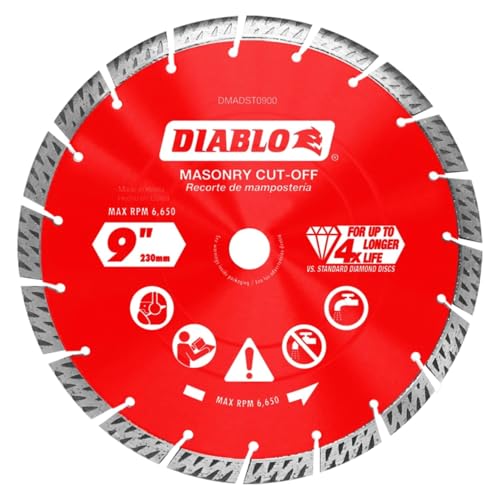
Best for: Faster cutting with reduced vibration in concrete and masonry, thanks to Diamond SPEED-Edge slot design. Durable enough for tougher materials.
Why selected: Diablo’s turbo design centers on speed and efficiency, offering up to substantially faster cuts and improved vibration control for demanding jobs.
Caution: The faster cutting can generate more heat; use water cooling or ensure adequate dust suppression during use.
Diablo Diamond Segmented Masonry Cut-Off Blade — 9″ DMADS0900

Best for: Concrete, brick, and block cutting with a robust 9″ diameter and 2.6mm kerf. Suitable for heavy-duty masonry tasks where consistent performance matters.
Why selected: Diablo’s cut-off blades provide reliable life in masonry tasks, balancing kerf thickness with a durable bond for steady performance.
Limitation: Data notes limited additional features; rely on proper technique and cooling for best results.
Evolution 9 Inch Diamond Blade with Segmented Edge

Best for: Compatibility with dedicated saws; excels on hard masonry, concrete, stone, and reinforced concrete. The segmented edge supports robust performance on tough materials.
Why selected: Evolution blades are designed to deliver heavy-duty performance with a segmented edge, making them versatile across multiple hard materials.
Caution: Ensure your saw is compatible with Evolution blades and monitor for heat buildup during extended cuts.
Buying Guide
What should you consider when choosing a 9 inch concrete blade?
- Material type: Concrete, brick, block, stone, or reinforced concrete? Some blades favor hard masonry, while others emphasize faster cuts or longer life on general-purpose materials.
- Cutting method: Dry vs. wet cutting affects heat, dust, and blade wear. Wet cutting helps control temp and dust but requires water supply and proper setup.
- Arbor size and compatibility: Most blades here use a 7/8″ arbor; confirm your tool’s arbor size and RPM rating before purchasing.
- Segment height and kerf: Higher segment height can extend life but may increase material removal; kerf thickness influences cut speed and heat. Balance for your project.
- Blade life vs. cost: Consider blade life projections relative to project scale. Multi-pack options offer cost efficiency for ongoing work.
- Heat management: Prolonged cutting can overheat blades. If cutting hot materials, use water cooling or pause to avoid warping.
FAQ
- What does the segment height mean for cutting performance?
– Higher segment height generally means longer life and better heat management, useful for heavy-duty or long cuts. - Is dry cutting acceptable for concrete with these blades?
– Yes, all listed blades support dry cutting, but wet cutting typically reduces dust and heat buildup. - Can I use these blades on angle grinders and table saws?
– Most are suitable for both, provided the tool accepts a 7/8″ arbor and matches RPM requirements. - Which blade lasts longer for masonry tasks?
– Blades with taller segments and premium bonds, like Makita and turbo designs, often offer longer life under heavy use. - Should I choose a blade with a multi-pack option?
– If you have frequent cuts, multi-pack blades reduce downtime and per-blade costs while maintaining consistent performance.