Answering the common buyer question: Which 4 inch cutting wheels offer the best balance of speed, durability, and safety for metalwork? This guide highlights five top options, clarifying who each wheel is best for and why. It’s ideal for DIY enthusiasts, metal fabricators, and professionals needing reliable, burr-free cuts. The table below summarizes core at-a-glance details to help you compare quickly.
| Product | Brand | Key Benefit |
|---|---|---|
| PRVEW 30-Pack 4 Inch Cut Off Wheels | PRVEW Store | High RPM, versatile 4×5/8 compatibility |
| SALI 50 Pack 4-1/2 Inch Cut Off Wheels | SALI Store | Thin profile for fast burr-free cuts |
| LotFancy 4 Inch Cut Off Wheels | LotFancy Store | Ultra-thin, durable, broad grinder compatibility |
| 4 Inch Indestructible Disc (5/8″) | Wakczshy Store | High-strength diamond/steel matrix for long life |
| PRVEW 50-Pack 4 Inch Cut Off Wheels | PRVEW Store | Widely compatible, durable, reliable |
PRVEW 30-Pack 4 Inch Cut Off Wheels
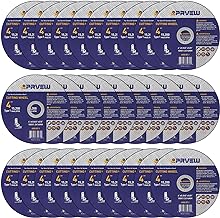
Features: Universal size fits all 4″ angle grinders with a 5/8″ arbor; thickness 0.045″ (1.2 mm); operating up to 15,200 RPM at 80 m/s. Reinforced by double fiberglass mesh to meet international safety standards including EN 12413. Made with premium aluminum oxide grain for aggressive cutting and long service life.
- Best for bulk projects where economy and availability matter, such as fabrication shops or busy hobbyists.
- Limitations: The 4″ wheel with 5/8″ arbor may require checking grinder compatibility for some models.
SALI 50 Pack Cut Off Wheels

Features: 4-1/2 inch diameter, 0.047 inch thickness, 7/8 inch arbor; operates up to 13,300 RPM and 80 m/s. Thin wheel design enables fast burr-free cutting. Proprietary aluminum oxide grain supports aggressive cutting action.
- Best for metal and stainless steel cutting where a larger wheel size is acceptable and burr-free performance is prioritized.
- Limitation: Slightly larger diameter than 4 inches; ensure grinder compatibility with 4-1/2″ wheels.
LotFancy Cut Off Wheels, 4 Inch

Features: 4 x 0.045 x 5/8 inches; maximum RPM 15,200; compatible with 5/8″ shank grinders like Bosch 1375A, Makita 9557PBX, and DEWALT DWE402. Ultra-thin design supports fast, burr-free cutting through metal. Fully reinforced with two fiberglass mesh layers for safety and durability.
- Best for workers needing a balance of thin kerf and broad compatibility with common 4″ grinders.
- Limitation: Design focuses on metal cutting; not ideal for non-ferrous materials with special requirements.
5pack 4 Inch Indestructible Disc

Features: 4 inch, 0.06 inch thick, inner hole 20 mm; designed for 4″ angle grinders and marble machines with included washer adapters. Claims high-temperature resistance, reduced vibration, and less dust during cutting. 2 mm diamond-like matrix provides improved cutting performance and longer life.
- Best for heavy-duty or continuous cutting tasks where high durability is required, such as ceramic tile and metal composites.
- Limitation: Data emphasizes durability; cutting speed may vary with material hardness and feed rate.
PRVEW 50-Pack 4 Inch Cut Off Wheels

Features: 4 x 3/8 inch; compatible with all 4″ angle grinders using 3/8″ arbor; thickness 1/16″ (1.6 mm); operates up to 15,200 RPM. Reinforced with double fiberglass mesh for safety and durability. Made with premium aluminum oxide grain for aggressive cutting action and long service life.
- Best for projects requiring a 3/8″ arbor compatibility and fast cutting across metal applications.
- Limitation: Slightly thinner kerf may wear faster on very hard metals; monitor wear and replace as needed.
Buying Guide
What grinder size and arbor do I need?
Most 4 inch cutting wheels fit grinders with 5/8 inch or 3/8 inch arbors. Confirm your grinder’s arbor size and ensure the wheel thickness matches the tool’s compatibility. Thin kerf wheels cut faster but can wear sooner on hard materials.
How thick should the wheel be?
Thicker wheels (around 0.045 to 0.047 inches) offer durability for frequent cuts and harder metals. Ultra-thin (0.045″ or 0.047″) wheels reduce burrs and save material, but may require more frequent replacements in tough cutting tasks.
What material is the wheel best for?
Aluminum oxide wheels are common for steel and iron. Diamond-enhanced options excel on ceramic tile or very hard composites. Match wheel composition to your primary materials to maximize efficiency and wheel life.
Safety and compatibility considerations
- Ensure wheels are EN 12413 or equivalent certified for safety, especially in professional environments.
- Use proper PPE: eye protection, gloves, and a face shield when cutting metal and masonry.
- Check for wheel cracks, chips, or glazing before each use; old or damaged wheels should be replaced immediately.
Bulk vs. specialty wheels
Bulk packs are cost-effective for frequent users and shops with high cutting throughput. Specialty wheels with diamond matrices or thicker profiles suit challenging materials or long-term durability needs. Always balance cost, availability, and wheel performance for your workflow.
Frequently Asked Questions
- What is the typical arbor size for 4 inch wheels? Most common arbors are 5/8 inch or 3/8 inch; check your grinder’s arbor and use the matching wheel diameter and arbor.
- Are these wheels suitable for stainless steel? Some wheels are designed for stainless steel; verify the product notes and choose a wheel with durable aluminum oxide grain specifically rated for stainless or hard metals.
- Can I use a 4 inch wheel on a larger grinder? Generally yes if the grinder supports a 4 inch wheel with the correct arbor, but verify guard clearance and safety guidelines for your model.
- How do I extend wheel life? Use proper feed rate, avoid twisting or bending the wheel, and replace worn or glazed wheels promptly to maintain cut quality.
- Is a thinner wheel safer? Thinner wheels reduce burrs and cut faster but may be more prone to breakage under heavy loads; use appropriate technique and tool speed.
- What should I consider for tile or stone cutting? Diamond or diamond-impregnated wheels are typically better for tile or stone; verify product suitability before cutting non-metal materials.