If you’re upgrading a drill press or replacing a motor, a 3/4 HP motor is a versatile choice for metalworking, woodworking, and light industrial tasks. This guide highlights five compatible Amazon options, explaining who each is best for, common limitations, and practical buying considerations. Whether you need dual rotation CW/CCW, a 56C or 56 frame, or a TEFC enclosure, you’ll find clear comparisons to help you decide.
Summary of selected products:
| Product | Frame | Rotation | Voltage | |
|---|---|---|---|---|
| VEVOR 3/4HP Electric Motor (56 Frame) | 56 | CW/CCW | 115V/230V | |
| VEVOR 3/4HP Electric Motor (56C Frame) | 56C | CW/CCW | 115V/230V | |
| 3/4HP General Electric Motor (56C, TEFC) | 56C | CW/CCW | 115V/230V | |
| Motor, 3/4 HP, Split Phase (115V) | N/A | Single direction | 115V | |
| BUCKTOOL 12-Inch Drill Press (3/4 HP motor option) | — | — | — |
VEVOR 3/4HP Electric Motor 56 Frame, 1725 RPM

This 0.75HP single-phase motor uses a 56-frame footprint and a reversible CW/CCW rotation. It operates on 115V or 230V at 60Hz and delivers 1725 RPM for general equipment tasks. Best for shop owners replacing a standard 56-frame motor in metalworking and agricultural setups. Caution: ensure wiring matches the dual-voltage capability and confirm shaft dimensions (5/8″ keyed shaft) fit your spindle assembly.
VEVOR 3/4HP Electric Motor 56C, 1725 RPM

This 0.75HP motor is designed for 56C-frame equipment, with a similar dual-voltage scheme and 1725 RPM speed. It’s a solid substitute in HVAC, standard agricultural machinery, and common workshop tools where 56C mounting is standard. Best for users upgrading to a reliable 56C motor while retaining CW/CCW flexibility. Limitation: check shaft length (1.88″) and keyway (0.188″) to ensure compatibility with your couplings.
3/4HP General Electric Motor (56C, TEFC)

With a TEFC enclosure, this 0.75HP motor is suited for environments where splash resistance is valued, and it supports 1725 RPM on 115V/230V. Best for general purpose use in metal and woodworking equipment requiring a durable, enclosed design. The motor supports CW/CCW rotation and is compatible with standard 56C mounting. Consider the Amp draw (11.0A / 5.5A) to ensure adequate circuit capacity and wire gauge.
Motor, 3/4 HP, Split Phase, 1725 RPM

This split-phase motor is a budget-friendly option, rated at 115V. It delivers typical 1725 RPM for light-to-moderate drilling and milling tasks. Best for cost-conscious projects or legacy machines. Limitation: data indicates a “Made in Mexico” origin; verify availability of compatible mounts and shaft alignment for a reliable replacement in diverse drill presses.
BUCKTOOL 12-Inch Benchtop Drill Press (3/4 HP Motor)
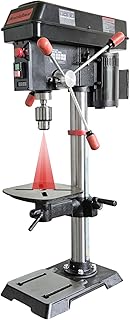
This benchtop drill press uses a 3/4 HP motor system with a 6-pole design, delivering strong low-end torque for metal drilling and dense woods. Best for small shops needing a compact, powerful drill press with wide speed control (360–2000 RPM) and stability from a reinforced column. Caution: for heavier metal workloads, ensure the motor’s mounting and belt drive can handle sustained loads without overheating.
Buying Guide: Key Considerations For 3/4 HP Drill Press Motors
- Frame and enclosure: Choose 56 or 56C frames for common drill press mounts. TEFC enclosures protect against dust and moisture, suitable for shop environments.
- Voltage and wiring: Look for dual-voltage (115V/230V) options to fit different outlets and regional buildings. Verify the motor’s full-load current to match circuit capacity.
- Rotation direction: Reversible CW/CCW rotation simplifies wiring and enables broader compatibility with various spindle configurations.
- Shaft specifications: Confirm shaft diameter (commonly 5/8 inch) and keyway size (0.188 inches) to ensure compatibility with your spindle and pulleys.
- RPM and speed range: 1725 RPM is typical for 60Hz systems; assess whether you need low-speed torque (for metal) or higher speeds for wood and plastics.
- Mounting frame compatibility: 56 vs 56C frames affect mounting dimensions and hardware. Check your drill press’s original motor measurements before replacement.
- Durability and environment: TEFC helps in dusty shops; air-cooled motors are standard for fixed installations.
FAQ
- What does 56C vs 56 frame mean? – They indicate mounting and shaft standards. 56C is a common, slightly larger frame than 56, affecting how you mount and align the motor.
- Is CW/CCW rotation important? – Yes, it provides wiring flexibility and compatibility with different spindle configurations.
- Can these motors be used on non-drill-press equipment? – Many are general-purpose motors suitable for various single-phase machines, provided frame size and shaft specs match.
- What safety considerations exist? – Ensure proper mounting, wiring, and belt tension. Use appropriate guards and ensure power is off during installation.
- Do these motors require special maintenance? – Routine checks for loose bolts, belt wear, and bearing noise help prolong life in workshop use.