Answering the need for faster, cleaner rip cuts, this guide highlights five top 10-inch rip saw blades suited for different woodworking tasks. These blades excel at heavy ripping, glue-line precision, or general purpose cuts. Ideal buyers include professionals needing durability, hobbyists seeking smooth finishes, and remodelers aiming for robust performance. Below, each product is evaluated for its best use case, with clear reasons and practical cautions. A quick buying table at the start helps you compare core specs at a glance.
| Product | Best For | Key Benefit |
|---|---|---|
| Freud LM72M010: 10″ Heavy-Duty Rip Blade | Heavy ripping on hardwoods | Flat tooth design for smooth finish |
| Diablo D1024X | Fast, clean cuts in plywood and OSB | Hi-Density TiCo, thin kerf |
| Freud LM75R010: 10″ Industrial Thin Kerf Glue Line Ripping Blade | Glue-line quality edges | Thin kerf for reduced waste |
| FOXBC 10-Inch Flat Tooth Ripping Blade | Lightweight, quiet ripping | Flat tooth for smooth finish |
| DEWALT DWA11024 | General purpose ripping with longevity | Ultra sharp carbide and long life |
Notes: All blades listed are 10 inches in diameter and designed for 5/8-inch arbors, which covers most consumer and contractor table saws. Kerf and tooth counts vary; select based on your material type and desired finish. The blades below are selected for broad appeal, performance consistency, and clear, purchase-ready specs.
Freud LM72M010: 10″ Heavy-Duty Rip Blade

Specs: Arbor 5/8″, Diameter 10″, Grind FLAT, Hook Angle 20°, Kerf .126″, Plate .087″, Teeth 24. Premium TiCo HI-Density Carbide Ripping Blend for Maximum Performance. Extra Large, Flat Tooth Design leaves a smooth finish without sanding or jointing.
Best for: Professional and hobbyist rippers tackling hardwoods or dense softwoods where a durable blade and consistent rip cuts matter.
Why selected: This blade’s flat-tooth design and TiCo carbide blend provide robust wear resistance, minimizing chatter and heat. The large tooth count balances aggressive removal with a smoother edge.
Caution: Heavier tooth load can create more resistance on softwood when feed rates are too high; reduce speed or feed as needed to avoid burn marks.
Diablo D1024X: Ripping Blade 10″ 24T

Features: High performance TiCo with Hi-Density carbide designed for wood, plywood, and OSB. Perma-SHIELD Non-Stick Coating resists heat, gumming, and corrosion. Ultra-thin kerf promotes fast, clean cuts for remodeling and demolition tasks.
Best for: Remodelers and builders needing quick, straight groove-ripping through panels with reduced waste.
Why selected: The combination of a thin kerf and non-stick coating helps maintain blade life and minimizes friction during long ripping sessions.
Limitation: Softwood cuts may show slightly more tear-out if feed rate is not well controlled; moderate feed is recommended for edge cleanliness.
Freud LM75R010: 10″ Industrial Thin Kerf Glue Line Ripping Blade
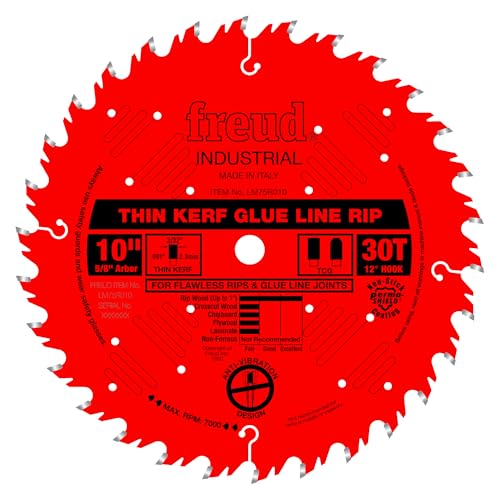
Specs: Arbor 5/8″, Diameter 10″, Grind TCG, Hook Angle 12°, Kerf .091″, Plate .071″, Teeth 30. Heavy-Duty Thick Kerf and Plate deliver stable, flat blades for long cutting life.
Best for: Pros needing glue-line ready edges and long, stable cuts in demanding materials.
Why selected: The thicker kerf and reinforced plate minimize blade deflection, supporting precise glue-ready edges after ripping.
Caution: Higher material removal per pass requires steady feed; avoid overfeeding to prevent blade deflection on very dense woods.
FOXBC 10-Inch Flat Tooth Ripping Blade

Features: 10 Inch Thin Kerf Rip Saw Blade, 24-Tooth, Flat Tooth, Kerf .094″, Plate .071″, Hook Angle 20°, 5/8″ Arbor. Made from high-density tungsten carbide for toughness and wear-resistance.
Best for: Cutters seeking fast, smooth cuts with reduced vibration and noise in general woodworking.
Why selected: Flat-tooth geometry provides a smoother finish, making it a good choice for finishing passes after initial ripping.
Caution: Thin kerf blades can bend more easily if used in warp-prone or poorly aligned blades; ensure the saw is well-tuned and the workpiece supported.
CMT Orange Tools 250.024.10: Ripping Blade

Materials: Hardwoods, OSB, Plywood, Pressure Treated, Softwoods. Machines: Portable or Stationary Table Saw. Applications: Rip cuts.
Best for: Versatile woodworkers who work with multiple material types and need a blade built for various ripping tasks.
Why selected: Broad compatibility with common saw configurations and a focus on reliable ripping across different woods.
Caution: Check compatibility with your saw’s arbor size and ensure the blade is securely mounted to prevent runout.
Freud LU87R010: 10″ Thin Kerf Rip Blade

Specs: Arbor 5/8″, Diameter 10″, Grind FLAT, Hook Angle 20°, Kerf .094″, Plate .071″, Teeth 24. Premium TiCo HI-Density Carbide Ripping Blend for Maximum Performance. Thin Kerf enables faster feed and less waste.
Best for: Woodworkers prioritizing material efficiency and reduced waste in ripping sessions.
Why selected: Thin kerf plus a durable carbide blend supports quicker cuts with good edge quality across softwoods and hardwoods.
Caution: Thin kerf blades demand precise setup; ensure saw alignment and balanced feed to prevent chatter on dense boards.
DEWALT 10″ 24-Tooth General Purpose Blade

Features: Up to 3x life, Optimized Tooth Geometry for accuracy, Ultra Sharp Carbide for clean cutting.
Best for: General purpose ripping with a focus on longevity and clean cuts in common framing woods.
Why selected: Balanced design aims to deliver reliable performance across a range of wood types while maintaining edge retention.
Caution: As a general-purpose blade, it may not match specialized blades in extreme glue-line or plywood-specific tasks; evaluate based on project needs.
Buying Guide
Material and blade design: For dense hardwoods, choose blades with TiCo carbide blends and flatter tooth geometry for stability and finish. For plywood or OSB, a Hi-Density carbide and thin kerf can reduce chip-out and waste.
Kerf and stability: Thin kerfs cut faster but require precise alignment and husbanded feed rates to avoid tear-out. Thicker kerfs offer durability in demanding cuts but remove more material.
Tooth count: Higher tooth counts (e.g., 30 teeth) provide smoother finishes and are better for glue-line work, while lower counts (e.g., 24 teeth) remove material faster for rough ripping.
Coatings: Non-stick coatings reduce gumming on resin-rich woods and help with heat. However, coatings are not a substitute for proper feed control and blade maintenance.
Compatibility: Always verify arbor size (5/8″) and plate stiffness with your saw. Some saws require higher rigidity blades for straight cuts and reduced vibration.
Maintenance: Regular cleaning, deburring, and occasional kerf checks help sustain blade performance over time. Replace blades with worn edges or noticeable chipping.
FAQ
- What blade is best for hardwood ripping? FREUD LM72M010 or LM75R010 for durability and clean results.
- How important is kerf width? Thinner kerfs reduce waste and can speed cuts, but require careful setup to prevent wandering.
- Can I use a general-purpose blade for plywood ripping? Yes, but specialized plywood-oriented blades often yield cleaner edges and less tear-out.
- What should I consider when selecting tooth count? More teeth provide smoother edges; fewer teeth cut faster but rougher edges.
- Is a coating necessary? Non-stick coatings help with heat management; ensure proper feed rate and blade tension for best results.
- How do I avoid burn marks? Use proper feed rate, adequate blade speed, and ensure the blade is sharp and clean.