Best T Nails for Nail Gun: Top 5 Concrete T-Nailer Choices for 2025
Choosing the right 14-gauge T nails and a reliable T-nailer can make concrete, wood-to-concrete projects, and siding installations faster and more secure. This guide highlights five standout options that pair well with common 14-gauge T nails and deliver solid performance on plywood, decking, furring strips, and siding tasks. Each entry includes practical features, safety considerations, and typical use cases to help you compare at a glance.
Summary of selected products:
| Product | Nail Size Range | Key Use | Special Feature |
|---|---|---|---|
| Freeman PCTN64 Pneumatic T Nailer | 5/8″ – 2-1/2″ | Decking, subflooring, furring | Heavy-duty steel drive blade |
| meite ST64E Concrete Nail Gun | 3/4″ – 2-1/2″ | Furring strips, siding, soffits | See-through nail magazine, dual safety |
| WOODPECKER ST64 Pneumatic Nailer | 3/4″ – 2-1/2″ | Furring, masonry interfaces | Thick safety frame, quick reload |
| Spot Nails X1T8664 T-Nailer | 5/8″ – 2-1/2″ | General T-nailing | Supports Spot Nails T08611H |
| Air Locker CN64A3 T Nailer | 5/8″ – 2-1/2″ | Plywood, decking, fencing | Dual-fire mode; high-capacity magazine |
Freeman PCTN64 Pneumatic T Nailer
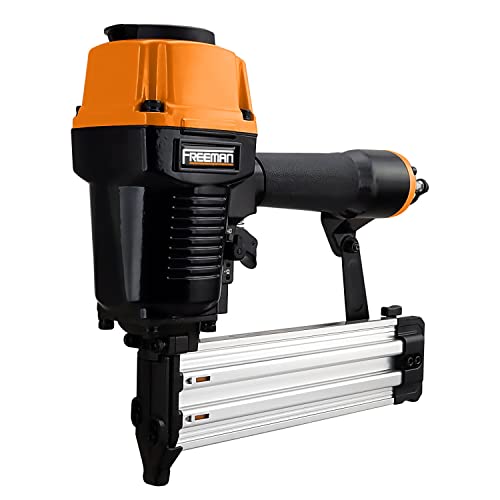
The Freeman PCTN64 is a rugged 14-gauge T-nailer designed for wood-to-concrete and steel projects. It accepts 5/8″ to 2-1/2″ glue-collated nails, making it suitable for decking, fencing, subflooring, and siding applications, including Hardie fiber cement. A one-piece hardened steel drive blade and anodized magazine and cylinder contribute to long-term durability, while the tool’s construction guards against damage in demanding jobsite environments.
meite ST64E Concrete Nail Gun

The meite ST64E is a high-visibility pneumatic T-nailer kit that ships with 400 nails and accommodates 3/4″ to 2-1/2″ nails. It is designed for efficient driving into concrete, steel, or wood at 85-120 PSI and includes a safety lock to prevent accidental ignition. A see-through magazine window and a 360° exhaust help streamline operation, while a 100-nail capacity promotes longer work intervals between reloads.
WOODPECKER ST64 Pneumatic Concrete T Nailer

The WOODPECKER ST64 delivers heavy-duty performance with a die-cast aluminum housing that keeps the tool lightweight yet robust. It features a thickened safety frame to prevent misfires and a user-friendly magazine that supports rapid reloads, capable of holding up to 100 nails. This makes it well-suited for continuous work on furring strips, masonry interfaces, and concrete-related fastening tasks.
Spot Nails X1T8664 T-Nailer

The Spot Nails X1T8664 supports nails from 5/8″ to 2-1/2″ and is specifically noted for compatibility with Spot Nails T08611H. It provides a straightforward option for standard T-nailing tasks across various substrates, including wood and concrete transitions. For users already aligned with the Spot Nails ecosystem, this model offers predictable performance and easy maintenance.
Air Locker CN64A3 5/8″ To 2-1/2″ T Nailer

The Air Locker CN64A3 emphasizes versatility with a high-capacity side-load magazine and a dual-fire mode (sequential or contact). Its aluminum housing combines durability with lighter weight and balance, while a UNI-LOK crimped driver enhances reliability during extended use. This model is well-suited for decking, fencing, subflooring, and siding installations where pace matters.
Buying Guide: Key Considerations For T Nailer Purchases
- Compatibility: Ensure nails match the nailer’s gauge and length range (14 GA, 5/8″ to 2-1/2″ is common). Consider whether you need 3/4″ nails for thicker assemblies.
- Power Source and Comfort: Pneumatic tools require an air compressor; cordless options provide mobility but may have limited nails per charge. Look for ergonomic handles, soft grips, and balanced weight for longer projects.
- Safety Features: A solid safety mechanism, such as a contact safety or trigger lock, helps prevent misfires. A muzzle-contact safety is especially useful when working near edges or in tight spaces.
- Magazine Capacity and Visibility: A larger capacity reduces reload frequency. A see-through window helps track remaining nails and plan pauses accurately.
- Build Quality: Durable materials (die-cast aluminum, hardened steel) extend tool life in concrete, masonry, or wood-to-concrete tasks. Corrosion resistance matters in outdoor or damp environments.
- Project Fit: For decking, fencing, and siding, choose tools with reliable driving power and good balance. For detailed trim or masonry work, a tool with precise firing modes can improve control.
- Availability Of Nails: Verify that the nails you plan to use are readily available in the US market, and consider a few different sizes to cover a range of tasks.
- Maintenance: Look for tools with easy disassembly for cleaning, straightforward safety checks, and spare parts availability.
Overall, the best choice depends on your typical job—whether you prioritize speed and capacity, or compact form and safety features. If you frequently work with concrete or masonry transitions, a nailer with robust safety controls and an easy reload system can reduce interruptions. For mobile work sites, cordless options add flexibility, while gas or compressor-powered models often deliver steady driving power for demanding tasks.