Best Solar and Gas Generators for Home, Off-Grid, and Emergencies
When choosing a generator setup, many seek a balance between clean solar power and reliable gas backing. This guide highlights five top options that pair portability with power, suitable for camping, emergencies, and home backups. Each selection emphasizes easy switching between solar or fuel, efficiency, and user-friendly features. Read on to compare performance, runtime, and startup convenience to find the best match for your needs.
Summary of Selected Products
- Jackery Solar Generator 1000 v2 with 200W Solar Panel
- WEN 4,750-Watt Dual Fuel Portable Generator (DF475T)
- EF ECOFLOW Delta 2 Portable Power Station
- Westinghouse 12500 Watt Dual Fuel Home Backup Portable Generator
- Oxseryn 4400-Watts Inverter Generator
Jackery Solar Generator 1000 V2 With 200W Panel

The Jackery Solar Generator 1000 V2 combines a 1,500W continuous AC output with a 3,000W surge capacity, powering refrigerators, air conditioners, and kitchen appliances during outdoor trips or emergencies. Its 1,070Wh LiFePO4 battery delivers durability and longevity, with a lightweight 23.8 lb frame and a foldable carry handle for portability. One-hour fast charging accelerates recharging via the Jackery app, while ChargeShield 2.0 enhances safety and speed. The system is engineered for long lifespan, promising sustained performance beyond a decade with proper care.
WEN 4,750-Watt Dual Fuel Portable Generator

WEN’s DF475T provides flexible power with a 4,750-watt peak on gasoline (3,800 running watts) and 4,350 peak watts (3,500 running watts) on propane. The dual-fuel design accommodates 120V and 240V outputs, making it suitable for transfer switches and diverse loads during outages. An electric start via a 224cc OHV engine offers convenient operation. The unit supports a broad range of backup tasks, from home appliances to essential tools, with a straightforward fuel selection dial for quick transitions between fuel sources.
EF ECOFLOW Delta 2 Portable Power Station

The Delta 2 acts as a flexible power hub with 1,024Wh of LiFePO4 capacity and up to 1,800W AC output. It supports rapid recharging, achieving 0-80% in about 50 minutes and 0-100% in roughly 80 minutes via AC input. Expandable capacity from 1 kWh up to 3 kWh makes it adaptable for longer outages, camping, or RV use. With many outlets, it can power a wide range of devices—from laptops to home essentials—without noise or emissions typically associated with gas generators.
Westinghouse 12500 Watt Dual Fuel Home Backup Portable Generator

This Westinghouse model delivers serious power with 12,500 peak watts on gasoline and 11,200 peak watts on propane. It supports 9,500 running watts gasoline and 10,500 running watts propane, with a 6.6-gallon tank and a fuel gauge for extended operation. Features include remote key fob start, several outlets including transfer switch readiness, and a robust 457cc OHV engine with a cast iron sleeve. It’s designed for whole-home backup or severe outage scenarios, providing substantial simultaneous power for multiple circuits.
Oxseryn 4400-Watts Inverter Generator
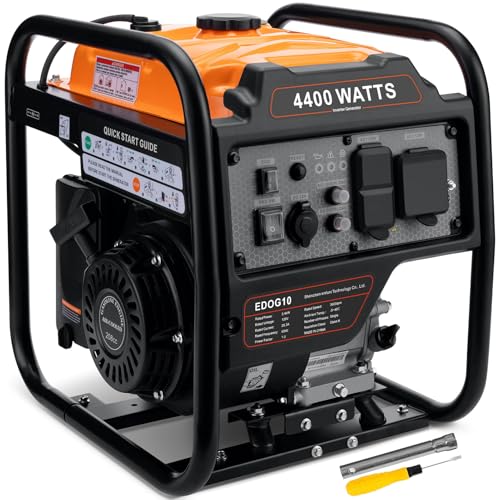
The Oxseryn inverter offers 4,400 peak watts and 3,400 running watts with multiple output ports, including a 30A RV port and 12V DC for accessories. A 2-gallon fuel tank supports extended runtime, and the unit uses inverter technology with ECO mode to optimize efficiency and fuel use. It’s designed for RVs, homes during outages, and outdoor activities where quiet operation and clean power are priorities.
Buying Guide
- Power needs: Match continuous watts and surge capacity to your essential loads. For heavy appliances, a unit with 4,000+ running watts is preferable.
- Fuel flexibility: Dual-fuel options (gasoline/propane) offer resilience during fuel shortages and longer outages.
- Solar compatibility: If prioritizing clean energy, consider solar-ready or solar-powered generators, plus expandable battery capacity for longer run times.
- Portability vs. capacity: Higher-capacity power stations are heavier; balance weight with the runtime and use-case (camping, home backup, RV).
- Charging speeds: Fast charging and multiple input/output options reduce downtime and enable rapid recharging after use or extended outages.
- Safety and durability: Look for inverter technology, low-oil shutdown, automatic shutdown features, and robust enclosures for outdoor use.
- Maintenance and lifecycle: Battery chemistry (LiFePO4 vs. standard lead-acid) affects longevity and cycle life; plan for long-term reliability.
- Noise and emissions: Inverter units generally run quieter and cleaner than traditional open-frame generators, important for home and campsite comfort.