Best Smallest Gas Powered Generators for Home and Outdoor Use
This guide highlights compact, gas-powered generators that deliver reliable power for home backup, camping, and outdoor recreation. Each option balances portability with sufficient wattage, ease of use, and essential safety features. Below, you’ll find concise product snapshots and practical factors to consider when selecting the right small generator for your needs.
| Product | Peak Watts | Running Watts | Fuel Tank | Weight | Key Benefit |
|---|---|---|---|---|---|
| Aceup Energy 1,200W | 1200 | 900 | 1.1 gal | 35.3 lb | Ultralight, EPA & CARB compliant |
| Pulsar PG1202SA | 1200 | 900 | 1.1 gal | Not listed | Carrying handle, compact |
| POXURIO 2450W Inverter | 2450 | 2450 | 1.6 gal | Not listed | Inverter, quiet |
| Aceup Energy 1200W | 1200 | 900 | 1.1 gal | Not listed | Low failure rate, EPA compliant |
| Oxseryn Portable 2500W | 2500 | 1800 | 1.1 gal | Not listed | Eco mode, multiple outputs |
Aceup Energy 1,200W Gas Powered Generator

The Aceup Energy 1,200W model provides 1,200 peak watts and 900 running watts, suitable for essential home loads or outdoor activities. It operates at 60Hz with a 120V household outlet and includes an American-style duplex socket. Safety features include AC and DC overload protections and an indicator light. Power is supplied by a 71cc Aceup single-cylinder, 2-cycle engine with air cooling and a recoil start. Weight is listed at 35.3 pounds, making it fairly portable for a compact gas generator.
Pulsar 1,200W Carrying Handle Generator
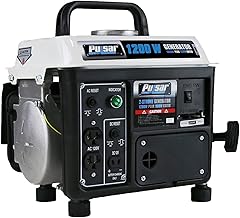
The Pulsar PG1202SA offers 1,200 peak watts and 900 running watts with a simple recoil start. Its single-cylinder, 2-stroke engine and compact, durable design make it suitable for camping and light outdoor use. The 1.1-gallon fuel tank provides up to approximately five hours of operation at half load, depending on conditions. The unit emphasizes portability, aided by a carrying handle for easy transport.
POXURIO 2450-Watt Inverter Generator

The POXURIO inverter generator delivers 2,450 peak watts and 1,800 running watts with a 1.6-gallon tank. It uses clean sine-wave power suitable for sensitive electronics and operates at a low noise level of 59 decibels. The compact design emphasizes quiet operation, making it well-suited for camping and home backup. It’s gasoline-powered, with gasoline being a convenient and common fuel choice for portability.
Aceup Energy 1200W Gas Generator

The Aceup Energy 1200W generator is a lightweight option designed for home use. It provides 900 running watts and 1,200 peak watts, with a recoil start and an AC 120V household outlet. It includes a 12V DC power supply and dual overload protections, with a 1.1-gallon fuel tank enabling several hours of operation. The model emphasizes portability and EPA compliance, appealing to users needing a compact, reliable power source for incidental loads.
Oxseryn Portable Inverter Generator 2500W

The Oxseryn 2500W inverter generator provides 2,500 peak watts and 1,800 running watts, powered by a 79.8cc four-stroke OHV engine. A 1.1-gallon fuel tank with a fuel indicator supports up to about 9.5 hours at 25% load. It features ECO mode, a parallel function, and multiple outputs: two 120V AC ports, one 12V DC port, plus a USB and Type-C port. It’s designed for quiet operation with clean power for sensitive electronics and offers versatile charging and backup capabilities.
Buying Guide: Key Purchase Considerations
When selecting a small gas-powered generator, consider wattage needs, portability, and fuel efficiency. Assess peak versus running watts to ensure your essential appliances won’t trip breakers during operation. Inverter technology can provide cleaner power with reduced THD, protecting sensitive devices like laptops and phones. Look for safety features such as overload protection and CO sensors for indoor use. Fuel capacity and runtime determine how long you can rely on backup power without refueling. Finally, verify emissions certifications (EPA/CARB) if you intend to use the generator in areas with strict environmental standards.
Additional perspectives include noise tolerance, maintenance requirements, and availability of spare parts or service centers. For campers and outdoor enthusiasts, a unit with a carrying handle and compact footprint enhances portability. For home backup, prioritize higher running watts and longer runtime, even if it means sacrificing some portability. Parallel operation capability can double output for heavier loads, but requires a compatible second unit. Consider your typical use case to balance power, durability, and convenience.