Best Smallest Three-Phase Generators for Education and DIY
Smallest three-phase generators are ideal for classrooms, maker spaces, and hobby projects where compact size meets practical demonstrations of AC generation. The following selections highlight compact, entry-level, brushless three-phase generators suitable for teaching, experiments, and small wind or wind-turbine projects. This guide compares core specs and practical applications to help educators and hobbyists choose the right model.
| Product | Brand | Voltage Range | Use |
|---|---|---|---|
| CrocSee Micro 3 Phase AC Mini Hand Brushless Motor Generator | CrocSee | 3V-24V | Education, experiments, starter projects |
| ECSiNG 2PCS 3-24V 3 Phase Micro Hand Brushless Motor Mini Generator | ECSiNG | 3-24V | Toys, models, DIY experiments |
| Acxico 1Pcs 3 Phase AC Micro Mini Wind Hand Brushless Generator | Acxico | 3-24V | Wind/educational demonstrations |
| Mini Wind Turbine Alternator 12V, 3-Phase | Bebykilemi | 3-24V | Teaching, classroom demonstrations |
| Small 3 Phase Wind Turbine Generator, Handheld | Pumixiy | 3-24V | Educational models, STEM learning |
CrocSee Micro 3 Phase Generator For Learning
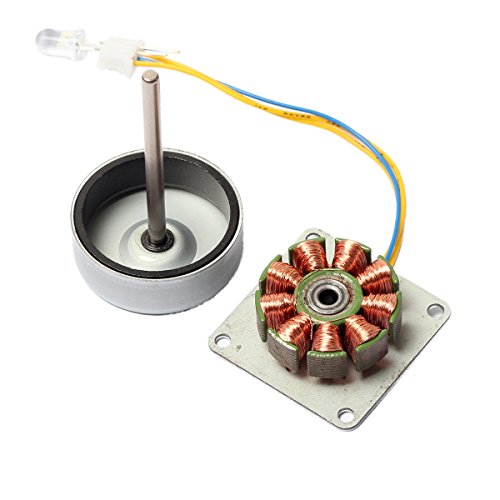
The CrocSee Micro 3 Phase AC Mini Hand Brushless Motor Generator is designed as a compact teaching aid that demonstrates how three-phase generators operate. It is suited for classroom demonstrations and individual experiments in power generation. Output voltage ranges from 3V to 24V with an output current of 0.1A to 1A, providing a safe and manageable power level for educational setups. The brushless design minimizes maintenance while delivering smooth AC output suitable for light loads and instructional activities. This model serves as a practical starting point for larger DIY projects and lab demonstrations, helping students visualize phase relationships and electrical generation concepts.
ECSiNG 2Pcs 3-24V Mini Generator Pack

The ECSiNG dual-pack provides two compact three-phase, brushless generators with a broad operating range of 3-24V. Designed for toys, models, experiments, and educational demonstrations, these units emphasize smooth three-phase output and low maintenance thanks to brushless technology. The versatile voltage range makes them suitable for a variety of small-scale projects, including classroom demonstrations and DIY energy experiments. This pair is ideal for group activities or comparative testing of different load conditions and RPM influences on output.
Acxico 3 Phase Micro Wind Generator

The Acxico 3 Phase AC Micro Mini Wind Hand Brushless Generator is a compact, wind-powered device designed for teaching and DIY projects. It supports an AC voltage range of 3-24V with typical output in the 0.1-1A range, suitable for small demonstrations or micro-wind energy experiments. Its motor and rotor assembly emphasize straightforward hand-crank or wind-driven operation, enabling students to observe three-phase generation in action. The unit’s small footprint makes it convenient for science labs and classroom setups that require portable demonstration equipment.
Bebykilemi Mini Wind Turbine Generator

The Bebykilemi Mini Wind Turbine Alternator is a 12V, three-phase generator designed for teaching and small-scale demonstrations. Its three-phase output provides realistic energy conversion behavior at educational scales, with a design focused on durability for classroom use. The kit-oriented construction supports assembly and experimentation, helping students understand wind-to-electric energy conversion, efficiency at low wind speeds, and the benefits of three-phase generation in compact systems. This model is well-suited for STEM labs seeking hands-on wind energy demonstrations.
Pumixiy 3 Phase Handheld Wind Generator
The Pumixiy small three-phase wind turbine generator is presented as a handheld educational tool, delivering immediate AC output in the 3V-24V range. Its three-phase AC alternator design supports classroom demonstrations of energy conversion and dynamic response to wind or mechanical input. Constructed for repeated classroom use, this model emphasizes compactness and ease of setup, making it a viable option for schools and hobbyist labs focusing on STEM learning and electricity fundamentals.
Buying Guide
- Voltage range and current: Look for units rated 3-24V with modest current output (roughly 0.1-1A). This range balances safety with meaningful electrical output for demonstrations and experiments.
- Three-phase brushless design: Brushless generators reduce maintenance and deliver smoother output, which is important for stable demonstrations and long-term classroom use.
- Size and portability: Prioritize compact, lightweight models for easy transport between classrooms, labs, or maker spaces. A smaller footprint also minimizes handling risk in school environments.
- Durability and materials: Durable housings and robust rotors support frequent use in educational settings. Look for devices with metal or reinforced plastic components designed for repeated assembly and disassembly.
- Safety and ease of use: Choose devices with simple wiring and low-voltage outputs suitable for students. Clear manuals and included adapters help minimize setup time.
- Educational value: Consider units that demonstrate both open-circuit and loaded output behavior, allowing students to observe voltage drop, current draw, and power generation under varying RPM or wind input.
- Compatibility and expansion: If planning to scale experiments, choose models that can be integrated with microcontrollers, load resistors, or small energy storage options to illustrate real-world energy systems.
- Price-to-performance: While prices vary, select generators that provide clear instructional benefits—consistent three-phase output, reliable performance, and straightforward installation relative to cost.
When selecting a smallest three-phase generator for education or DIY projects, prioritize units with broad voltage support, brushless construction, and a compact form factor. The options above offer a mix of single and multi-pack configurations to accommodate individual learners or group activities, with different emphasis on wind-driven demonstrations, classroom portability, and hands-on experimentation.