Best Home-Use Generators Rated for Safety and Reliability
Selecting a generator for home use requires balancing power needs, fuel options, and safety features. This guide highlights five highly capable machines that span dual-fuel and inverter designs, offering strong performance for outages, RV trips, and critical loads. Each model below is evaluated for portability, run time, and ease of operation so you can choose with confidence when the lights go out.
| Product | Brand | Peak Watts | Running Watts | Fuel Type | Special Feature |
|---|---|---|---|---|---|
| Westinghouse 14500 Peak Watt Tri-Fuel | Westinghouse Store | 14,500 | 11,500 (gas) / 13,500 (propane) / 12,000 (natural gas) | Gas / Propane / Natural Gas | Remote start; transfer switch ready |
| Power Equipment 4400 Watts Inverter | Oxseryn Store | 4,400 | 3,400 | Gas | Low noise; ECO mode |
| A-iPower 4600W RV-Ready Inverter | A-iPower Store | 4,600 | 3,600 | Gas | CO sensor; ultra-light |
| Westinghouse 4000 Peak Watt Dual Fuel | Westinghouse Store | 4,000 | 3,300 | Gas / Propane | Remote start; CO shutdown |
| Westinghouse 12500 Peak Watt Dual Fuel | Westinghouse Store | 12,500 | 9,500 (gas) / 8,500 (propane) | Gas / Propane | Remote start; transfer switch ready |
Westinghouse Tri-Fuel Backup Generator

The Westinghouse 14500 Peak Watt Tri-Fuel Generator combines gas, propane, and natural gas options with a heavy-duty 550cc OHV engine. It supports up to 19 hours of operation on a full 9.5-gallon tank, and it offers a long-range backup solution for larger homes or critical loads. The unit includes a remote electric start and is designed to be transfer-switch ready, easing integration with home electrical systems. Running watts vary by fuel, providing flexibility for different fuel availability. A durable build and high peak output make this model suitable for extended outages or demanding power needs.
Power Equipment 4400 Watts Inverter Generator

Ideal for RV use and home backup, this 4400-watt inverter delivers robust surge power with 3400 running watts. Its multiple outputs include two 120V outlets, a 12V DC port, and an RV port, with ECO mode to stretch fuel. A 2-gallon tank and fuel gauge help monitor runtime, while its open-frame design facilitates portability. The unit emphasizes quiet operation and efficient performance, making it a practical choice for mild-to-moderate power needs without sacrificing fuel economy.
A-iPower 4600W RV-Ready Inverter
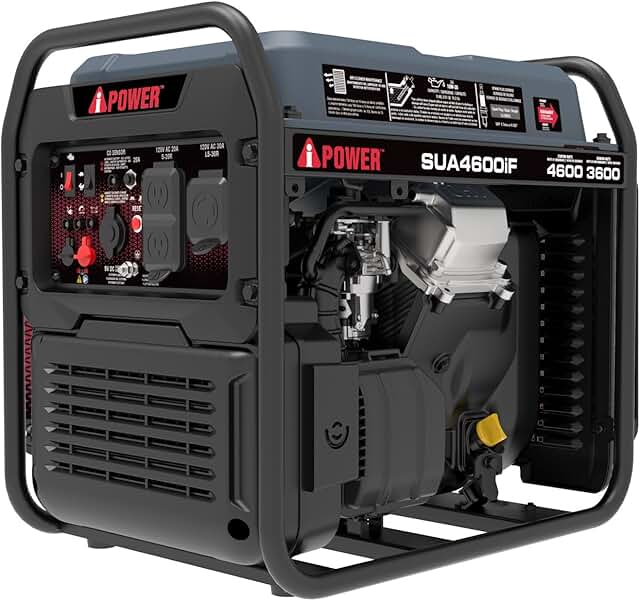
Engineered for portability and reliable performance, the A-iPower 4600W inverter weighs about 56 pounds and provides 4600 starting watts with 3600 running watts. It uses inverter technology to deliver clean power with about 3% total harmonic distortion, suitable for sensitive electronics like laptops and TVs. Its compact size and relatively low weight make it a strong option for tailgating and off-grid use, while maintaining sufficient power for essential appliances during outages.
Westinghouse 4000 Peak Watt Dual Fuel

This dual-fuel inverter generator blends flexibility with modern features. With 4000 peak watts and 3300 running watts, its dual fuel capability lets users switch between gas and propane depending on fuel availability. Remote start adds convenience, while the unit’s CO safety shutdown contributes to safer operation during outages. It’s a versatile choice for travelers and homeowners who want an easy, reliable backup power source that’s quieter than traditional open-frame models.
Westinghouse 12500 Peak Watt Dual Fuel

The Westinghouse 12500 Peak Watt Dual Fuel unit offers substantial power with 12,500 peak watts and 9,500 running watts on gasoline, plus 8,500 running and 11,200 peak watts on propane. It features remote start and transfer switch readiness for seamless home integration. A 6.6-gallon fuel tank with a gauge supports run times up to 12 hours. The engine’s sturdy design, automatic safety shutdowns, and a digital hour meter help monitor maintenance and ensure dependable performance during extended outages.
Buying Guide
Key considerations when choosing a home-use generator include power requirements, fuel availability, and operating environment. Consider the following perspectives to balance safety, cost, and convenience:
- Power needs: List essential appliances and their wattages. For larger homes, dual-fuel and inverter models with higher peak watts provide headroom for surge loads like air conditioners and water heaters.
- Fuel options: Dual-fuel units offer flexibility during fuel shortages. Propane and natural gas can be cleaner and easier to store, but gasoline typically provides more readily available peak output. Consider installation of a transfer switch for seamless mains connection.
- Noise and footprint: Inverter generators generally run quieter and produce cleaner power for electronics, but may offer lower peak wattage compared to traditional open-frame units. Weigh portability against total runtime needs.
- Safety features: Look for CO shutdown, automatic low-oil alerts, and robust enclosure designs. CO sensors are particularly important for indoor or semi-enclosed spaces.
- Run time and fuel capacity: Run time depends on load and fuel tank size. For extended outages, models with larger tanks or multiple fuel options can reduce refueling frequency.
- Remote start and status monitoring: Remote electric start and a digital hour meter simplify operation and maintenance tracking, especially for standby setups or less accessible installations.
- Device compatibility: Ensure the generator produces clean power suitable for sensitive electronics. Inverter technology and low THD are desirable for electronics-heavy loads.
- Safety certifications: Check for UL or equivalent certifications and proper CO shutdown mechanisms to minimize risk during operation.