Best Quiet Industrial Air Compressors for Low-Noise Work
For workshops, garages, and job sites that demand powerful air, a quiet air compressor can boost productivity without disrupting nearby work or noise-sensitive environments. The following selected models emphasize ultra-quiet operation, reliable performance, and durable construction, making them suitable for both professional and DIY projects. Read on to compare top options and key buying considerations.
Summary of chosen products:
| Product | Tank Size | Noise Level | Best For | Power |
|---|---|---|---|---|
| California Air Tools 8010A | 8 gal | 60 dBA | Indoor, portability | 1.0 HP |
| California Air Tools 2010ALFC | 2 gal | 60 dBA | Industrial quiet use | 1.0 HP |
| Metabo HPT EC28M | 1 gal | 59 dBA | Very quiet on job sites | 1.0 HP |
| California Air Tools CAT-1P1060SP | 1 gal | 56 dBA | Extreme quiet for small tasks | 0.6 HP |
| Nessxa 14 Gallon | 14 gal | 70 dB | Auto repair, tire inflation | 2 HP |
California Air Tools 8010 1.0 HP Ultra Quiet and Oil-Free

The California Air Tools 8010 combines a compact 8-gallon tank with an oil-free dual piston pump for low-maintenance operation. It runs at a low noise level of 60 dBA, making it suitable for indoor use and noise-sensitive environments. Its 1.0 HP motor operates at 1680 RPM to reduce wear and sound, while delivering 3.10 CFM at 40 PSI and 2.20 CFM at 90 PSI for common shop tasks. This model balances portability with reliable airflow, ideal for spray painting, nail guns, and light framing tools in a workshop where quiet performance matters.
California Air Tools 2010ALFC Ultra Quiet Oil-Free
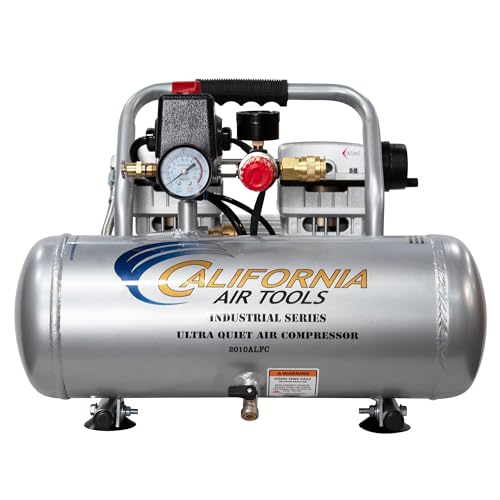
The 2010ALFC is a compact, ultra-quiet option with a 2-gallon aluminum tank and a silent 60 dBA operation. Its oil-free dual-piston pump enables longer wear life (over 4000 hours) and a 1.0 HP motor running at 1400 RPM for reduced vibration. With 4.0 CFM at 40 PSI and 3.0 CFM at 90 PSI, this unit supports a range of professional tasks while staying unobtrusive in indoor environments or shared shops.
Metabo HPT Quiet Air Compressor EC28M

The Metabo HPT EC28M weighs just about 25.2 pounds, offering true portability with a 1-gallon tank. Operating at a mere 59 dB, it enables quiet operation even on busy job sites. Its 4-pole motor provides efficient performance with a quick-coupler system for fast tool changes. The compact design and low noise profile make this unit well-suited for carpentry, trim work, and nail gun tasks in confined spaces where ambient noise matters.
California Air Tools CAT-1P1060SP Light & Quiet

The CAT-1P1060SP is a 1-gallon, ultra-quiet portable air compressor with a 0.6 HP oil-free pump. It operates at about 56 dBA, one of the quietest options in its class, and features a 1.20 CFM @ 90 PSI and 1.60 CFM @ 40 PSI airflow profile. Designed for low-noise operation, it suits light-duty tasks such as finishing, nailers, and small inflations where a compact, serene device is required.
Nessxa 14 Gallon Ultra Quiet Air Compressor

The Nessxa 14-gallon unit brings a larger storage tank and a 2 HP oil-free motor, offering higher airflow (8.75 CFM at 115 PSI) while maintaining a relatively quiet operation at about 70 dB. With a dual-coupler setup and a robust build, it’s suitable for longer run times, tire inflation, and auto repair scenarios where extended use is needed without excessive noise. The portable design helps teams maneuver it between bays or customers’ locations with ease.
Buying Guide: Key Considerations For Quiet Industrial Air Compressors
- Noise level: If you work in shared spaces or residential-adjacent shops, prioritize compressors listed at or below 60 dBA. A few models push into the 56–59 dBA range for extra quiet operation.
- Tank size vs. run time: Larger tanks (like 8–14 gallons) deliver longer, steadier air before cycling. Smaller tanks are lighter and more portable but cycle more often for higher-demand tools.
- Oil-free vs oil-lubed: Oil-free pumps require less maintenance and stay cleaner, but oil-lubed units can deliver higher torque for heavy-duty tasks. For quiet operation, oil-free options are typically preferred.
- Portability: Consider wheel design, weight, and handles. A portable unit helps you relocate the compressor as jobs shift between floors or bays without straining.
- Flow and pressure specs: CFM at given PSI indicates tool compatibility. Match the required CFM at the target PSI of your most-used tools to avoid undersupplying air.
- Power requirements and voltage: Most quiet models use standard 120V in residential settings, but check for higher voltage needs on larger commercial units and plan for electrical circuit capacity.
- Durability and warranty: Look for cast-iron or reinforced aluminum tanks, oil-free pump longevity, and manufacturer warranties that cover wear and pump life over thousands of hours.
- Maintenance needs: Oil-free pumps reduce maintenance frequency. Still, verify filter availability, noise-dampening features, and ease of servicing.
- Use-case versatility: If your tasks include tire inflation, spray painting, nailers, and light automotive work, a mid-size tank paired with oil-free pumping offers the best blend of performance and quiet operation.
- Energy efficiency: Models with lower RPM motors often run cooler and quieter. They also tend to wear less over time, reducing long-term maintenance costs.
In evaluating options, align your selection with your typical workload, space constraints, and noise tolerance. For interiors or shared workshops, a model like the 8010A or 2010ALFC provides strong quiet performance with substantial air output. If portability with ultra-quiet operation is paramount, the Metabo HPT EC28M or CAT-1P1060SP excels in small tasks while keeping noise minimal. For higher-volume or longer-running tasks, Nessxa’s larger tank offers substantial air supply at a tolerable noise level for a 14-gallon system.