Best Propane Backup Generator for Reliable Power (Twin Fuel or Hybrid Options)
Choosing a propane backup generator involves weighing power needs, fuel versatility, and runtime. The models below cover a range of home, RV, and off‑grid applications, prioritizing propane compatibility, transfer switch readiness, and user safety features. This guide highlights five robust options and compares their fuel capabilities, run times, and outlets to help you select a dependable backup solution.
Summary of selected products
| Product | ||||
|---|---|---|---|---|
| Westinghouse 12500 Watt Dual Fuel | Gas/Propane | Running 8500W (Propane) / 12500W (Gas) | Up to 12 hours | Remote start, transfer switch ready |
| WEN 6800-Watt Dual Fuel | Gas/Propane | Gas 6800W peak, 5100W running; Propane 6000W peak, 4500W running | Depends on fuel; moderate runtime | Inverter design, CO watchdog |
| A-iPower 4600W Inverter | Gas | 4600W starting / 3600W running | Varies with load | Ultra-light, fuel-efficient, CO sensor |
| Westinghouse 14500 Peak Watt Tri‑Fuel | Gas/Propane/Natural Gas | Gas 11500W running; Propane 10500W running; Nat Gas 9500W running | Up to 19 hours | Tri‑fuel versatility, long runtime |
| Westinghouse 6500 Watt Dual Fuel | Gas/Propane | Gas 6500W peak / 5300W running; Propane 5800W peak / 4800W running | Up to 14.5 hours | Multiple outlets, CO sensor |
Westinghouse 12500 Watt Dual Fuel Generator

This Westinghouse model provides robust dual‑fuel capability with substantial starting and running watts. Gas operation delivers up to 12,500 peak watts, while propane runs at about 8,500 watts, making it suitable for whole‑home projects that require heavy load handling. Features include remote start via a key fob, a digital hour meter, and a VFT display showing real‑time voltage, frequency, and hours. The 6.6‑gallon tank supports longer operation between refuels, and multiple outlets, all with safety covers, support a wide range of appliances and tools.
Design emphasizes practical power transfer readiness, including a transfer switch‑ready configuration and a 457cc Westinghouse engine built for durability. Safety is addressed with automatic low oil shutdown and a life‑of‑unit hour meter. For users who want quick startup in outages, the remote start and easy recoil option provide flexible access to power without stepping outside in storm conditions.
In terms of fuel flexibility and versatility, this unit shines by supporting RV 14–50R and standard household outlets with heavy‑duty circuits. It’s well‑suited for large homes or job sites where a dependable, remote‑start generator is a key requirement. Energy management features and robust build make it a strong option for those prioritizing reliability and expandability during extended outages.
WEN 6800-Watt Dual Fuel Inverter

The WEN DF680iX inverter generator balances power and portability. It runs on gasoline with 6800 surge watts and 5100 running watts, or propane with 6000 surge watts and 4500 running watts. A bonded‑neutral 240V configuration makes it suitable for Level 2 charging of electric vehicles and hybrids, extending its utility beyond typical camping or basic home backup. The CO watchdog sensor adds a vital layer of safety by shutting the unit off when carbon monoxide is detected.
With a focus on clean power, the WEN inverter design delivers stable AC suitable for laptops, TVs, and sensitive electronics. The unit also supports easy transportation for RV use and remote locations, aided by a relatively quiet operation and efficient fuel consumption. This model is a good pick for smaller power needs where quiet operation and fuel flexibility are valued, particularly when weekend camping or occasional outage backup is needed.
As a dual‑fuel option, it allows running on propane, which can be more convenient when propane supply aligns with home backup needs. The compact size and inverter efficiency make it appealing for users who prioritize portability without sacrificing essential power for critical devices during outages or off‑grid trips.
A‑iPower 4600W Inverter For RV and Home
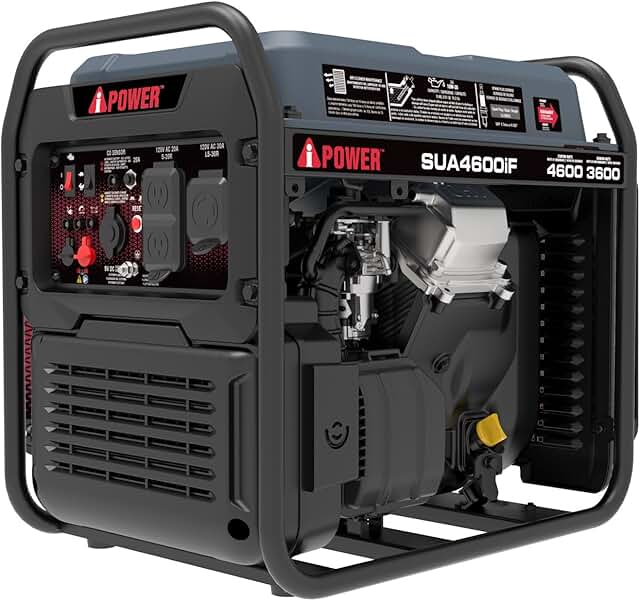
The A‑iPower model delivers a compact, lightweight solution with 4600 starting watts and 3600 running watts. With an open frame design and a weight of about 56 pounds, it’s easy to transport for tailgating or camping setups, as well as home backup on a smaller scale. The inverter technology provides clean, stable 120V power, suitable for sensitive electronics, including laptops and chargers, thanks to a low total harmonic distortion (THD around 3%).
Gasoline performance delivers adequate power for RV appliances and essential devices, while the unit’s portability makes it ideal for users who need a lightweight, space‑efficient generator. The CO sensor adds measurable safety benefits for indoor or semi‑indoor use where ventilation is a factor. Overall, this model balances portability with dependable, clean power for lighter power needs.
Potential buyers should consider their total wattage needs and whether a compact, lighter unit fits their location constraints. For intermittent use or light residential backup, the A‑iPower offers portability and reliability without adding significant bulk or fuel storage complexity.
Westinghouse 14500 Peak Watt Tri‑Fuel

This tri‑fuel unit provides significant versatility for larger homes or remote sites. It delivers 11,500 running watts on gasoline and 10,500 on propane, with peak outputs around 14,500 gasoline. On natural gas, it provides 12,000 peak and 9,500 running watts. A heavy‑duty 550cc engine with a cast‑iron sleeve ensures durability and long life in challenging conditions, while a large 9.5‑gallon tank supports extended runtime—up to about 19 hours—with a gauge to monitor fuel levels. The 7‑hour runtime on a standard 20‑lb propane tank adds flexibility for propane users.
This model is best suited for homeowners seeking a robust, all‑fuel platform that can handle heavy loads across multiple appliances during extended outages. The remote electric start and transfer switch readiness are practical features for seamless integration into a home backup system. For those with larger power demands or longer outage scenarios, the tri‑fuel capability offers a strategic advantage for fuel flexibility.
Westinghouse 6500 Watt Dual Fuel

The 6500‑watt Westinghouse model is designed for reliable home backup with both gasoline and propane capability. Gas performance runs at about 5300 running watts with a 6500 peak, while propane offers around 4800 running watts with 5800 peak. A 4.7‑gallon fuel tank provides lengthy operation, up to roughly 14.5 hours at lower loads. Outlets include a 5–20R 120V duplex, RV‑ready TT‑30R, and transfer switch readiness with a 30A L14‑30R receptacle, all protected with rubber outlet covers for safety. A CO sensor adds protection in mixed usage environments.
For homeowners seeking balanced power for essential circuits during outages, this unit provides a practical blend of capacity, safety features, and ease of use. It’s capable of supplying air conditioning, refrigerators, and other critical loads when matched with proper transfer switch configurations. The included package elements, such as the oil and hoses, support straightforward setup out of the box.
Buying Guide: Key Considerations And Comparisons
- Fuel flexibility: Dual fuel or tri‑fuel options expand fuel availability during outages. Consider propane as a more stable, longer‑term fuel for some households.
- Power needs: Estimate your essential load (refrigerator, well pump, furnace, lights, outlets) and choose a generator with sufficient running watts and surge watts.
- Run time and fuel tank size: Larger tanks provide longer operation between refuels but add weight and footprint.
- Outlets and transfer readiness: Ensure the generator has the appropriate outlets (duplex, RV, 30A/50A) and is transfer switch ready for seamless grid connection.
- Safety features: CO sensors, automatic low oil shutdown, spark arrestors, and rubber outlet covers improve safety for home use.
- Portability vs. capacity: Lighter units offer easier transport but typically provide less peak power. For home backup, consider a model with wheels and a good runtime on propane for reliability during long outages.
- Noise and location: Inverter designs typically run quieter and provide cleaner power, while conventional brace engines deliver higher continuous output. Plan placement away from living spaces and ensure ventilation.
- Maintenance and warranty: Look for units with durable engines, accessible parts, and reputable after‑sales support to minimize downtime during outages.
When choosing a propane backup generator, match your fuel strategy, anticipated outage duration, and load profile to the unit’s wattage, runtime, and safety features. For households requiring substantial power with long runtime, tri‑fuel or high‑capacity dual‑fuel models with transfer switch readiness offer the most comprehensive solution. For lighter use or portable needs, compact inverter units still provide clean power for essential electronics and appliances during emergencies.