Best Portable Home Backup Generators for Power on Demand
When outages strike, a reliable portable home backup generator keeps essentials running. This guide rounds up five highly capable models that balance power, fuel options, and portability. Each section highlights key features, run times, and suitability for home backup, RV trips, or off-grid use. Compare fuel types, noise levels, and outlet configurations to find the right fit for your needs and property size.
| Product | Fuel Type | Peak / Running Watts | Run Time (approx.) | Special Feature |
|---|---|---|---|---|
| Westinghouse 12500 Watt Dual Fuel | Gas/Propane | 12500 / 9500 (gas) • 11200 (propane) | Up to 12 hours | Remote start, transfer switch ready |
| Power Equipment 4400 Watts Inverter | Gas | 4400 / 3400 | Up to 14 hours | Multi-output, ECO mode |
| A-iPower 4600W RV-Ready | Gas | 4600 / 3600 | Not specified | CO sensor, lightweight |
| WEN 4750 Dual Fuel | Gas/Propane | 4750 / 3800 (gas) • 4350 / 3500 (propane) | Not specified | Wheel kit, electric start |
| Westinghouse 14500 Tri-Fuel | Gas/Propane/Natural Gas | 14500 / 11500 (gas) • 13500 / 10500 (propane) • 12000 / 9500 (nat gas) | Up to 19 hours | Tri-fuel versatility |
Note: Each model offers different fuel flexibility, engine size, and outlet configurations. For homes with transfer switches, look for models labeled transfer switch ready and consider potential install costs. Noise levels, weight, and portability also play a role in choosing the right generator for your space and power needs.
Westinghouse 12500 Watt Dual Fuel Generator

The Westinghouse 12500 Watt Dual Fuel generator delivers substantial power with flexibility. It runs on gasoline or propane, offering 9500 running watts on gas and up to 11200 watts on propane, with a peak of 12500 watts on gas. A remote electric start via included key fob adds convenience, especially during night outages. The unit includes a 6.6-gallon fuel tank for extended runtimes and a digital hour meter for maintenance tracking. It’s designed with a VFT display showing real-time voltage, frequency, and hours, helping monitor performance during operation. Safety features include rubber-covered outlets and an automatic low oil shutdown.
Output options include a 120V household receptacle, a 120/240V L14-30R for transfer switches, and a 50A RV-ready receptacle. The engine is a heavy-duty 457cc Westinghouse 4-stroke OHV with a cast iron sleeve for durability. Overall, this model suits larger households needing robust backup power with multiple fueling options.
Power Equipment 4400 Watts Inverter Generator

This portable inverter generator offers 4400 peak watts and 3400 running watts, making it a versatile option for RVs and home backup. It features multiple outputs, including two 120V AC outlets, a 12V DC port, and an RV connection, enabling flexible wiring for different loads. With ECO mode, it runs efficiently and can extend runtime to approximately 14 hours on a smaller fuel tank. The design emphasizes quieter operation and portability, ideal for emergency power at a cabin or during outdoor events. Its compact frame makes storage simpler than larger equivalents.
Inverter technology ensures cleaner power with low total harmonic distortion, which is beneficial for electronics like laptops and TVs. This model is well-suited for situations where space is limited, yet you still need dependable backup electricity for essential appliances and devices.
A-iPower 4600W RV-Ready Inverter Generator
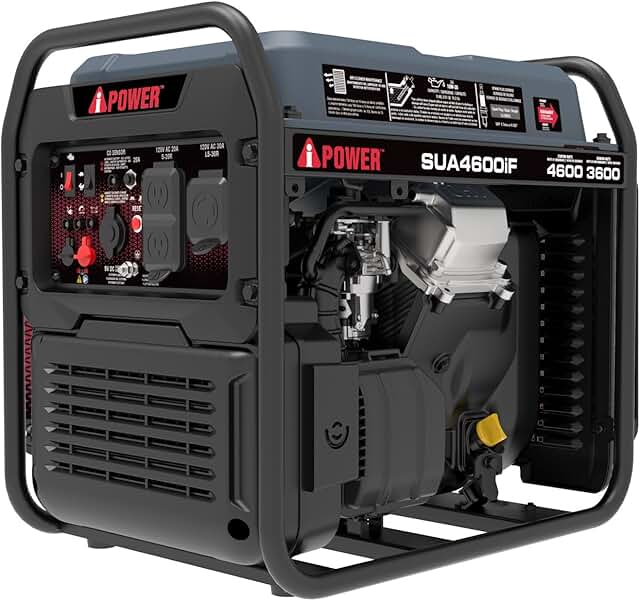
The A-iPower 4600W model combines portability with practical power delivery. It provides 4600 starting watts and 3600 running watts, suitable for RV appliances and home backup. With a lightweight design at about 56 pounds, it is easy to transport for camping or off-grid use. The generator uses inverter technology to deliver clean power with a low total harmonic distortion of around 3%, protecting sensitive electronics such as laptops, TVs, and chargers. Its compact 149 cc engine makes it a convenient choice for users prioritizing mobility without sacrificing essential power.
Key considerations include fuel efficiency, noise levels, and ease of start. The RV-ready output makes it compatible with mobile living scenarios, while inverter reliability helps minimize disruptions during outages or outdoor excursions. The device is best for those who need dependable, clean power on the go rather than high-watt rapid bursts for heavy machinery.
WEN 4750 Dual Fuel Generator

The WEN 4750 Dual Fuel generator provides substantial power with dual-fuel capability for flexibility during outages. It delivers 4750 surge watts and 3800 running watts on gasoline, and 4350 surge watts with 3500 running watts on propane. The 120V to 240V output range accommodates transfer switches and emergency backups, broadening its usability for homes and work sites alike. An electric start powered by a 224cc 4-stroke OHV engine enhances ease of use, especially during cold-weather outages. Wheel kit support improves portability for garages and sheds where wheel-on storage is preferred.
Considerations include fuel availability, noise, and maintenance needs. The dual-fuel option allows choosing based on fuel price or availability, and the 120/240V capable output helps connect to home electrical systems through a transfer switch or manual connections. This model suits users seeking a balance of power, flexibility, and mobility for mid-sized backup tasks.
Westinghouse 14500 Peak Watt Tri-Fuel

The Westinghouse 14500 Peak Watt Tri-Fuel generator is designed for larger homes or portable power needs with three fuel options: gasoline, propane, and natural gas. It delivers 11,500 running watts on gasoline with a peak of 14,500, and 10,500 running watts on propane with a peak of 13,500, plus a natural gas rating of 9,500 running watts and 12,000 peak watts. A heavy-duty 550cc 4-stroke OHV engine with a cast iron sleeve supports durability and longevity. The unit runs up to 19 hours on a generous 9.5-gallon tank and can operate for about 7 hours on a 20-pound propane tank. This tri-fuel capability offers maximum versatility for home backup, large events, or off-grid scenarios.
Consider load management and fuel availability when selecting this model. Tri-fuel capability is advantageous for long outages, but installation considerations, including proper lines and safety, must be addressed. Noise and weight are factors for yard placement and storage, but the power output makes it a strong option for substantial emergency power needs.
Buying Guide: Key Considerations For Choosing A Portable Home Backup Generator
Power needs: Start by listing essential devices and estimating total running watts. Include HVAC, sump pumps, refrigerators, lights, and communications devices. If you expect frequent outages or large load surges, prioritize higher running watts and peak wattage.
Fuel options: Dual-fuel and tri-fuel units offer flexibility during fuel shortages or price fluctuations. Consider fuel availability, storage space for gasoline, and the ongoing cost of fuel over time.
Transfer switch compatibility: If you plan to hook up to a home transfer switch, verify the generator’s receptacle configuration and whether it is transfer-switch ready. This simplifies the move from grid to generator power safely.
Portability and runtime: Weight, wheel kits, and lifting handles influence where you store and how you move the unit. Longer runtimes reduce the need for frequent refueling, especially during prolonged outages.
Outlets and safety: Look for a mix of 120V and 240V outlets, plus RV-ready connections if you plan to power recreational equipment. Rubber outlet covers and automatic low-oil shutdown provide added safety and peace of mind.
Engine durability: A cast-iron sleeve and OHV engine design often indicate longer life under heavy use. A digital hour meter helps track maintenance intervals and oil changes.
Noise and emissions: Inverter generators typically run quieter and produce cleaner power, which is important for noise-sensitive neighborhoods and electronic devices.
Budget and warranty: Compare upfront costs with expected lifespan and available warranty terms. Even with a higher upfront price, a longer warranty and better support can reduce total ownership costs.