Best Hook and Loop Pad Sets for Angle Grinders
Choosing the right hook and loop backing pad can dramatically improve finish quality and reduce vibration when using an angle grinder for sanding, grinding, or polishing. This guide reviews five top-performing 5-inch and 4-inch backing pads and their compatible discs, highlighting construction, durability, vibration control, and ease of use. Whether you’re refining wood, metal, or composite surfaces, these pads convert your grinder into a capable small sanding system with reliable performance.
Summary of selected products
| Product | Brand | Thread | Material | Key Benefit |
|---|---|---|---|---|
| 5 Inch Hook and Loop Backing Pad 5 Inch Backing Plate with 5/8-11 Threads | HILBERTBROOK | 5/8-11 | Polyurethane | Smooth, consistent finishes with easy installation |
| Pomsare 5 Inch Backing Pad with 50PCS Discs | Pomsare | 5/8-11 | Polyurethane | Wide grit range; versatile for wood, metal, and more |
| Upgraded 5 Inch Hook and Loop Backing Pad Plate | Pomsare | 5/8-11 | PU backing with foam interface | Reduced vibration; better edge filing |
| ComeFloor Rubber Backer Pad 5 Inch Hook and Loop | ComeFloor | 5/8-11 | Rubber | Flexible, durable, easy changes |
| Boounyatin 100PCS Discs with 4 Inch Backing Pad | Boounyatin | 5/8-11 | Aluminium oxide discs with PU pad | Excellent value pack for varied projects |
5 Inch Hook and Loop Backing Pad 5 Inch Backing Plate with 5/8-11 Threads
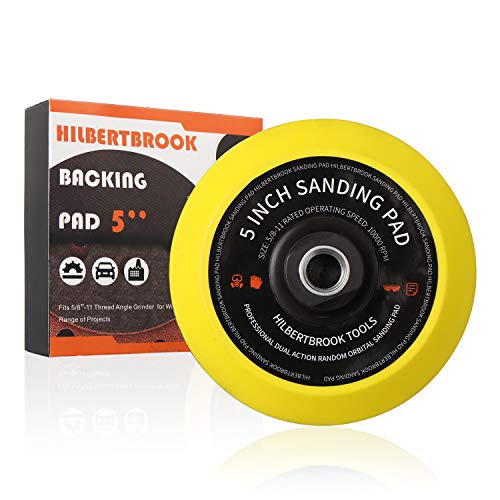
The HILBERTBROOK 5-inch backing pad is designed to fit standard grinders with a 5/8-11 thread. It features a polyurethane backing that helps maintain balance and consistent results across grinding and polishing tasks. The installation is straightforward, allowing quick disc changes and minimizing contact with the disc holder. Ideal for home shop use where portability and reliability are valued.
Pomsare 5 Inch Backing Pad With 50PCS Discs

The Pomsare 5-inch kit includes a backing pad and 50 assorted sanding discs ranging from coarse to fine (80/120/240/320/600 grit). The kit is designed to outperform some random orbit sanders in aggressive sanding while delivering balanced performance. Its polyurethane backing and precise fit reduce vibration and promote smooth finishes on wood, metal, and composite surfaces.
Upgraded 5 Inch Hook and Loop Backing Pad Plate

This upgraded pad from Pomsare uses a reinforced PU backing that outperforms standard plastic versions. The soft, flexible sponge interface reduces vibration and protects the backing pad. It’s particularly effective for contoured surfaces, making it suitable for automotive, boat, and furniture refinishing. Recommended operating range sits around 3000–4000 RPM for best results.
ComeFloor Rubber Backer Pad 5 Inch

ComeFloor’s 5-inch rubber backer pad emphasizes durability and rigidity while maintaining a flexible edge near curves. The rubber back provides strong attachment with hook and loop discs and helps prevent pad separation. It features a brass arbor with 5/8-11 threads and is rated for high RPM, supporting efficient material removal on multiple substrates with minimal heat buildup.
Boounyatin 100PCS Disc Pack With Backing Pad

The Boounyatin set combines 4-inch sanding discs with a 5/8-11 backing pad in a value-packed option. The discs use high-quality aluminium oxide abrasive, offering flexibility and long life across wood, metal, rubber, and more. The included range of grits (40–800) supports a wide workflow from rough shaping to fine finishing, making it a practical choice for DIY enthusiasts and professionals seeking coverage and economy.
Buying Guide
Backing pad selection influences surface finish, tool life, and overall productivity. Consider these factors when choosing a hook and loop pad for an angle grinder:
- Thread compatibility: Ensure the pad matches your grinder’s spindle, typically 5/8-11 for most 4″ and 5″ pads.
- Backing pad material: PU foam or rubber reduces vibration and guards the disc; rigid plastic pads often deliver direct power transfer but may transmit more vibration.
- Foam or interface layer: A foam or soft interface improves edge polishing and contouring on curved surfaces, while a stiff pad works well for flat stock.
- Grit range and disc compatibility: If you purchase a kit, verify the grit spectrum covers your project needs and that discs are compatible with hook and loop backing.
- Durability and temperature management: Look for pads designed for high RPM use and heat resistance to sustain long finishing sessions without deformation.
- Vibration control: Pads with balanced construction and vibration-dampening interfaces help reduce tool fatigue and deliver smoother finishes.
- Application scope: Some pads excel in wood, others in metal, stone, or composite surfaces. Choose based on your primary material workflow.
Performance considerations show tradeoffs between ruggedness, flexibility, and ease of disc changes. For example, rubber-backed pads offer resilience and edge protection, while PU-backed pads emphasize vibration absorption and consistent disc contact. When assessing value, factor in disc pack contents, replacement abrasives, and the pad’s lifespan under your typical workload.
Product diversity matters: exterior finishes, interior repairs, and hobby projects each call for slightly different pad characteristics. A kit with multiple discs and a compatible backing pad can streamline workflows, reduce downtime, and improve final results by ensuring the backing pad maintains consistent contact across varied surfaces.
Finally, compatibility with accessories such as shank adapters or interface foams can influence performance on curved surfaces or contoured furniture. The right combination improves material removal rates while protecting the workpiece from gouging or heat damage. Consider the types of materials you most frequently sand and polish to determine which backing pad’s balance of rigidity, damping, and edge control best suits your needs.