Best Concrete T Nail Gun for Solid Masonry and Framing Projects
The right concrete T nailer can speed up masonry and wood-to-concrete projects, from furring strips to subflooring. This guide reviews five top options, highlighting their performance, safety features, and usability. Each product section includes a quick overview and practical considerations to help you choose the best tool for your needs.
| Product | Key Use | Nail Range | Drive Type |
|---|---|---|---|
| Freeman PCTN64 Pneumatic T Nailer | Wood-to-concrete projects, decking, siding | 5/8″ – 2-1/2″ | Sequential/air-driven |
| meite ST64E Concrete Nailer | Furring, siding, soffits, decking | 3/4″ – 2-1/2″ | Standard pneumatic |
| Air Locker CN64A3 | Plywood nailing, fencing, subflooring | 5/8″ – 2-1/2″ | Sequential / contact |
| CREWTOWER Concrete Nailer | Plywood to concrete, masonry tasks | 3/4″ – 2-1/2″ | Selective actuation |
| Kamsin ST64 | Truss building, brick nailing, wood-to-concrete | 3/4″ – 2-1/2″ | Standard pneumatic |
Below are five concrete T nailers that consistently appear in professional recommendations, each bringing a balance of durability, safety, and practical features for American job sites.
Freeman PCTN64 Pneumatic T Nailer
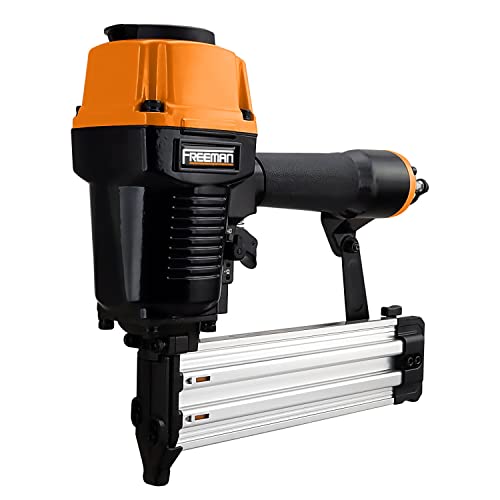
Designed for wood-to-concrete and steel projects, the Freeman PCTN64 accepts 14-gauge glue-collated T-nails from 5/8″ to 2-1/2″. Its one-piece hardened steel drive blade and anodized aluminum magazine and cylinder contribute to long-term durability, making it suitable for decking, furring, and subflooring. The tool excels in applications like fastening Hardie fiber cement siding and concrete corner boards, soffits, and fascia, delivering steady performance under demanding conditions. The lightweight yet rugged construction supports extended use on large projects.
Meite ST64E Concrete Nailer

The Meite ST64E is a high-capacity pneumatic concrete nailer that ships with 400 nails and accepts 3/4″ to 2-1/2″ nails. It is designed for efficient, continuous work on projects such as furring strips, siding, and decking. A dual safety feature prevents accidental ignition, and a see-through 100-nail magazine with a smooth latching mechanism enables quick reloading. The tool’s 360-degree exhaust helps keep dust away from the operator’s face, contributing to a safer and more comfortable work environment on job sites with concrete and masonry.
WOODPECKER ST64 Pneumatic Concrete Nailer

The Woodpecker ST64 offers a robust 14-gauge 3/4″ to 2-1/2″ concrete nail range. Its die-cast aluminum housing keeps the tool light while maintaining durability. A thickened safety frame on both sides reduces the risk of accidental firing when the tool is not pressed against a work surface. The magazine design supports easy reloading, and the overall construction aims to balance strength with operator comfort for extended sessions of masonry and framing work.
Air Locker CN64A3 Concrete Nailer

The Air Locker CN64A3 handles 14-gauge nails from 5/8″ to 2-1/2″ and features a UNI-LOK forged steel driver for durability. A high-capacity side-load magazine simplifies nail replenishment, and the tool offers dual-fire modes (sequential and contact) with a safety system to prevent misfires. An aluminum housing keeps weight down while maintaining toughness, and a 360-degree adjustable exhaust helps manage debris and dust during nailing tasks on concrete and wood surfaces alike.
CREWTOWER Concrete Nailer

CREWTOWER’s 14-gauge concrete nailer is built to drive nails from 3/4″ to 2-1/2″ with a sturdy die-cast aluminum body. It emphasizes safety with a selectable actuation feature, allowing users to switch between sequential and contact firing. The durable construction and flexible firing options make it suitable for fastening plywood to concrete, securing furring strips, and other masonry-to-wood applications on busy sites where precision and control are essential.
Kamsin ST64 14 Gauge Concrete Nailer

The Kamsin ST64 is a portable 14-gauge pneumatic concrete nailer designed for 3/4″ to 2-1/2″ nails. Its die-cast aluminum body provides a balance of strength and lightness for long-day use. A safety frame on both sides of the muzzle reduces accidental discharge, and a reliable power train supports heavy-duty workloads such as truss building, brick nailing, and other wood-to-concrete applications. The tool is designed to handle tough masonry jobs while remaining manageable on standard framing tasks.
Buying Guide: Key Considerations For Choosing A Concrete T Nailer
- Drive range and nail compatibility: Most 14-gauge T nails span 3/4″ to 2-1/2″. Confirm your preferred lengths and check that the tool accepts glue-coated or standard nails as needed for your project.
- Power source and comfort: Pneumatic nailers require a compressor. Look for models with lightweight housings, ergonomic grips, and balanced weight distribution to reduce fatigue on long days.
- Safety features: Reputable models include side safety frames, muzzle safety triggers, and locking mechanisms to prevent misfires. Consider sequential trigger options for more controlled nailing in tight spaces.
- Magazine capacity and reload: A larger capacity reduces downtime. Transparent or windowed magazines help you monitor nail levels and plan reloads before you reach the job’s end.
- Durability and maintenance: Die-cast aluminum or hardened steel components offer longevity. Check for corrosion-resistant nails and reliable drive blades to withstand masonry drilling environments.
- Versatility: Some tools offer selective actuation (sequential vs. contact) and adjustable exhausts to adapt to different job sites and material types, from soft plywood to dense cement blocks.
- Brand and service: Reputable brands often provide better spare parts availability, warranties, and customer support, which can matter for professionals who rely on year-round use.
- Accessories: Availability of compatible nails (size, coating) and optional safety gear can influence the overall cost and project planning.
These considerations help compare tools beyond price, focusing on reliability, operator safety, and suitability for common American construction tasks such as decking, siding, furring, subflooring, and trim against masonry.