Best Arc Welder Generator Combos for Outdoor Projects
Discover reliable arc welder generator combos that pair welding capability with portable power. This guide reviews five versatile choices, highlighting output, duty cycles, and generator compatibility so you can select a unit that fits on-site work, maintenance tasks, or emergency power needs. Each product is evaluated on weld quality, portability, fuel efficiency, and ease of use to help you decide which model delivers the best value for your metalworking projects.
| Product | Brand | Key Features |
|---|---|---|
| Portable 2000 Watt Engine Driven Welder 130 Amp Stick Welder | Unknown | 2000W generator; 130A MMA welding; outdoor use up to 6 hours |
| TOMAHWAK 15 HP Engine Driven Portable 2,000 Watt Generator | Tomahawk Power Store | 210A output; 60% duty cycle; stable sine wave; welds and runs tools |
| TOMAHAWK Welder Generator Stick Welder Engine Driven 120 Amp | Tomahawk Power Store | 120A MMA; 2200W; stable inverter sine wave |
| KICKINGHORSE A220 ARC Welder 240V | KickingHorse Store | 220A; 40K Hz IGBT; generator-friendly; CSA/US certified |
| Engine Driven Generator/Welder, 40 to 145 | Hobart Store | Engine-driven generator/welder combo; occupational health & safety |
Portable 2000 Watt Engine Driven Welder 130 Amp

The unit combines a 2000-watt power generator with a 130A MMA welding capability. It is designed for outdoor use and can operate for up to six hours, reducing the need for frequent refueling during a job. The integrated motor-driven setup aims to minimize the need for a separate power source on worksites, potentially lowering overall operating costs. The welder handles various ferrous metals with 130A stick welding power, suitable for common iron and steel projects in field conditions.
TOMAHWAK 15 HP Engine Driven Portable 2,000 Watt Generator

With 210 amps of output and a 60% duty cycle, this inverter generator delivers stable sine waves for welding while running electric tools. The model supports welding and running other equipment concurrently, making it useful for job sites where power distribution is needed. Its high output helps tackle thicker materials, and the inverter technology supports smoother arc stability for consistent welds in outdoor environments.
TOMAHAWK Welder Generator Stick Welder Engine Driven 120 Amp
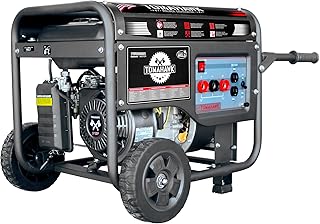
This engine-driven model provides smooth 120-amp stick welding with a 2200-watt capacity. The inverter engine features a stable sine wave for dependable welding performance, while its design supports welding facilities and running tools at the same time. The combination of portability and adequate arc power makes it suitable for light to mid-range fabrication tasks performed away from a fixed power source.
KICKINGHORSE A220 ARC Welder 240V

The A220 is CSA/US certified and designed to work reliably with generators and extension cords. It provides a robust 220-amp output at a 25% duty cycle and is capable of welding thicker plates and heavy metals. The device emphasizes durability and safety, with a heavy-duty metal body built for on-site use and fluctuating power conditions, including dirty electricity common on remote jobsites.
Engine Driven Generator/Welder, 40 to 145

This Hobart model pairs an engine-driven generator with welding capabilities, emphasizing occupational health and safety. It is positioned for users who require integrated power and welding operations on site, with a reputation for U.S. manufacturing standards and the Hobart brand’s reliability in industrial settings. The unit is suitable for light to moderate welding tasks where a portable generator is also beneficial.
Buying Guide: Key Purchase Considerations
- Power output and duty cycle: Assess the amperage needed for your typical welding tasks and ensure the unit’s duty cycle matches the workload and material thickness you encounter.
- Fuel and runtime: Compare fuel type, efficiency, and advertised runtime to determine how often refueling is required during field work.
- Generator stability: For on-site projects with variable power, choose models with inverter technology or robust voltage stability to maintain arc quality across tools.
- Portability and weight: If you transport the unit frequently, consider weight, handle design, and wheel configuration to meet mobility needs.
- Safety certifications: Look for CSA/US or other safety certifications indicating compliance with industry standards and reliable protection features.
- Durability and construction: A metal-bodied enclosure and rugged design help withstand harsh environments and jobsite conditions.
- Compatibility with tools: Ensure the generator’s electrical output can run your additional tools without overloading the system.
- Maintenance and spare parts: Check availability of consumables, service centers, and warranty coverage to minimize downtime.