Best 7.5 Hp Rotary Screw Air Compressor for Industrial-Grade Performance
Finding a reliable 7.5 hp rotary screw air compressor requires balancing power, reliability, and maintenance needs. The following selections offer robust 7.5 hp configurations with varying voltages, tank sizes, and CFM outputs to fit diverse American workflows—from auto shops to small manufacturing. Each model below is chosen for its compatibility with common job-site tools and its track record in industrial settings. Compare features, tank capacity, and control systems to determine the best fit for continuous operation and long-term maintenance needs.
| Product | Brand | Key Strengths |
|---|---|---|
| HPDAVV 208-230V 3-Phase Rotary Screw Air Compressor | HPDAVV | 33 CFM, 125 psi, spin-on oil separator |
| EMAX Electric Air Compressor | EMAX | 26 CFM at 100 psi, 7.5 HP, two-stage |
| HPDAVV 208-230V Single-Phase Rotary Screw with Vertical ASME Tank | HPDAVV | 23 CFM, 150 psi, 60 gallon tank |
| HPDAVV Total Rotary Screw Air Compressor With Vertical Tank | HPDAVV | 23 CFM, 150 psi, 60 gallon tank, 3-phase |
| Ingersoll Rand Rotary Screw Compressor | Ingersoll Rand | 7.5 HP, 28 CFM, 200V, 3-phase |
Note: The right rotary screw compressor depends on your electrical supply (single-phase vs. three-phase), the desired air flow (CFM), and the installation footprint. The models listed emphasize solid build quality, accessible maintenance, and components designed for steady production environments.
HPDAVV 10HP 7.5KW Rotary Screw, 33 CFM
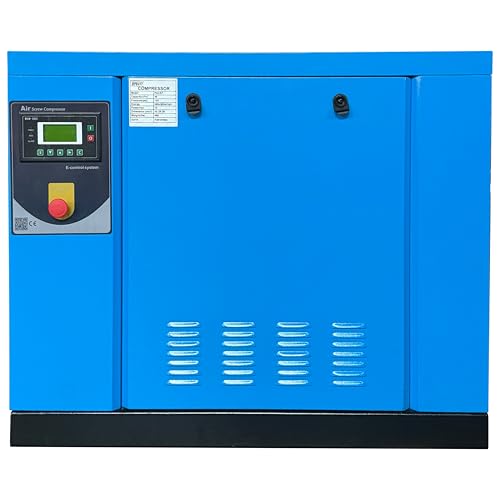
The HPDAVV 208-230V, 3-phase rotary screw model delivers up to 33 CFM at a maximum 125 psi, suitable for demanding industrial tasks. With a spin-on air oil separator, routine maintenance is simplified, allowing quick replacement of the filtration element and housing. The unit operates at 3600 RPM and is designed for production settings spanning manufacturing, textiles, and automotive repair. It emphasizes stability and durability, reducing oil content in compressed air and ensuring consistent performance across shifts.
Key considerations include the availability of a three-phase power supply, the need for reliable oil separation, and maintenance accessibility. The listed features emphasize the integrated separator as a maintenance-friendly solution, minimizing downtime and improving air quality for downstream tools.
EMAX 80 Gal, 7.5HP, 26 CFM, 200 PSI

EMAX pairs a robust 7.5 HP motor with a two-stage design to deliver 26 CFM at 100 PSI, suiting heavy-duty tools that demand steady airflow. A manual tank drain facilitates straightforward maintenance, helping guard against moisture build-up and ensuring long-term reliability. The splash-lubricated pump configuration supports extended service life, while the single-phase operation makes it accessible for smaller shops without three-phase power. This setup is well-suited for personnel who prioritize dependable airflow and simpler upkeep in automotive, woodworking, and fabrication environments.
When evaluating this model, consider the trade-off between higher PSI capacity and the practical airflow needs of your tools. The manual drain system is a maintenance feature that some users prefer for its simplicity, though it requires periodic attention to avoid water accumulation in the tank.
HPDAVV 208-230V Single-Phase Rotary Screw With Vertical ASME Tank

This HPDAVV model offers 7.5 HP (5.5KW) with a 60-gallon vertical ASME tank, delivering 23 CFM at up to 150 psi. The single-phase input makes it a practical choice for smaller facilities or locations without three-phase power. A microprocessor-based control panel provides a graphic display for essential parameters, supporting easy operation and monitoring of performance. The unit’s design emphasizes reliability and a wide operating pressure range, supporting tools and processes that require consistent pressure at varying loads.
Considerations include electrical availability, tank size, and the need for precise digital controls. The 60-gallon tank provides ample reserve air for short-term demand spikes, while the single-phase input keeps infrastructural costs manageable for smaller shops or retrofit projects.
HPDAVV Total Rotary Screw With Vertical Tank

This 7.5HP/5.5KW unit is a 230V, 3-phase machine rated for 23 CFM and 150 psi with a vertical 60-gallon ASME tank. It uses intelligent electronic controls with a microprocessor that presents essential parameters clearly, enabling uniform operation and reduced downtime. The included warranty and HPDAVV’s service network are designed to support ongoing maintenance and quick issue resolution, which is valuable for production lines that require consistent air delivery across multiple shifts.
The key decision factors for this model involve phase compatibility, pump and motor efficiency, and the benefits of a vertical tank format in spaces with limited footprint. The microprocessor control can help optimize performance in varying operating conditions and loads.
Ingersoll Rand Rotary Screw Compressor, 7.5 HP

The Ingersoll Rand unit provides 7.5 HP, 28 CFM, and is a 200V, 3-phase model designed to integrate with full-voltage motor starters and air-cooled aftercoolers. The system’s 3-phase configuration supports steady, continuous operation in more demanding environments, with attention to reducing discharged air temperatures through aftercooling. This model emphasizes reliability and compatibility with larger shop layouts that rely on robust electrical infrastructure.
When assessing this option, consider the availability of full-voltage motor starters and your plant’s cooling strategy. The 28 CFM output provides a strong baseline for tools like high-demand impact wrenches and sanders, while the aftercooler helps maintain compressed air quality and system longevity.
Buying Guide: Key Purchase Considerations
- Electrical configuration: Determine whether your shop has single-phase or three-phase power, and match the unit’s voltage and phase to avoid costly retrofits.
- Air flow and pressure: Evaluate the CFM requirement of your most-used tools and the peak air demand during workload surges. Higher CFM at stable pressure supports continuous operation.
- Tank size and layout: Larger tanks offer greater air reserve for peak demand and reduce cycling, but require more floor space. Vertical tanks save footprint in tight areas.
- Maintenance features: Spin-on oil separators, manual drains, and digital controls affect long-term upkeep and downtime. Consider service networks and warranty terms in your decision.
- Control and monitoring: Microprocessor controls help monitor pressure, temperature, and run-time. Look for intuitive displays, quick diagnostics, and remote monitoring options if available.
- Installation footprint: Check dimensions and clearance in your facility, especially in automotives or industrial spaces with limited ceiling height or wall space.
- Oil management and air quality: Rotary screw compressors rely on oil to seal and lubricate. An integrated oil separator or robust filtration helps ensure clean air and reduces contamination risk for downstream tools.
- Maintenance access: Easy access to filters, separators, and drain valves reduces service time and improves uptime.
These considerations help balance upfront equipment costs with ongoing operating expenses, downtime, and maintenance labor. By aligning your selection with real-world usage patterns and facility constraints, you can maximize the efficiency and resilience of your compressed-air system.