Answering the needs of hobbyists and professionals seeking robust, large-table sanding solutions, these belt-disc combos deliver dependable material removal, stable bases, and versatile tilting work surfaces. The top picks below are best for making flat panels, wide boards, and curved pieces with consistent finishes. Each product section explains who it’s best for, plus a practical caution to consider before buying.
| Product | Best For |
|---|---|
| WEN Benchtop Belt and Disc Sander (6502T) | General shop projects; users needing a two-in-one unit with a cast-iron base for stability |
| VEVOR 6″ Disc & 4″ x 36″ Belt Sander | Precision sanding with adjustable angles and dust management |
| BUCKTOOL 4×36″ Belt, 6″ Disc Sander | Maintenance-free operation with direct-drive efficiency |
| Woodskil 4.3A Belt Disc Sander Combo | Higher speed, versatile belt/disc setup with dual exhaust |
| WEN 6524 Oscillating Belt & Spindle Sander | Specialized belt/spindle tasks with multiple drum sizes |
WEN Benchtop Belt and Disc Sander (6502T)

This two-in-one machine combines a 4-by-36 inch belt with a 6-by-6 inch disc, offering solid versatility for woodworking projects. The belt tilts from 0 to 90 degrees for horizontal and vertical sanding, and the cast-iron base minimizes vibrations for cleaner finishes. Best for hobbyists and workshop upgrades who want an affordable, space-efficient combo.
Best for: Budget-conscious hobbyists needing both belt and disc capabilities in a single unit. Why selected: stable cast-iron base and flexible tilting belt surface improve control on large panels.
Caution: Belt tracking and belt replacement may require periodic adjustment; ensure clear workspace for safe operation.
VEVOR 6″ Disc Sander & 4″ x 36″ Belt Sander
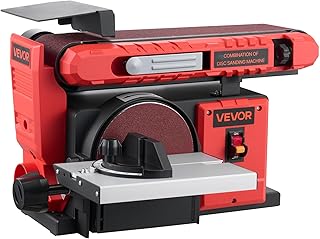
Powered by a 400W motor, this belt-disc combo emphasizes strong power and adjustable sanding angles. The belt tilts 0–90°, and the disc table tilts 0–45°, with a miter gauge for improved accuracy. It’s well-suited for users needing adjustable profiles and a compact footprint without sacrificing power.
Best for: Crafters needing multi-angle sanding with reliable disc-belt performance. Why selected: balanced power and flexibility for varied shapes, plus a dedicated dust-collection port for cleanliness.
Caution: Some users may prefer optional dust-collection accessories for larger workloads; setup could benefit from an air-tight shop environment.
BUCKTOOL Bench Belt Disc Sander

BUCKTOOL’s model emphasizes maintenance-free operation with direct-drive design. The belt tilts 0–90 degrees, enabling horizontal and vertical sanding. A quick belt replacement feature improves workflow efficiency, making it attractive for busy shops and beginners who value ease of use.
Best for: Users who want low-maintenance, efficient operation for routine projects. Why selected: direct-drive design reduces belt tension adjustments and simplifies belt changes.
Caution: It may be less suitable for very large, thick stock that requires extended belt life; consider future upgrades if workload grows.
Woodskil 4.3A Belt Disc Sander

Woodskil offers a 3/4 HP motor delivering up to 3570 rpm on the belt and 1732 fpm on the disc. The belt and disc are independently adjustable with 0–90 degrees tilt, and a 0–45 degree work-table tilt with a miter gauge. Dual dust exhaust ports aid cleanup, beneficial in busy shops.
Best for: Projects requiring higher belt speeds and flexible shaping on varied stock. Why selected: robust motor and dual exhaust reduce dust buildup and improve cut consistency.
Caution: Ensure proper dust extraction compatibility and workspace ventilation for extended sanding sessions.
WEN 6524 Oscillating Belt & Spindle Sander

This unit adds versatility with multiple sanding drums and a 4 x 24 inch belt, combining belt and spindle operations. The 3.5-amp motor drives belt and spindle at speeds suitable for detailed contour work and smaller parts within a compact benchtop footprint. Useful for shaping curved edges and delicate profiles.
Best for: Professionals needing a dedicated spindle and belt option in one machine. Why selected: broad drum assortment enables diverse shaping tasks with a single tool.
Caution: The compact size may limit sheer material removal on very large panels; consider a larger, dedicated belt sander for heavy stock removal.
Buying Guide: Large Table Belt Sander Essentials
What to consider before buying
Power and speed: Look for belt speeds around 3000–3600 FPM and a sturdy motor (3/4 HP or higher) for consistent stock removal without overheating. A dedicated disc motor helps with corner finishing and edge work.
Table and tilting range
Choose a model with a main belt table that tilts 0–90 degrees for horizontal and vertical sanding. A tilting disc table (0–45 degrees) enhances control when shaping angled profiles.
Base and vibration control
A cast-iron or heavy-duty steel base minimizes vibrations, providing flatter finishes on larger panels. A rigid frame improves tool longevity and reduces ride during aggressive passes.
Dust management
Dual exhaust ports or robust dust-collection compatibility keeps the workspace cleaner and protects the operator’s lungs during extended sessions.
Maintenance and belt life
Direct-drive designs reduce belt tension adjustments and belt changes, improving workflow efficiency. Consider models with quick belt replacement for convenience.
How to choose among the top models
- Best overall for versatility: WEN 6502T balances belt and disc with a stable base.
- Best power-to-budget option: VEVOR 6″ x 4″ combo offers solid torque and angle flexibility.
- Best for maintenance-free operation: BUCKTOOL emphasizes direct drive and quick belt changes.
- Best for high-speed shaping: Woodskil’s 3/4 HP motor provides strong performance with dual exhaust.
- Best for specialized belt/spindle work: WEN 6524 covers both belt and spindle tasks in one unit.
Why a large-table belt sander is worth it
For projects requiring flat panels, large boards, or shaped edges, a large-table belt sander delivers consistent material removal and improved surface finishes. The ability to tilt both belt and disc work surfaces expands the range of profiles you can achieve, reducing manual sanding time and increasing repeatability.
FAQ
- What is the main benefit of a belt-disc combo sander? It combines two essential sanding methods in one machine, saving space and price compared to buying separate units.
- Can I use these sanders for curved stock? Yes, especially models with tilting belts and adjustable discs, which help follow curved contours.
- Is a cast-iron base necessary? A heavy base minimizes vibration and helps maintain accuracy on larger stock.
- Do these units require dust collection? Dust collection is highly recommended to maintain a clean workspace and prolong tool life.
- What should I consider about belt replacement? Quick-release or easy-tracking designs reduce downtime between grits or belt types.
- What projects benefit most from a 4×36 inch belt? Wide boards, panels, and doors where a long belt produces a smoother, consistent finish.