Finding the right entry level table saw means balancing power, portability, and table size for your DIY projects. This guide highlights five solid options that are friendly to beginners yet capable for small shop tasks. Each pick is evaluated for who it’s best for, what kind of projects it suits, and any practical limitations to watch out for. The buyer-friendly summary table below helps you compare at a glance.
| Product | Best For | Notable Benefit |
|---|---|---|
| DOVAMAN 15A Table Saw, 8.5″ Dustless | Compact spaces, dust-conscious setups | 98% dust extraction with vacuum connector |
| 15Amp Portable Table Saw 10″ (MarvTool) | Small workshops, job sites | Collapsible portability with adjustable blade |
| DOVAMAN 10″ 15A Table Saw w/ Stand | Stand-alone bench use, larger cut capacity | 5300 RPM copper motor, expandable work area |
| DEWALT 15 Amp 8-1/4 in. Compact Portable Jobsite Table Saw | Professional-grade on-site tasks | 12″ or more rip capacity with sturdy fence |
| SKIL 15 Amp 10-Inch Jobsite Table Saw | Portable jobsite work with quick setup | Integrated folding stand for storage |
DOVAMAN 15A Table Saw, 8.5″ Dustless Portable

Best for small workshops and budget buyers this 8.5″ saw uses a 15A motor and reaches up to 5000 RPM, enabling precise cuts on various materials. It is designed to minimize dust with up to 98% dust extraction efficiency, and it includes a vacuum connector for easy cleanup. The soft-start feature reduces motor jerk at startup, extending blade life and protecting delicate workpieces. This saw suits hobbyists and DIY builders who prioritize a clean shop and straightforward operation.
- Power: 15A, 120V; Speed: up to 5000 RPM
- Dust control: up to 98% extraction; vacuum connector
- Soft-start for smoother starts and safer operation
Who it’s best for: buyers with limited space who want cleaner shop air and a compact, easy-to-transport saw.
Limitations: 8.5″ blade size limits handle on larger boards; lower cutting depth than larger benchtop models.
15Amp Portable Table Saw 10 inch, 36T Blade
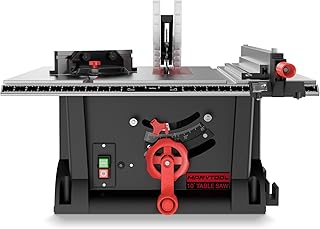
Best for versatile, on-the-go projects this 10″ benchtop saw provides a 15A motor with 4600 RPM for hardwoods, plywood, OSB, and some non-metal materials. Its compact 28.3-pound design makes it easy to carry between job sites. The adjustable blade height and 0-45° bevel deliver flexible cutting options, with a miter gauge and rip fence that help ensure accuracy. It is a solid middle-ground choice for hobbyists who need portability without sacrificing capability.
- Power: 15A; Speed: ~4600 RPM
- Compact and portable: weighs 28.3 lb
- Adjustable 0–90° and 0–45° cuts; includes basic alignment tools
Who it’s best for: builders who need a portable yet capable saw for a mix of materials.
Limitations: 10″ blade limits cross-cut depth compared with larger saws; metal cutting is not emphasized.
DEWALT 15 Amp 8-1/4 in. Compact Jobsite Table Saw

Best for professionals needing reliable on-site work this model offers a 24.5-inch rip capacity, a compact footprint for portability, and a rack & pinion fence system for quick fence adjustments. The result is fast, precise fence positioning and straightforward setup. It is well-suited for light to medium-duty carpentry tasks on job sites or in small workshops where space is at a premium.
- Rip capacity: 24.5 in; compact footprint
- Rack & pinion fence rails for fast, smooth adjustments
- Fence and blade alignment features support accuracy
Who it’s best for: buyers needing robust fence adjustments and a compact design for site use.
Limitations: may have a higher price point versus basic benchtop saws; 8-1/4″ blade limits certain wide-cut tasks.
SKIL 15 Amp 10-Inch Jobsite Table Saw

Best for quick setup and portability this SKIL model features an integrated folding stand, enabling easy transport and storage. The rack and pinion fence rails help keep the fence aligned with the blade for accurate cuts, and the parallel blade alignment feature allows micro-adjustments to ensure precision. It is a solid pick for contractors and DIYers who value speed of setup on busy worksites.
- Integrated folding stand for portability
- Rack and pinion fence rails for parallel cuts
- Parallel blade alignment with micro-adjustments
Who it’s best for: buyers needing fast deployment and straightforward accuracy on job sites.
Limitations: folding stand adds bulk when stored; check weight for transport needs.
Buying Guide
What should I look for in an entry level table saw?
Power, blade size, and build quality are key. Look for at least a 15A motor for versatile cutting in common woods. A 10″ to 8-1/4″ blade is typical in entry level models, with a fence system that stays true under use. Consider dust management if you plan to work indoors.
Should I prioritize portability or cutting capacity?
Portability is crucial for on-site work or tight spaces. If you mostly work in a small shop, prioritize cutting capacity and fence accuracy over portability. For job sites, a compact footprint with a robust fence is more valuable than larger cut-depth only.
What are common limitations of entry level saws?
Most entry level saws have smaller blade diameters and shorter fences. They may lack advanced miter gauges or as precise a fence system as higher-end models. Dust collection can vary, and some models rely on external vacuums for best results.
How important is a stand or portability feature?
A stand improves setup time and stability, especially on uneven surfaces. Folding stands help with storage and transport, but they add weight and bulk. Choose a stand that folds flat and locks securely when in use.
What tasks are best for these saws?
Crosscuts, bevel cuts, and simple rip cuts on boards, plywood, and softwoods are well-suited for entry level saws. Avoid heavy-duty hardwood tasks beyond their capacity without upgrading components or blade quality.
How to compare models quickly?
Make a quick table of rip capacity, maximum bevel angle, blade diameter, motor amperage, and whether a built-in stand is included. Then note dust collection features and fence quality. This helps you choose the model that aligns with your primary use case.
Frequently Asked Questions
- What is the typical blade size on entry level table saws? Answer: Most entry level saws use 8-10 inch blades, suitable for common household and hobby projects.
- Do entry level saws require special maintenance? Answer: Regular cleaning, blade alignment checks, and motor upkeep help maintain accuracy and safety.
- Is a fence important for beginners? Answer: Yes, a solid fence ensures straight cuts and repeatability, which is crucial for learning good technique.
- Can I use these saws for cutting plywood? Answer: Yes, within the saw’s depth and capacity specifications; avoid forcing material beyond limits.
- Should I buy a stand with an entry level saw? Answer: A stand improves stability and portability; many kits include a stand or are compatible with it.
- What safety features matter most? Answer: Soft-start, blade guards, riving knife/anti-kickback features, and proper anti-tip design improve safety in operation.