Answer: A basic handyman tool kit should include versatile, durable hand tools that cover common home repairs and simple projects. This guide highlights five well-rounded kits ideal for beginners and casual DIYers. Whether you’re tackling furniture assembly, quick fixes, or light electrical tasks, these sets offer practical selections and organized storage. The buyers best suited are renters starting their toolkit, homeowners who want a starter kit, and hobbyists expanding from single tools to a complete set. Below is a concise summary table of the featured products to compare at a glance.
| Product | Brand | Best For |
|---|---|---|
| CARTMAN 39-Piece Household Tool Set | CARTMAN Store | Beginner projects, basic repairs, organization |
| Amazon Basics 142-Piece Household Tool Kit | Amazon Basics Store | Comprehensive starter for varied tasks |
| Amazon Basics 65 Piece Home Repair Tool Kit | Amazon Basics Store | Compact, versatile for everyday fixes |
| 32-Piece Basic Home Repair Tool Kit | KAFUWELL Store | Budget-friendly with essential tools |
| Amazon Basics 131-Piece General Tool Set | Amazon Basics Store | Expands capabilities for frequent projects |
CARTMAN 39-Piece Household Tool Set
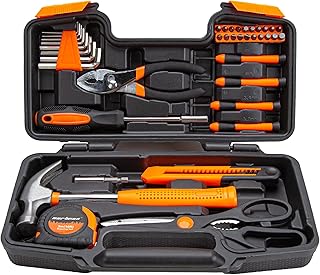
This comprehensive set covers essentials: hammer, pliers, screwdrivers, tape measure, and more. Tools are heat-treated and chrome-plated for corrosion resistance, and the included plastic toolbox keeps everything organized. Best for: beginners setting up a first toolkit and homeowners who want a broad, ready-to-use collection. Caution: the case may be cramped if you add more tools over time.
Amazon Basics 142-Piece Household Tool Kit

This large set is designed for everyday home projects and repairs. It includes a hammer, level, auto-lock tape measure, pliers, screwdrivers, bits, hex keys, a utility knife, and hardware kit. Best for: households needing a wide range of tools in one organized package. Better for: frequent small projects rather than heavy-duty tasks. Caution: larger size means more storage space is required.
Amazon Basics 65 Piece Home Repair Tool Kit

Includes an assortment of hex keys, a fiberglass hammer, a tape measure with auto locking, a torpedo level, and a utility knife with snap-off blades. Best for: compact tool collections that still cover common household tasks. Choose this if you want a lighter, more portable kit. Caution: fewer bits and wrenches than larger sets may limit some repairs.
32-Piece Basic Home Repair Tool Kit with Toolbox

Professional-grade tools with a sturdy case and ergonomic grips. Includes adjustable wrench, long-nose pliers, scissors, tape measure, utility knife, screwdriver bits, hex keys, and more. Best for: users seeking durable materials and a comfortable grip for frequent DIY use. Better for: ongoing projects due to strong construction. Caution: the toolkit may be heavier than ultra-compact options.
Amazon Basics 131-Piece General Tool Set

This set covers a wide range of basic tools, including hex keys, wrenches, precision screwdrivers, an 8-ounce claw hammer, pliers, and more. Made from heat-treated, chrome-plated alloy steel for durability. Best for: expanding a starter toolkit into a more capable collection. Caution: larger set may require more storage and organization.
Buying Guide
What should you look for in a basic handyman tool kit?
Key considerations include tool variety, durability, and storage. Look for heat-treated steel, corrosion resistance, and comfortable grips. A sturdy carrying case or toolbox helps keep tools organized and portable.
What tools are essential for most homes?
Essentials typically include a claw hammer, screwdrivers (flathead and Phillips), pliers, tape measure, utility knife, hex keys, level, and a set of wrenches or a compact hex key set. A utility knife and tape measure are frequent daily-use items.
Should you prioritize size or specialization?
Smaller sets are easier to store and ideal for beginners. Larger kits offer more versatility for a wider range of projects but require more space. Choose a kit that aligns with your project plans and storage options.
How does storage impact usability?
A well-organized toolbox reduces time spent searching for tools. Look for color-coded compartments, labeled trays, or modular cases that can be expanded as you add tools over time.
Best approach for selecting your first kit
Begin with a mid-sized set that covers common needs and includes a durable case. If you anticipate frequent projects, opt for a larger collection with a broader tool assortment. If you rent or have limited space, a compact kit with core tools may be better.
Summary of top picks by scenario
- Best all-around starter: Amazon Basics 142-Piece Household Tool Kit
- Best compact option: Amazon Basics 65 Piece Home Repair Tool Kit
- Best budget-friendly full-featured set: CARTMAN 39-Piece Household Tool Set
- Best durable build: 32-Piece Basic Home Repair Tool Kit (KAFUWELL)
- Best expanded capability: Amazon Basics 131-Piece General Tool Set
FAQ
- What is the most important tool to own first? Answer: A reliable hammer and a versatile screwdriver set, as many household tasks begin with fastening or prying components.
- Are chrome-plated tools better for beginners? Answer: They resist corrosion and are generally easier to clean, beneficial for longevity and maintenance.
- Should I buy a large set or several smaller sets? Answer: A large set offers variety, but a focused starter kit can be easier to manage and store for beginners.
- Do these kits include electrical testing tools? Answer: Some kits may include basic testers; check the product features to confirm included electrical tools.
- Is a carrying case necessary? Answer: A case helps organization and transport, especially for beginners who gradually build their collection.
- How do I upgrade my toolkit over time? Answer: Start with core tools, then add specialty items (slot-head bits, extra wrenches, or extra pliers) as projects require.