Answering the top buyer questions about 10-inch single bevel compound miter saws, this guide highlights five strong options and explains who each is best for. These saws are ideal for DIYers, woodworkers, and pro remodeling projects that require precise bevel and miter cuts. Each product section notes who benefits most, plus a practical limitation to consider for your workshop setup. A compact buying table at the start helps compare key features at a glance.
| Product | Best For | Notable Feature |
|---|---|---|
| Metabo HPT C10FCG2 | Builders on a budget, light-to-medium projects | Powerful 15-amp motor, 5000 RPM |
| DEWALT DWS713 | Pros seeking precision and durability | 14 positive mitre stops, robust miter system |
| SKIL MS6305-00 | Budget-conscious users needing dual bevel | Dual bevel with four stops, LED shadow line |
| Marvtool 10″ Sliding | Versatile cuts with extension table | Slide and extension capabilities |
| DEKOPRO 10-Inch | Entry level with solid feature set | 5,000 RPM, 0–45° bevel |
Metabo HPT 10-Inch Compound Miter Saw, C10FCG2

The Metabo HPT C10FCG2 pairs a 15-amp motor with a compact, portable form. Its no-load speed up to 5,000 RPM supports efficient, precise cuts for wood and similar materials. The design emphasizes user-friendliness with an improved miter scale and straightforward controls, aiding repeatable accuracy. A large 10-inch table enhances material support, while a robust vise clamp helps keep workpieces steady during cuts. Weighing about 24 lbs, this model is easy to transport between job sites.
Best for: DIYers and small shops needing a balance of power and portability without sacrificing accuracy. Limitations: the single bevel design may require flipping for certain bevel-to-mull orientation tasks, potentially increasing setup time for complex cuts.
DEWALT Miter Saw, Single Bevel, DWS713

The DEWALT DWS713 brings a stainless-steel miter detent plate with 14 positive stops and a precise miter system. The machine also offers a machined base fence support for stability, and a tall sliding fence capable of handling 4-1/4-inch base vertically. This combination makes it well-suited for accurate, repeatable cuts on trim, molding, and framing projects. Best for: professionals or serious hobbyists who rely on precise stop settings and a sturdy fence system. Limitation: the single bevel design may limit bevel versatility compared with true dual-bevel models.
SKIL 10″ Dual Bevel Sliding Miter Saw MS6305-00

The SKIL MS6305-00 features a 15-amp motor delivering up to 4,800 RPM, which supports quick, detailed cuts. Its dual-bevel capability enables bevel cuts at 0°, 45°, and left/right 45°, while an LED shadow line helps with alignment and precision. Best for: users who value versatility in angles and who want an economical option with reliable dual-bevel capability. Caution: some users find the dual-bevel mechanism somewhat heavier or bulkier than single-bevel counterparts.
Marvtool 10-Inch Compound Miter Saw, 5000RPM

The Marvtool 10-Inch Compound Miter Saw offers a 15-amp motor with up to 5,000 RPM to handle wood, plastics, and other common workshop materials. It includes a transparent blade guard for visibility and a vise clamp to secure workpieces. A dust collection bag helps keep the workspace cleaner. Best for: projects requiring solid, consistent power in a compact package. Limitation: advertised versatility includes metal and laminate work, which may require blade changes for optimal results on non-wood materials.
Marvtool 10-Inch Sliding Compound Miter Saw
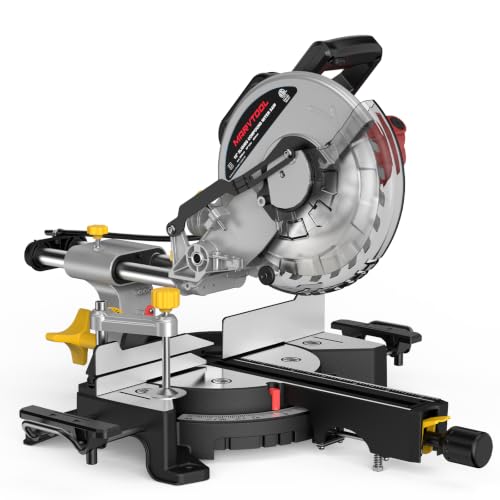
This Marvtool model resembles a sliding compound miter saw with extended reach. It supports left miter angles from 0° to 45°, and bevels 0° to 45°, with an extension table similar to the fixed version. It emphasizes safety and precision with a vise clamp and a dust bag for cleanup. Best for: users needing extended capacity and flexible angle adjustments in a single-saw setup. Limitation: sliding functionality can add weight and require more space in tighter shops.
DEKOPRO 10-Inch Compound Miter Saw

The DEKOPRO 10-Inch Compound Miter Saw provides a 13-amp motor and reaches up to 5,000 RPM, with 0–45° bevel and 0–45° miter range. A large work table and a clamp system help stabilize materials for cleaner, more accurate cuts. Best for: entry-level users seeking a capable, budget-friendly option. Caution: the lighter design may feel less rigid on heavy-duty tasks compared with some pro-grade models.
Buying Guide
Key considerations when choosing a 10-inch single bevel compound miter saw include motor power, bevel range, and stability features. A 15-amp motor with 4,800–5,000 RPM typically delivers sufficient speed for most woods and light plastics. A single bevel is simpler and lighter, but dual-bevel options offer more flexibility without flipping the saw. Look for a solid miter detent system, positive stops, and a sturdy base and fence for accurate repeat cuts. A large extension table and a reliable clamp improve cutting precision on longer workpieces. Portability is important for job sites; models around 24 pounds balance power and transportability well.
For workshop layout, consider included features such as laser guides or LED shadow lines, which help with alignment. Laser guidance can provide precise cut lines, but ensure the system is easy to calibrate and doesn’t require frequent adjustment. Dust collection and a bag help keep the workspace clean, but actual dust control varies with blade type and material. If space is limited, sliding and extension-capable models offer greater flexibility but take up more room.
FAQ
- What is the advantage of a single bevel miter saw?
Single bevel saws are lighter and easier to use for most standard cuts, with bevels allowing you to tilt the blade in one direction for compound cuts. - Do I need a dual-bevel model for trim work?
Dual-bevel models offer bevel adjustments in both directions without flipping the workpiece, which can speed up certain trim and crown molding tasks. - Is a laser guide essential for accuracy?
Laser guides improve alignment in many setups, but they should be paired with solid measurement practices and a stable fence for best results. - Can these saws cut metal or plastic effectively?
Some models claim multi-material capability, but blades and feed rates must be appropriate for each material; wood-focused blades yield the best results on wood. - What maintenance is needed for a miter saw?
Keep blades sharp, clean the dust, check the blade guards for smooth operation, and ensure the clamp and fence are secure for accurate cuts. - Which saw is best for portability?
Models around 24 pounds with a compact design are typically easiest to transport for on-site work.