If you want clean, repeatable 35mm hinge cup holes for European-style concealed hinges, a cabinet hinge hole jig is essential. This guide highlights top jigs for DIYers and professional woodworkers, focusing on accuracy, ease of use, and dust control. The best options fit a range of cabinets—from kitchen to bathroom vanities—and accommodate common hinge offsets. The table below summarizes the five recommended jigs and who they’re best for.
| Product | Best For | Key Feature |
|---|---|---|
| Kreg Concealed Hinge Jig | Professional upgrades and precise cup holes | Four-cutter carbide bits with stop collar for controlled depth |
| RUITOOL 35mm Concealed Hinge Jig System | One-person installations with alignment system | Snap-on ruler system for identical hole placement |
| GOINGMAKE Metal Concealed Hinge Jig | Dust-free drilling with built-in vacuum adapter | Built-in dust bracket and adjustable depth (0–0.6 in) |
| Bestgle 35mm Concealed Hinge Jig Kit | Budget-friendly, quick-start projects | Forstner bit and 35mm drilling guide for fast results |
| Gohelper Metal Concealed Hinge Jig | Flexible hinge offsets and repeatable holes | Wide offset range (2–8mm) with three-point stability |
Kreg Concealed Hinge Jig

The Kreg jig provides a dedicated 35mm cup drilling system with four-cutter carbide-tipped bits and a stop collar for precise, repeatable depth. It supports hinge offsets of 3–6mm, allowing flexible placement on doors. Best for professionals or serious hobbyists who require repeatable accuracy and depth control. A caution: setup requires some familiarity with hinge spacing to maximize accuracy across multiple doors.
RUITOOL 35mm Concealed Hinge Jig System

The RUITOOL system functions as both a hinge drilling guide and a cabinet door mounting jig. Its built-in alignment system keeps doors flush and ready for one-person installation. The snap-on ruler ensures identical hole placement across multiple doors, with adjustable margins at 3–6mm and standard pilot spacings to fit most 35mm concealed hinges. Best for one-person jobs or shop environments where speed and alignment are priorities. Limitation: assembly may require careful alignment when switching door thicknesses.
GOINGMAKE Metal Concealed Hinge Jig

GOINGMAKE emphasizes durability with an all-metal construction and a built-in dust bracket that connects to vacuum hoses. The jig supports 0–0.6 inch drilling depths and 3–6mm edge margins, making it suitable for standard 35mm hinges and different door overlays. Best for workshops needing dust control and a sturdy, fast setup. Caution: may be heavier than plastic counterparts, which could affect ease of handling on small doors.
Bestgle 35mm Concealed Hinge Jig Kit

The Bestgle kit is positioned as an efficient, lightweight option using engineering plastic for easy handling. It speeds up drilling relative to traditional methods and is designed for home use—ideal for DIY cabinet projects. Choose this if you want a budget-friendly start or quick, straightforward installations. Limitation: may not offer the same long-term durability as all-metal jigs for frequent professional use.
Gohelper Metal Concealed Hinge Jig
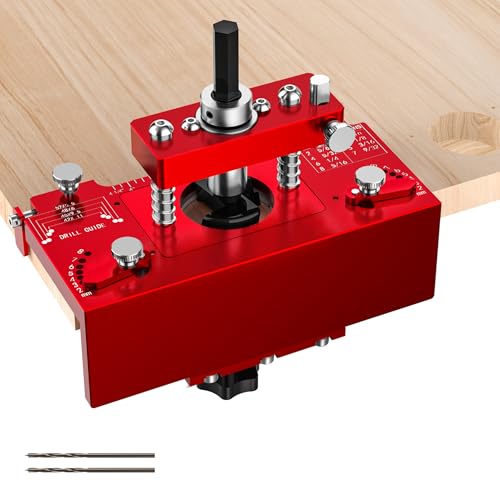
The Gohelper jig features a wide 2–8mm offset range and a three-point stability system for repeatable hole drilling. It includes a built-in 15mm depth stop and compatibility with common hinge spacings, making it versatile for various concealed hinges, including Blum and Grass brands. Best for frequent hinge installation with varying offsets. Caution: ensure the three-point stabilization is correctly engaged to avoid drift on larger doors.
Buying Guide
What should you check before buying a cabinet hinge hole jig?
- Depth control: Look for a jig with a fixed depth stop or adjustable depth to avoid drilling too deep into the door.
- Offset range: Choose a model with adjustable hinge offsets (commonly 3–6mm or wider) to fit different hinges and door overlays.
- Material and durability: All-metal jigs tend to be sturdier and longer-lasting than plastic ones; consider your project frequency.
- Guidance and alignment: Rulers, edge margins, and snap-on guides reduce measurement errors and save time on multiple doors.
- Dust management: Built-in vacuum adapters or dust brackets can keep work surfaces cleaner and improve accuracy.
- Installation footprint: Ensure the jig can clamp securely to the door and accommodate your door thickness and style.
Frequently Asked Questions
- What is a 35mm concealed hinge jig used for?
It guides precise drilling for European-style concealed hinge cups in cabinet doors, ensuring consistent spacing and alignment across multiple doors.
- Can I use these jigs with any drill?
Most jigs are designed to work with standard hand drills, but some provide built-in stops or depth control to standardize results across tools.
- What is the typical hinge offset range I should look for?
Common ranges are 3–6mm, with some models offering wider offsets up to 8mm for flexibility with various cabinet designs.
- Is dust control important for hinge drilling?
Yes. Dust control helps maintain cleaner work surfaces and may improve accuracy by reducing particle interference during drilling.
- Are all-metal jigs worth the extra cost?
For frequent use or professional work, yes. Metal jigs are generally more durable and offer longer life under repeated drilling.
- Which jig is best for one-person installation?
Jigs with built-in alignment guides and snap-on rulers are particularly suited for one-person installations, such as the RUITOOL system.