Find the best straight line jig for your table saw to achieve precise, repeatable cuts. This guide compares top options designed for straight ripping and tapered work, highlighting who each jig is best for, plus practical tips to choose the right one. Ideal buyers include hobby woodworkers seeking consistent strips, cabinet makers needing accurate straight cuts, and furniture builders aiming for clean tapered legs.
Summary of featured products:
- POWERTEC 71395 Taper/Straight Line Jig for Table Saws
- Rockler Taper Jig/Straight Line Jig
- Peachtree Woodworking Supply Adjustable Taper/Straight Line Jig
- POWERTEC Table Saw Tapering Jig (71875)
- GOINGMAKE Thin Rip Jig Table Saw Jig Guide
POWERTEC 71395 Taper/Straight Line Jig

The POWERTEC 71395 serves as both a taper jig and a stable straight line ripping jig. It includes a 36” miter bar, adjustable fence, hold-down clamps, and abrasive grip strips for stability. Best for woodworkers who want a dual-purpose jig that supports taper cuts and reliable straight ripping. Caution: setup requires careful alignment and securing stock to prevent shifting during cuts.
Who it’s best for: hobbyists or small shops that want a versatile jig without buying separate taper and straight-line devices.
Why selected: It combines an ample base size with locking features and angle indexing, enabling repeatable taper and straight cuts in a single jig.
Limitations: The included hardware and base are MDF-based; ensure you inspect for wear after extensive use.
Rockler Taper Jig/Straight Line Jig
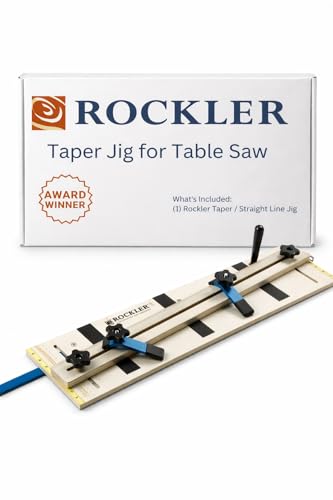
Rockler’s Taper & Straight Line Jig is designed for fast tapered cuts and, with the miter bar removed, acts as a stable straight-line ripping jig. It fits standard 3/8″ x 3/4″ miter slots and features an ergonomic handle for smooth push-action. Best for chair legs, table legs, and similar projects. Caution: rely on proper clamping to prevent movement when working with long stock.
Who it’s best for: woodworkers prioritizing quick tapered cuts and a dedicated straight-line mode for long stock.
Why selected: Its versatility and clear indexing system streamline both tapering and straight ripping without swapping components.
Limitations: The setup depends on precise slot fit and clamp security; misalignment may affect accuracy.
Peachtree Woodworking Supply Adjustable Taper/Straight Line Jig

This adjustable taper jig supports precise tapering and can double as a straight-line ripping jig when the miter bar is removed. It emphasizes precise clamps and adjustable settings to align angles and lengths. Best for craftspeople who need dependable, repeatable tapered cuts with the option to convert to straight-line ripping. Caution: check maximum stock height to ensure compatibility with your projects.
Who it’s best for: cabinetmakers and carpenters who routinely produce tapered components and require reliable straight-line capability.
Why selected: The dual-function design, along with quick adjustments, helps keep workflow efficient for varied tasks.
Limitations: Might require additional setup time to convert between modes for first-time users.
POWERTEC Table Saw Tapering Jig (71875)

The POWERTEC 71875 is a compact taper jig with a 12” miter bar and a melamine-coated MDF base. It focuses on taper cuts while also functioning as a straight-line jig when needed. Best for small shops or projects with limited space. Caution: smaller footprint may limit the maximum stock length for long rip cuts.
Who it’s best for: woodworkers needing a smaller, affordable taper option that still doubles as a straight-line guide.
Why selected: Lightweight design and simple setup make it a practical choice for quick tapering tasks without sacrificing straight-line capabilities.
Limitations: The smaller base could limit support for very long workpieces during ripping tasks.
GOINGMAKE Thin Rip Jig Table Saw Jig Guide

The GOINGMAKE thin rip jig is designed for making repetitive narrow strip cuts. It fits 3/8″ x 3/4″ T-slot and U-slot tracks, with an anti-kickback roller to enhance safety. Best for users performing numerous thin strips or precise narrow cuts. Caution: ensure compatibility with your T-slot type and slot size before purchase.
Who it’s best for: users who frequently cut thin strips and need consistent thickness across many pieces.
Why selected: The combination of a one-way roller and laser-engraved scales helps maintain uniform depth and thickness across cuts.
Limitations: May require accurate slot matching; not all tables saws may support every slot profile.
Buying Guide
Key considerations when choosing a straight line jig for table saws include slot compatibility, jig size, and whether you need dual taper/straight functionality. If you regularly produce tapered components and straight-rip tasks, a dual-purpose jig can save time. For long stock, prioritize a larger base and secure clamps. If space is limited, a compact jig with reliable straight-line capability can be advantageous. Safety features such as anti-kickback rollers and robust hold-downs help prevent movement during cuts. Look for easily adjustable fences and clear indexing to ensure repeatable results.
Slot compatibility and fit
Most jigs shown here fit standard 3/8″ x 3/4″ mitre slots. Verify slot type (T-slot or U-slot) on your table saw before purchasing to ensure a secure fit and accurate cuts.
Dual functionality or specialized use
Some jigs are designed as taper jigs with straight-line options. Choose a dual-purpose model if you frequently switch between taper cuts and straight ripping to minimize setup time and tool clutter.
Base size and workpiece support
A larger base improves stability for long stock. If you work with chair legs or table legs, consider a jig with extended support and strong hold-down clamps to prevent stock shifting.
Ease of use and setup
Pre-assembled designs or tool-free adjustments reduce setup time. Look for clear calibration marks and ergonomic handles for smooth operation during repeated cuts.
Safety considerations
Anti-kickback features and secure clamping reduce the risk of stock movement. Ensure you follow best practices for guarding and use push blocks as appropriate to maintain safe cutting distances from the blade.
Maintenance and longevity
Jigs with melamine-coated MDF bases resist wear for longer use. Check grip strips and clamps periodically and replace any worn components to preserve accuracy over time.
Frequently Asked Questions
- What is a straight line jig for a table saw used for?
It guides stock through straight ripping cuts and can be used for tapered cuts when designed as a taper/straight line jig.
- Do I need a separate taper jig if I already have a straight line jig?
Not necessarily. Some jigs combine taper and straight-line functionality, reducing setup time and tool clutter.
- What slot sizes do these jigs typically fit?
Most fit standard 3/8″ x 3/4″ mitre slots; verify exact slot type (T-slot vs U-slot) on your saw before purchasing.
- Is a larger base always better for straight ripping?
Generally yes for long workpieces, as it provides more stock support and stability, minimizing wobble during cuts.
- What safety features should I look for in a jig?
Anti-kickback features, secure hold-down clamps, and ergonomic handles that keep hands away from the blade are important.
- Can these jigs be used on different brands of table saws?
Many are designed to fit common slot sizes and can work across brands, but always confirm slot compatibility with your saw model.