Answering the top search question for DIYers and HVAC professionals: choose a 1/2 inch copper tubing bender that delivers clean, consistent bends with minimal effort and material stress. This guide highlights five reliable options suitable for soft copper and alloy tubes, and explains which buyer profiles benefit most from each. Whether you’re a homeowner tackling a small A/C line or a pro wiring complex refrigeration loops, these tools help you achieve accurate 180° or angled bends with less fatigue.
| Product | Best For | Key Benefit |
|---|---|---|
| Imperial Tool 370FH Triple Head 180 Degree Tube Bender | Versatile pros | Integrated markings and comfort grip |
| VEVOR Pipe Tube Bender (3-in-1) | General HVAC and automotive | Three sizes in one, even force distribution |
| iCrimp 1/2″ Tubing Bender | Tight spaces | Cross-free 0-180° action |
| Antstone 1/4” 3/8” 1/2” O.D. Tubing Bender | Lightweight setups | Three-in-one design with aluminum body |
| RopeTon 1/4″, 3/8″, 1/2″ O.D. Tubing Bender | Budget-friendly kits | Clear tube compatibility and bending radii |
Imperial Tool 370FH Triple Head 180 Degree Tube Bender
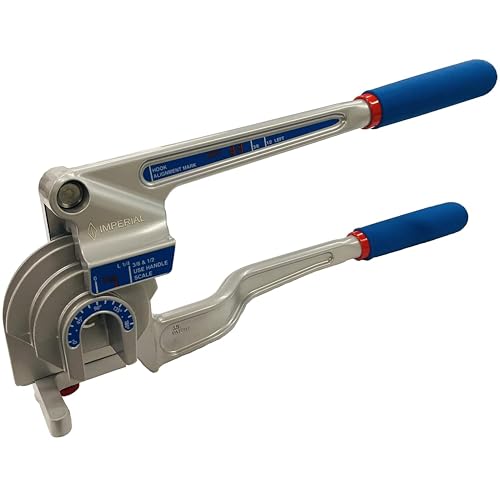
Best for: Pros handling multiple tube sizes in one job. This bender can bend 1/4″, 3/8″, and 1/2″ O.D. tubes, with a special 3/16″ O.D. option via the 1/4″ slot. It creates precise bends with integrated calibration markings for left-hand, right-hand, and offset bends. Cushioned handles reduce operator fatigue during long sessions.
Why selected: The triple-head design minimizes tool changes on a single project, saving time. Integrated markings help ensure repeatable results, and the light yet durable die-cast aluminum construction strikes a balance between ease of use and durability. A potential limitation is that larger 1/2″ bends may require careful alignment to avoid kinks when tubing is routed tightly.
VEVOR Pipe Tube Bender, 1/4″, 3/8″, 1/2″ (3 in 1)

Best for: General HVAC and automotive workers needing a three-size option in one tool. This bender supports 1/4″, 3/8″, and 1/2″ O.D. tubes and provides a 0-180° bend range with even force distribution to prevent deformation. The handle length is generous for leverage, but note that tubes thinner than 0.5 mm may risk damage if over-bent.
Why selected: The 3-in-1 design reduces kit clutter and expands versatility for different projects. It excels when you need consistent bends across multiple tube sizes without swapping tools. Limitation: the device may require careful setup with very delicate walls to avoid flattening on aggressive bends.
iCrimp 1/2″ Tubing Bender
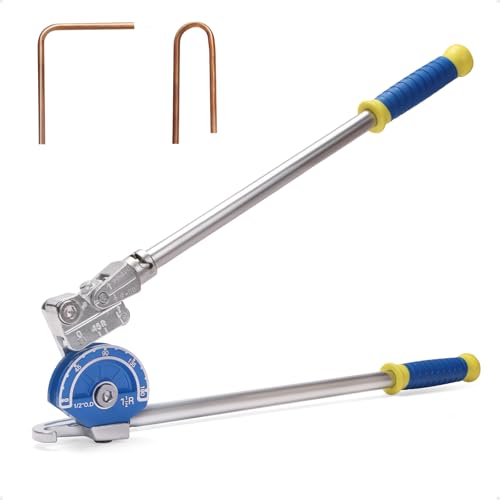
Best for: Installers working in tight spaces where cross-free bends matter. It features a 0°-180° range with a cross-free action, allowing 90° to 180° bends without handle interference. The laser-cut track and sealed ball-bearing rollers provide smooth operation on copper, aluminum, and some stainless tubes.
Why selected: The design minimizes the risk of crossovers and scratches on sensitive tubing. Suitable for complex layouts such as refrigerator coils or hydronic loops. Limitation: the tool is optimized for 1/2″ OD copper or similar tubing; very thick-walled or unusually tough metals may demand more force beyond its intended range.
Antstone 1/4” 3/8” 1/2” O.D. Tubing Bender

Best for: Lightweight setups where you want a reliable 3-in-1 tool in a single aluminum body. It supports soft copper and aluminum tubes with wall thickness between 0.027″ and 0.059″ and provides bending radii of 0.82″, 1.14″, and 1.43″ across 0–180° range.
Why selected: The high-quality aluminum body keeps weight down while delivering adequate strength for routine HVAC and refrigeration work. Caution: tubes with walls thicker than 0.059″ may not bend cleanly and could deform.
RopeTon 1/4″, 3/8″, 1/2″ O.D. Tubing Bender

Best for: Budget-conscious buyers who still need a capable three-size bender for soft copper and aluminum tubes. It covers 1/4″, 3/8″, and 1/2″ OD with bending radii in the low-to-mid range and a quick-action trigger for easier tube positioning.
Why selected: The setup focuses on practical bending in common HVAC refrigerant lines and air-conditioning connections. Limitation: verify outside diameter before use to ensure compatibility with your pipe; nominal 1/2″ pipes can vary in actual OD.
Buying Guide: Key Considerations For 1/2″ Copper Tubing Benders
- Tube compatibility: Confirm that the bender supports 1/2″ OD copper or aluminum tubing and check wall thickness limits to avoid deformation.
- Bend range and geometry: Look for 0–180° capability, with clear radii options to fit tight spaces or broad layouts. Consider models with integrated angle guides or lasers for accuracy.
- Adaptability: If you frequently switch between sizes, a 3-in-1 model reduces tool swaps. Velvety handle grips reduce fatigue on long jobs.
- Material and construction: Aluminum or steel bodies balance weight and durability. A robust build helps maintain bend precision over time.
- Ease of use: Cross-free operation and smooth track systems prevent scratches and kinks on delicate tubes. A simple locking or release mechanism helps reposition mid-bend.
- Limitations: Some tools specify minimum wall thickness or warn against very thin or very thick walls. Check for potential tube deformation at extreme angles.
- Portability and storage: Compact, lightweight designs are ideal for field service. If you work on trucks or rooftops, consider a tool with ergonomic grips and a compact footprint.
FAQ
- What tube sizes can a typical 3-in-1 bender handle? Most models support 1/4″, 3/8″, and 1/2″ outer diameter tubes.
- Is a 0-180° bend necessary for HVAC work? Yes, many installations require full-face bends around fittings or in cramped spaces.
- Can I bend thick-walled copper with these tools? Check the specified wall-thickness limits; very thick walls may not bend cleanly.
- Should I choose a lightweight aluminum bender over steel? Aluminum is lighter and comfortable for extended use, but steel can offer extra rigidity for frequent heavy bending.
- Are 3-in-1 benders better for beginners? They reduce the number of tools needed and can simplify workflow, but ensure you understand each diameter’s bend behavior.
- How can I prevent kinking on sensitive tubing? Use a tool with a smooth track and avoid too-tight corners; practice with scrap tube to dial in technique.