Answer: Ribbed wafer head screws are ideal when you need a flush, clean finish on fiber‑cement board, metal, and light‑gauge applications. This guide showcases top ribbed wafer head options suitable for fiber‑cement projects, metal fastening, and general household and shop use. Each pick targets a specific task: fiber‑cement fastening, trim and flashing, or quick self‑drilling installations. The list below helps buyers choose the right length, drive type, and head style for their project.
| Product | Type | Length | Drive | |
|---|---|---|---|---|
| Simpson Strong‑Tie CB3BLG114S | Fiber‑cement board screw | 1-1/4 in. | #3 Square | Ribbed wafer head, Type 17 point |
| Simpson Strong‑Tie CB3BLG158S | Fiber‑cement board screw | 1-5/8 in. | #3 Square | Ribbed wafer head, Type 17 point |
| Simpson Strong‑Tie CB3BLGHL158S | Fiber‑cement board screw | 9 x 1-5/8 in. | #3 Undersized | Ribbed wafer head with nibs |
| Mid Michigan Metal 8 x 9/16″ Wafer Head Trim | Wafer head trim screw | 9/16 in. | Phillips | Ultra‑low profile for clean finish |
| Small Parts 1016KWAFMS | Self‑drilling wafer head | 1 in. | #3 Star | Wafer head, zinc plated |
Simpson CB3BLG114S Fiber-Cement Screw

Best for exterior fiber‑cement board installations where boards must fasten securely to wood framing. The 1-1/4 in. length suits typical backerboard and underlayment jobs. The ribbed wafer head provides a clean, low‑profile finish that minimizes surface marring while maintaining holding power. The Type‑17 point supports quick starts in dense substrates. Choose this if you work with fiber‑cement and need flush results, especially on large exterior projects.
Caution: Undersized #3 square drive can be less forgiving on tight screws; ensure correct bit fit to prevent cam-out during driving.
Simpson CB3BLG158S Fiber-Cement Screw

Best for longer fiber‑cement installations where board thickness and spacing demand extended engagement. At 1-5/8 in., this screw increases anchorage in wood framing while preserving a neat surface finish. The ribbed wafer head and Type‑17 point continue to offer fast driving and a clean appearance. Ideal for experienced installers handling larger fiber‑cement panels or backerboard in exterior walls.
Caution: Lengthier screws can protrude if boards are unusually thick; verify substrate depth before installation.
Simpson CB3BLGHL158S CB3BLGHL Fiber-Cement Screw
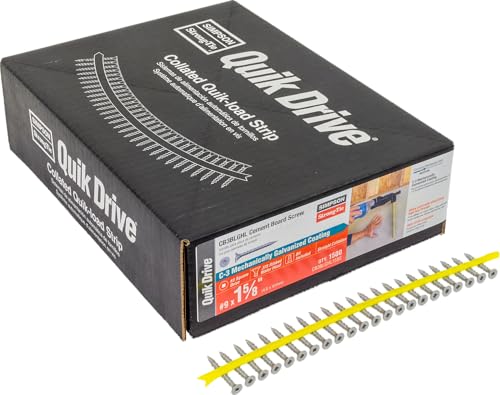
Best for high‑hold demands where nibs on the ribbed wafer head help countersinking and minimize surface marring during countersinking. The 9 x 1-5/8 in. length and #3 undersized square drive are suited for heavy fiber‑cement backer installs. Alternating high‑low threads improve driving efficiency in dense substrates. Use this when extended reach and a flush finish matter most in exterior installations.
Limitation: The undersized drive may require specific driver bits; keep BIT3SU replacement bits on hand for efficiency.
Mid Michigan Metal Wafer Head Trim Screw

Best for projects where appearance matters and a near flush finish is essential. The ultra‑low profile wafer head is excellent for trim, flashing, and decorative panels, as well as HVAC ductwork and metal enclosures. The self‑piercing point helps speed up installation in thin metal and wood. Choose this if you want speed with a clean, professional look.
Caution: Not ideal for thick gauge metal or high‑pull‑load structural applications where deeper penetration would be required.
Small Parts 1016KWAFMS Self‑Drilling Wafer Head Screw

Best for quick, self‑drilling metal fastening where a straight, flush finish is desired. The wafer head provides a low profile, while the star drive and 1 in. length support fastening in light‑gauge metal and thin wood. It is suitable for repetitive tasks like HVAC paneling and lightweight metal framing.
Limitation: Not a heavy‑duty choice for thick metal or hardwood substrates where longer, reinforced fasteners are needed.
Buying Guide: Key Purchase Considerations
- Material compatibility: Choose fiber‑cement screws for concrete boards and wafer head screws for metal or trim work. Ensure the screw length matches substrate thickness plus backing material.
- Head design: Ribbed wafer heads provide flush finishes and reduced surface marring. Consider nibs and countersinking features for a clean look.
- Drive and bit type: Square drives (undercut) offer solid torque. Star and Phillips drives vary in availability and bit compatibility; have spare bits on hand.
- Threading: Coarse threads grip better in fiber‑cement and wood; alternating high‑low threads improve drive efficiency in dense substrates.
- Self‑drilling vs. pre‑drilled: Self‑drilling options save time, especially on metal; ensure the metal thickness warrants self‑drilling capability.
- Length and gauge: Longer screws increase holding power but risk protrusion; shorter screws reduce risk but may not reach framing depth.
- Finish and corrosion resistance: Zinc plating resists corrosion; exterior installations benefit from corrosion‑resistant coatings.
FAQ
- What is a ribbed wafer head screw best used for?
They provide a flush finish with strong holding power, ideal for fiber‑cement backerboards, trim, and light metal work. - Why choose Type‑17 point screws?
Type‑17 points start easily in dense materials, improving penetration and reducing splitting in fiber‑cement. - When is a longer screw necessary?
Use longer screws for thicker boards or when fastening through multiple layers into wood framing. - Are undersized square drives harder to use?
They can be more challenging if the bit doesn’t fit perfectly; ensure you use the correct bit with the screw size. - Can I mix wafer head trims with fiber‑cement screws?
Yes, for projects requiring different finishes, but keep to compatible lengths and loads for each substrate. - Do self‑drilling screws replace pre‑drilling?
In many thin metals, yes; for dense substrates or thick materials, pre‑drilling may still be needed.