Answer: The best 5.5 inch saw blades deliver clean, precise cuts for framing, finishing, and general woodworking. These blades suit different buyers: hobbyists seeking affordability, professionals requiring durability and fast cuts, and DIYers needing versatility. Below are five well-rounded options with clear strengths and practical limits, plus a Buying Guide to help you compare specs like tooth count, kerf, and arbor size.
| Product | Tooth Count | Arbor | Best For |
|---|---|---|---|
| Revvstark 5-1/2″ (10mm Arbor) Circular Saw Blades | 24T / 48T | 10 mm | Versatile framing and finishing cuts |
| Ryltanks 5-1/2 Inch Circular Saw Blades (4-Pack) | 24T / 36T / 48T / 130T | 10 mm | Combo pack for framing, ripping, and finishing |
| Diablo Fast Framing Saw Blade 5-1/2″ | 18T | 20 mm | Heavy framing with durable TiCo carbide |
| ANGELSWORD 5-1/2 Inch Circular Saw Blade | 24T / 48T | 10 mm | Fast cuts in framing and fine finish work |
| UXACE 5-1/2-Inch 40-Tooth Circular Saw Blade | 40T | 10 mm | Smooth finish for plywood and laminates |
Revvstark 5-1/2 Inch Circular Saw Blades

The Revvstark blades come in 24T and 48T variants, with a 10 mm arbor. They use durable alloy steel and carbide teeth for heat and wear resistance, aiming for true cuts in wood, plastics, and composites. The kerf is designed to be ultra-thin for fast, clean cuts, improving efficiency on crosscuts and rip cuts. Best for: woodworkers needing a dual-tooth configuration for framing and finishing with reliable edge quality.
Caution: The data notes 8,000 RPM maximum, so avoid use with equipment exceeding that speed. Also, as with most carbide blades, tooth durability depends on feed rate and material hardness.
Ryltanks 5-1/2 Inch Circular Saw Blades (4-Pack)

The Ryltanks set features 24T, 36T, 48T, and 130T blades, all with 10 mm arbors and a 0.063″ kerf for balanced waste and smooth cuts. This combination covers framing (24T), ripping/cross-cutting (36T), fine finishing (48T), and sharp edges for plywood and OSB (130T). Best for: users who need a versatile pack that can adapt to different cut types without switching blades.
Caution: The 130T blade is designed for finish work and may be slower on heavy ripping compared with lower-tooth blades.
Diablo Fast Framing Saw Blade

Diablo’s 5-1/2″ blade uses Hi-Density TiCo carbide for framing tasks and offers a multi-arbor capability with bushings for 1/2″, 5/8″, 10 mm, and 20 mm arbors, supporting a broad range of saws. Thin laser-cut kerf reduces material waste and power requirements. Best for: professionals needing a long-lasting blade that handles frequent framing cuts with clean edges.
Caution: The 18° hook angle and 0.049″ kerf may produce aggressive cuts on very hard materials; feed rate control remains important for crisp finishes.
ANGELSWORD 5-1/2 Inch Blade Set
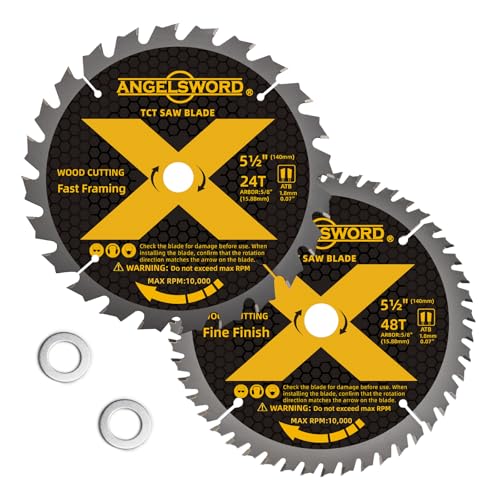
The ANGELSWORD blades come in 24T and 48T, with a 10 mm arbor and bushings included. They feature high-quality plate and thin kerf for fast, smooth cuts and carbide teeth for wear resistance. Best for: those who need a balanced blade for framing and fine finish tasks in one package. Caution: The included bushings ensure compatibility; verify arbor size before installation.
UXACE 5-1/2-Inch 40-Tooth Blade

The UXACE blade offers 40T with a 10 mm arbor and a thin kerf design for plywood, MDF, and laminated surfaces. The TiCo carbide tips are positioned for smoother cuts and improved durability. Best for: DIYers and professionals cutting softwood, plywood, and laminates who value a higher tooth count for clean edges. Caution: Higher tooth counts may reduce cutting speed on very hard woods compared to lower-T blades.
Buying Guide
What should I look for in a 5.5 inch saw blade?
Key factors include tooth count, kerf width, arbor size, and material quality. A lower tooth count (like 18-24T) favors fast, aggressive cuts in framing or rough work, while higher tooth counts (30-130T in some packs) prioritize smooth finishes and minimal tear-out on plywood and laminates. A 10 mm arbor is common for many small circular saws; confirm compatibility with your tool.
Which blade is best for framing versus finishing?
- Framing: blades with 18-24T are typically preferred for quick, durable cuts in lumber.
- Finishing: blades with 48T or higher (up to 130T in some packs) provide finer finishes with reduced tear-out on plywood and veneers.
Is a multi-pack more cost-effective for a small shop?
Yes. A multi-pack offers a mix of tooth counts (24T, 36T, 48T, and sometimes 130T) that cover framing, ripping, cross-cutting, and finishing. This flexibility reduces blade swaps and can lower long-term costs, especially for projects with varied materials.
How important is kerf thickness?
Thin kerf blades waste less material and require less power, which is advantageous for cordless saws and sensitive materials. However, very thin kerf blades can be more prone to deflection on hard cuts; reinforce proper feed pressure and material support.
Are interchangeable bushings necessary?
Yes, bushings expand compatibility across saws with different arbor sizes. When selecting a blade, check whether a 1/2″, 5/8″, 10 mm, or 20 mm arbor is supported or included. This avoids incompatible fits and ensures secure mounting.
Maintenance tips for longevity
- Keep blades clean and free of pitch; wipe after use to prevent buildup.
- Store blades in a dry location to prevent rust on premium carbide teeth.
- Use the correct feed rate to reduce heat and tooth wear.
Quick comparison at a glance
- Best all-around framing and finishing: Revvstark and ANGELSWORD (24T/48T).
- Best value for mixed tasks: Ryltanks 4-pack with 24T, 36T, 48T, and 130T.
- Best for finish cuts on plywood and laminates: UXACE 40T.
Frequently asked questions
- What is a 5.5-inch blade best used for? – It is suitable for compact circular saws performing framing, ripping, cross-cutting, and finishing tasks on wood, plywood, and composites.
- Do I need different blades for plywood and hardwood? – Yes. Higher tooth counts give smoother finishes on plywood, while lower tooth counts handle hardwood more aggressively.
- Can I use these blades on cordless saws? – Yes, provided the arbor size and Kerf match your saw and the RPM is within the blade’s rating.
- Should I buy a set or single blade? – A set provides versatility for a range of materials and cuts, letting you switch as material changes without shopping mid-project.
- How important is Arbour compatibility? – Very. An incorrect arbor can cause wobble or mounting failure and reduce cut quality.
- Are carbide blades safer for beginners? – Carbide blades offer longer life and cleaner cuts, but they require proper technique and blade speed to avoid kickback and chipping.