When outages strike, a portable back up generator provides essential power for essentials like refrigeration, lighting, and medical devices. This guide reviews top options that balance running watts, fuel flexibility, and ease of use, helping you choose the right unit for home and outdoor needs. Below, you’ll find five strong choices with features that matter in real-world scenarios, from dual-fuel performance to compact solar-ready power stations.
| Product |
|---|
| Westinghouse 12500 Watt Dual Fuel |
| Jackery Explorer 300 |
| Westinghouse 14500 Peak Watt Tri-Fuel |
| Anker SOLIX C1000 Gen 2 |
| DuroMax XP13000EH |
Westinghouse 12500 Watt Dual Fuel Back Up Generator

The Westinghouse 12500 Watt Dual Fuel generator delivers substantial power with gasoline or propane operation. Running watts reach 9500 on gasoline and 8500 on propane, with peak outputs of 12500 and 11200 respectively. It includes a remote start key fob and both electric and recoil start options, along with a 6.6-gallon tank for extended run times. A digital hour meter and VFT (voltage, frequency, hours) display help monitor performance. Transfer switch readiness and rubber-covered outlets enhance safety and compatibility for home backup applications.
Jackery Explorer 300 Portable Power Station

The Jackery Explorer 300 offers a compact 293Wh lithium battery with multiple output ports, suitable for outdoor adventures and emergency needs. It recharges quickly—about 2 hours to 80% via wall outlet and 60W PD USB-C—while weighing only 7.1 pounds for easy transport. It provides two Pure Sine Wave AC outlets and a total of several ports to power drones, laptops, cameras, and more. While not a full home backup, its portability and quick recharge make it a strong secondary option for off-grid scenarios.
Westinghouse 14500 Peak Watt Tri-Fuel Generator

Designed for larger power needs, the Westinghouse 14500 Peak Watt Tri-Fuel generator supports gas, propane, and natural gas. It delivers up to 11,500 running watts (gas) or 10,500 (propane) and 12,000 peak watts (natural gas). The heavy-duty 550cc engine is built for durability and runs up to 19 hours on a 9.5-gallon tank with a built-in fuel gauge. It’s a viable solution for whole-home backup, workshops, and job sites requiring sustained power across multiple devices.
Westinghouse EFI 12500 Peak Watt Dual Fuel Generator
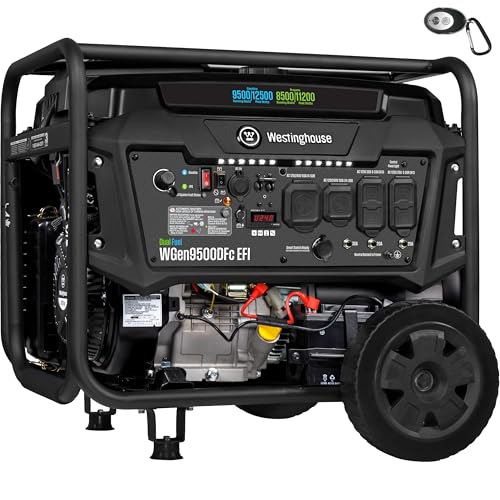
This EFI version adds a fuel-efficient edge with CO sensor, carb compliance, and multiple outlets—two GFCI 20A duplex outlets plus a 50A and a 30A twist-lock for heavy loads. It retains dual-fuel flexibility (gasoline and propane) and a transfer switch-ready setup for seamless home backup integration. Remote start and a robust 457cc engine underpin reliable performance for longer outages while maintaining essential safety features.
DuroMax XP13000EH 13,000-Watt Dual Fuel

The DuroMax XP13000EH provides substantial power with 13,000 watts of gas or propane output and an electric start for quick ignition during outages. Marketed for whole-home backup, it emphasizes durability and a broad power band, suitable for kitchens, HVAC systems, and well pumps during emergencies. It’s transfer switch ready and designed for extended operation, making it a top pick for homeowners seeking robust standby capability in a portable form.
Buying Guide: Key Purchase Considerations
Power needs: Match running watts to essential appliances. For a full home backup, prioritize higher continuous watts and a stable peak. If you only need lights and small devices, a midsize unit or a high-capacity power station can suffice.
Fuel flexibility: Dual- or tri-fuel models expand versatility during fuel shortages. Propane and natural gas options offer longer storage and stability compared to gasoline alone.
Run time and fuel tank: Look for larger tanks and efficient engines to maximize uptime between refueling. Digital hour meters assist with maintenance scheduling.
Starting method: Remote or electric start adds convenience, especially in adverse weather or hard-to-reach deployments. Recoil starts remain a reliable backup option.
Outlets and safety: Sufficient 120V and 120/240V outlets, GFCI protection, and rubber outlet covers increase safety for outdoor use and home backup. CO sensors and automatic low oil shutdown enhance protection.
Portability and weight: For frequent relocation, consider total weight, wheel configuration, and handles. Power stations excel for portability, while larger generators favor stationary setups or professional use.
Noise and emissions: In-residence installations benefit from quieter operation and emissions compliance. Verify CARB or equivalent compliance if you’re in regulated areas.
Expansion options: If you anticipate growing needs, consider models with transfer switch readiness and compatibility with home electrical panels for seamless integration.
Overall, choosing the right portable back up generator involves balancing power needs, fuel flexibility, and practical features like remote start and transfer switch readiness. The selected products offer a spectrum of capabilities—from high-wattage home backup units to compact solar generators—so you can select a solution aligned with your outage scenarios and lifestyle.